Link Building for Online Course Creators
Online course creators sell expertise.
Online course creators sell expertise. Giving some of it away publicly — free lessons, guides, talks — is how they earn links and trust.
Why online course creators link building is different
A course is, by definition, gated. That creates an odd problem for link building: the thing you’re selling can’t itself be the linkable asset, so the links have to come from what you give away around it — free lessons, guest teaching, honest outcome data — rather than from the course page itself. This is uncomfortable for creators used to thinking of the course as the product, but it’s worth reframing: the free material is the marketing asset, and the course is simply what it leads to. Creators who invest real effort in the free lesson, rather than treating it as an afterthought, consistently see it reused, cited and linked far longer than a launch announcement ever is.
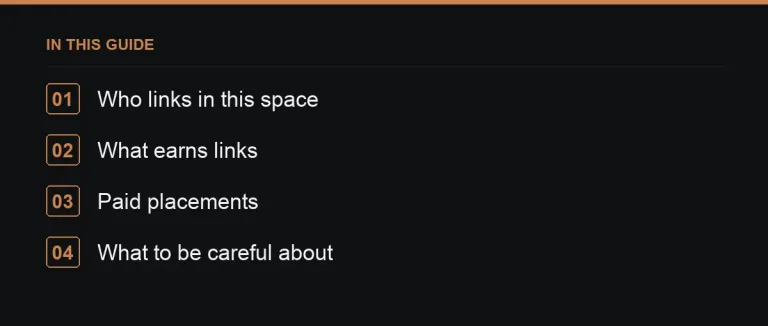
Who links in this space
- Blogs and publications in the course topic
- Podcasts and YouTube channels
- Communities and forums in the subject area
- Education and careers sites
- Tool and platform partners used in the course
What earns links
- Free lessons and guides — substantial free content in the course topic that stands on its own (linkable assets).
- Podcast guesting — teaching on other shows in the subject area (podcasts).
- Partnerships — tools and platforms used in the course, who sometimes link back to course-provider case studies.
- Student outcomes — honest, permission-based case studies of what students achieved (case studies).
- Community answers — genuinely useful contributions to forums and communities in the topic area.
A worked example
A course creator publishes one substantial free lesson from the middle of their paid curriculum — not a watered-down teaser — and pitches it to two or three blogs in the topic area as a standalone resource. One site links to it as further reading in a related article; the creator then uses that same lesson as the basis for a podcast guest appearance, extending the same piece of content into a second link a few weeks later.
Common mistakes
The most common mistake is publishing free content that’s obviously a teaser for the paid course rather than something useful on its own — readers and publishers can tell immediately. A second is exaggerating income or career outcomes, which invites scrutiny from both regulators and sceptical readers. A third is treating the course sales page itself as something worth pitching for links; it never is. Redirecting that same energy toward making the free lesson genuinely excellent tends to produce far better results than any amount of polish applied to a page nobody outside your existing audience will ever willingly link to.
Measuring what’s working
Track links to your free lessons and guest appearances separately from anything pointing at the sales page, since those are the assets actually capable of earning links (content that earns links), and watch branded search volume as a proxy for whether guesting is building real recognition (brand search and SEO). Course creators sometimes discount podcast guesting because a single episode rarely produces an immediate spike in links, but the cumulative effect across a year of regular appearances tends to be exactly the kind of steady authority growth that outlasts any single campaign.
Paid placements that fit the niche
Choose sites in the course topic’s niche plus the education and careers niches for guest content and directory-style listings. Weigh audience relevance over raw domain authority when choosing between two options; a smaller site with an audience actively searching for your specific topic usually outperforms a larger, more generic one. Vet every site for relevance, real traffic from your market and editorial quality (evaluation checklist), and keep anchors natural and varied (anchor text strategy) rather than repeating the same commercial phrase on every placement.
What to be careful about
Avoid exaggerated income or career outcome claims; they’re increasingly scrutinised by regulators and audiences, and a single debunked claim can undo months of credibility-building. A useful internal test before publishing any outcome claim is whether it would still sound reasonable read aloud to a sceptical journalist looking for a story about misleading course marketing; if it wouldn’t, it needs softening or removing before it goes anywhere near a pitch, however good it might look on a landing page.
Where to go next
Pick one lesson from your curriculum substantial enough to stand alone, publish it free, and pitch it to a short list of topic-relevant blogs and podcasts before building a wider content programme. Treat that first free lesson as a long-term asset rather than a one-off launch tactic; refreshed and re-pitched a year later with new examples, it can earn a second wave of links from an entirely different set of publishers. Compare shortlisted publishers side by side before you commit budget (compare tool), and browse https://successtoroad.com/marketplace/ once you know which niches and price bands fit your plan.
Frequently asked questions
How do course creators earn links?
By publishing substantial free content, teaching on relevant podcasts and forming genuine partnerships — not by pitching the sales page.
Should course pages be link targets?
No. Build links to free guides and lessons, then link internally from those pages to the paid course.
Are student outcome case studies risky?
Only if outcomes are exaggerated; honest, permission-based case studies with realistic framing are safe and effective.
What's the best single link-building activity for a new course creator?
Publishing one genuinely useful free lesson and pitching it directly to a handful of relevant blogs or podcasts.
Put it into practice
Filter 54,483 websites by DR, traffic, niche and price, and order with escrow — you pay only after the link is live.
Browse the marketplace