Link Building for Artists, Photographers and Creative Studios
Your images are probably already on other sites. Here's how creatives turn that — and their work — into links.
Artists and photographers have a link advantage most businesses don’t have: their work gets published and shared across the web on its own merit. The challenge is making sure credit comes with it, and building a genuine presence in the publications and communities that matter within their specific field.
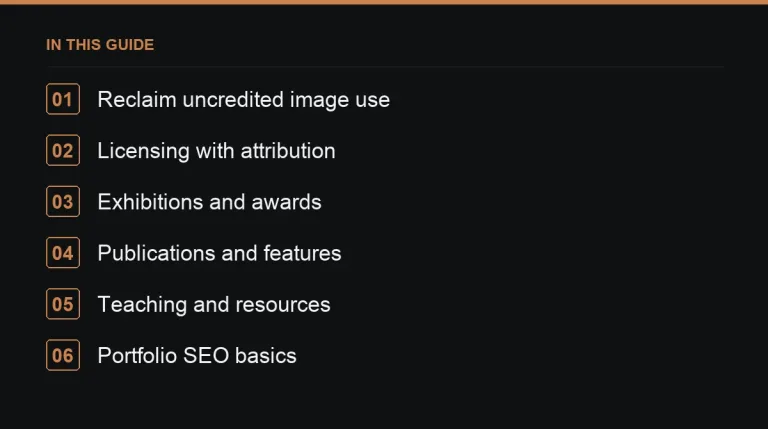
Reclaim uncredited image use
Run a reverse image search on your best-known work periodically. You’ll often find it used without credit somewhere you never gave permission. A polite request to add a credit link works more often than a takedown demand, and it quietly turns existing misuse into a legitimate backlink (link reclamation for unlinked mentions).
Licensing with attribution
Offering some images under a licence that requires attribution, including a link, spreads your work further and earns links from blogs and publications that use it under those terms, at a scale that manual outreach alone could never achieve.
Exhibitions and awards
Galleries, festivals, competitions and awards list participants and winners, usually with links back to their own sites. Local press regularly covers exhibitions taking place in the area, which is worth pitching directly rather than assuming it will be covered automatically.
Publications and features
Art and photography magazines, blogs and interview series regularly feature working artists. Pitch with a strong portfolio link and a specific angle — a particular project, a technique, a personal story — rather than a generic request to be featured.
Teaching and resources
Tutorials, gear guides and technique breakdowns earn links from communities and learners looking for exactly that kind of practical explanation. A photographer explaining precisely how they got a specific shot is a classic, reliable form of link bait in this space.
Portfolio SEO basics
- Descriptive file names and alt text on every image, not just the flagship pieces.
- Individual pages for major projects, so external links have somewhere specific to point.
- Fast-loading, properly optimised images, using modern formats where your platform supports them.
For placements, the art niche includes creative blogs and galleries with real audiences. For commercial photographers, local business sites and directories matter too (local business link building).
Where effort pays off by career stage
| Career stage | Priority |
|---|---|
| Early career | Reverse image search reclamation, competitions, local press |
| Established | Feature pitches, licensing programmes, teaching content |
| Commercial / studio | Local business directories, client-facing case studies |
Pricing and selling prints without undermining editorial coverage
If a publication does ask about pricing, answer plainly rather than deflecting, since a straightforward answer reads as professional while evasiveness reads as a red flag.
A clear, straightforward print shop alongside editorial and portfolio content doesn’t undermine your credibility with publications, provided the two stay clearly separate — a feature pitch should never read as a sales pitch. Keep pricing and purchase information on dedicated pages rather than folded into the portfolio pieces you’re hoping a publication will feature, since editors are wary of anything that feels like advertising dressed as a submission.
Diversifying beyond a single platform
Artists who build their entire following on one social platform are exposed to that platform’s algorithm changes and policy shifts in ways that can wipe out reach overnight. A personal site that hosts a proper portfolio, alongside whichever platforms are currently useful for discovery, ensures that press coverage and collector interest have a stable place to land regardless of what happens to any single platform.
Building a mailing list of engaged collectors and fans
A direct mailing list, separate from social platforms an algorithm controls, is one of the most durable assets a working artist can build. Beyond direct sales, a list gives you a channel to notify press contacts and past feature subjects about new work, which often produces a second or third mention from a publication that covered you once before.
Pitching editorial features effectively
Editorial pitches to art and photography publications work best when they read like a story rather than a portfolio dump — a specific project, a technique worth explaining, or a body of work tied together by a clear theme (what makes content genuinely linkable). A scattergun pitch of unrelated images to a general-interest editor rarely lands, however strong the individual photos are (evaluating whether a publication is worth pitching).
Protecting your work while still earning links
Attribution licensing and open sharing can feel at odds with protecting the commercial value of your work, but the two aren’t mutually exclusive. Watermarking or lower-resolution sharing for casual use, alongside a clear path to licensing full-resolution or commercial use, lets you benefit from wide distribution without giving away everything a paying client would need.
Where to go next
Start with a reverse image search sweep of your most-shared work, since it’s usually the fastest way to find easy, existing link opportunities. Then build outward into features and teaching content, using the art niche marketplace for paid placements where it fits your specific practice.
Frequently asked questions
How do I find sites using my photos without credit?
Use reverse image search tools regularly on your most popular or most-shared images, since misuse tends to spread gradually rather than all at once.
Should I ask for a link or a takedown?
Asking for a credit link is usually more productive, unless the use is clearly harmful or commercial without any licence in place.
Do image credits count as backlinks?
A credit that includes a working link to your site is a backlink like any other, and it's often easier to secure than a conventional guest post.
Is watermarking worth the trade-off in shareability?
A light watermark or lower-resolution version for casual sharing, paired with an easy path to licensing full quality, tends to protect commercial value without stopping legitimate sharing.
Put it into practice
Filter 54,483 websites by DR, traffic, niche and price, and order with escrow — you pay only after the link is live.
Browse the marketplace