Headlines vs Titles vs H1: What Each One Actually Does
An SEO title, an H1, and a promotional headline solve three different problems and are not interchangeable.
Writers submitting guest posts often treat the title as a single field, when a published article actually carries at least three distinct pieces of text doing different jobs: the SEO title shown in search results, the on-page H1 the reader sees at the top of the article, and any separate headline used for social sharing or a homepage teaser. Confusing these leads to titles that are individually weaker at each job.
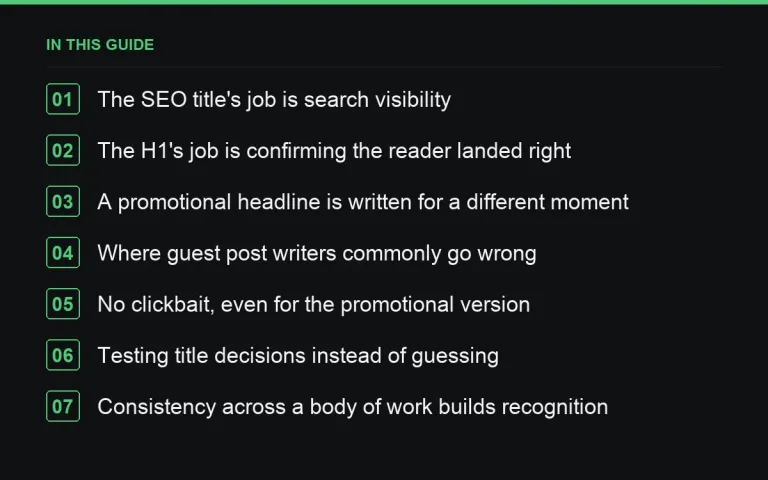
The SEO title’s job is search visibility
The title tag shown in search results needs to include the primary keyword close to the front, stay within roughly 60 characters so it doesn’t get cut off, and give a searcher enough reason to click among several similar results. It’s written for someone who hasn’t read anything yet and is comparing your result against several others on the page.
Keyword placement without keyword stuffing
Include the actual phrase people are likely to search, phrased naturally — a title like “How to Write a Guest Post Brief” reads naturally and contains the likely search phrase, whereas cramming in multiple keyword variants produces an unnatural, spammy-looking title that can actually reduce clicks.
The H1’s job is confirming the reader landed right
The on-page H1 is what a reader sees immediately after clicking, and its job is to confirm they arrived at the right place — it can be slightly more descriptive or nuanced than the SEO title since character limits matter less here, though it should still be direct rather than clever. A mismatch between what the search result promised and what the H1 delivers is a fast way to lose a reader who feels misled.
H1 and SEO title can differ, but shouldn’t contradict
Many sites use a slightly different H1 than the meta title — perhaps a fuller version without the character constraint — but the core promise should match. If the search result promises a specific number of steps and the H1 talks about something else entirely, readers bounce immediately, which then hurts the very search performance the title was optimised for.
A promotional headline is written for a different moment
If the piece will be shared on social media or featured on a homepage, that headline is competing for attention in a feed rather than against other search results — it can afford to be more curiosity-driven or punchier, as long as it doesn’t cross into misleading clickbait the article itself doesn’t deliver on.
Where guest post writers commonly go wrong
- Writing one title and reusing it identically everywhere, missing the chance to optimise each version for its actual context.
- Writing an H1 so clever it doesn’t clearly state what the article covers.
- Exceeding the SEO title’s practical length limit, causing search engines to truncate or rewrite it.
- Using clickbait framing that the article’s actual content doesn’t support, which damages trust in the byline over time.
No clickbait, even for the promotional version
House style for most reputable publications, including guest posting guidelines generally, disallows misleading or clickbait framing regardless of which of the three title types you’re writing — see https://successtoroad.com/blog/writing-seo-headlines/ for more detail on this specific to search-facing titles.
Testing title decisions instead of guessing
If you or the host publication can see how a title performs after publication — click-through data from search console tools, for instance — treat the first version as a hypothesis rather than a permanent choice. A title that underperforms similar articles on the same site is worth revisiting, provided any change stays accurate to the article’s actual content rather than drifting toward exaggeration to chase clicks.
Symbols and formatting in titles
Pipes, brackets, and numerals can help a title stand out in a crowded results page, but overusing them starts to look like every other overly-optimised title competing for the same query. Use them sparingly and only where they add real clarity, such as a bracketed year for genuinely time-sensitive content, rather than as a default habit applied to every title regardless of whether it helps.
Consistency across a body of work builds recognition
If you write regularly for the same publication or under the same byline, a consistent approach to titling across pieces — not identical, but recognisably yours in structure and clarity — helps returning readers recognise and trust your work faster than if every title follows a completely different pattern. This is a smaller-scale version of the brand consistency a publication itself maintains across its own headlines.
Where to go next
Pair this with https://successtoroad.com/blog/meta-descriptions-for-guest-posts/ since the two fields are written together and read together in a search result, and https://successtoroad.com/blog/writing-introductions-that-earn-the-read/ since the H1’s promise needs to be immediately fulfilled by the opening paragraph. For placing content where title strategy matters across many pages, https://successtoroad.com/services/writing/ and https://successtoroad.com/marketplace/ both support finding the right writers and publishers for search-driven guest content.
Frequently asked questions
Can the H1 and the SEO title be exactly the same?
Yes, and on many sites they are — this is fine as long as the SEO title fits within the practical character limit. Some sites prefer a slightly longer, more descriptive H1 than the constrained meta title.
How long should an SEO title be?
Roughly 55-60 characters is a safe practical limit before search engines are likely to truncate it, though the exact cutoff varies by the characters used.
Is a question format a good headline choice?
It can work if the article genuinely answers that exact question directly and early, but a question headline that doesn't get answered promptly frustrates readers who clicked for the answer.
Should guest post writers submit a suggested SEO title separately from the H1?
If the brief asks for it, yes — many editors appreciate a suggested meta title alongside the on-page headline, since they don't always have time to write both themselves.
Put it into practice
Filter 54,483 websites by DR, traffic, niche and price, and order with escrow — you pay only after the link is live.
Browse the marketplace