Link Building for Food and Drink Stores
Food and drink link building leans on recipe and pairing content more than almost any other vertical, alongside strong seasonal gifting demand.
Food and drink e-commerce has one advantage most verticals don’t: recipe and pairing content is one of the most consistently linked and shared content formats online, and it maps naturally onto a food or drink product range. The vertical also carries constraints — shipping, freshness, regional availability — that shape which link tactics are realistic.
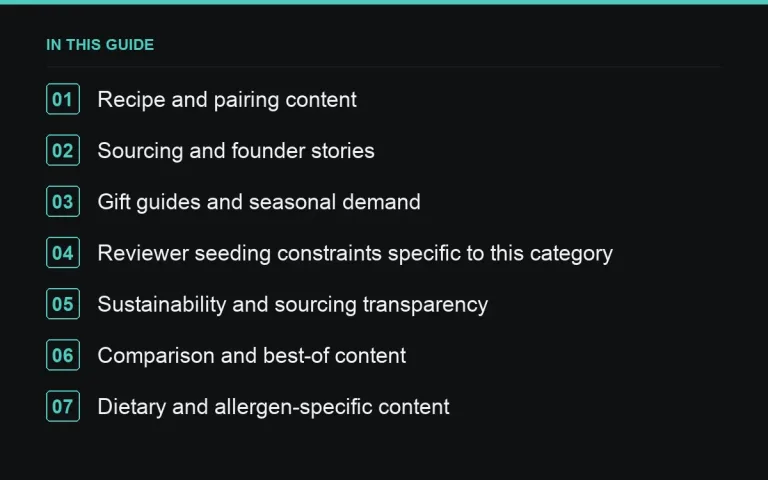
Recipe and pairing content
- Recipes that genuinely use your products (not just mention them) get referenced by food bloggers and aggregators looking to link out to an original source
- Pairing guides (what wine with what dish, what spice blend for a specific cuisine) work as evergreen buying-guide content
- Seasonal recipe content timed to holidays performs especially well when pitched with the same lead time as gift guides — see https://successtoroad.com/blog/gift-guides-seasonal-pr/
Sourcing and founder stories
Food and drink is a category where sourcing genuinely matters to buyers — where ingredients come from, how they’re produced, who makes them. A specific, honest sourcing or founder story is a stronger PR angle here than in categories where origin matters less to the end customer. See https://successtoroad.com/blog/founder-story-pr-ecommerce/ for building this without resorting to vague claims.
Gift guides and seasonal demand
| Occasion | Typical angle |
|---|---|
| Winter holidays | Gift hampers, specialty items, hosting-focused bundles |
| Valentine’s Day | Small-batch or indulgent items, gifting for two |
| Summer | Outdoor entertaining, grilling, drinks for warm weather |
Food and drink gift guide coverage is dense and competitive; submitting with clear shipping information (does it ship nationally, does it need refrigeration, what’s the shelf life) helps editors assess fit quickly.
Reviewer seeding constraints specific to this category
Perishable or alcohol products add logistics that other categories don’t face — shipping windows, age verification, regional shipping restrictions. Build these into the seeding process from the start rather than discovering them mid-campaign; the disclosure principles from https://successtoroad.com/blog/product-seeding-reviews-disclosure/ still apply fully, logistics aside.
Sustainability and sourcing transparency
Food and drink press is increasingly interested in sourcing transparency and sustainability claims specifically, more so than many other categories — but also quick to scrutinise vague claims like “sustainably sourced” with no specifics behind them. See https://successtoroad.com/blog/sustainability-pr-ecommerce/ for pitching this credibly.
Comparison and best-of content
“Best coffee subscription”, “best hot sauces ranked” — this format is common in food and drink and tends to be updated regularly as new products launch, which creates ongoing opportunities to be added rather than a one-time pitch. See https://successtoroad.com/blog/comparison-best-of-placements/.
Dietary and allergen-specific content
| Angle | Why it earns links |
|---|---|
| Allergen-free recipe guides | Underserved, high-intent audience actively searching for reliable options |
| Dietary lifestyle content (specific diets, restrictions) | Communities around these diets actively share and link to trustworthy sources |
| Ingredient sourcing for specific dietary needs | Concrete, checkable claims perform better than general “healthy” positioning |
These angles work particularly well because the audience is actively searching for reliable, specific information and is more likely to bookmark and share a genuinely useful resource than a general recipe blog would attract.
Regional and local food press
Food and drink has a strong local and regional press dimension that many other categories lack — local food writers, regional lifestyle publications, and area-specific “best of” lists covering local producers. If the store has any regional or local sourcing angle, this is worth pursuing alongside national press, since local publications are often more accessible and more willing to feature a smaller producer than national outlets are.
Working with food writers and recipe developers
| Relationship | What it produces |
|---|---|
| Recipe developer collaboration | Original recipe content with genuine creative input, more likely to be shared and linked to independently |
| Food photographer partnership | Higher-quality visual assets that make any resulting coverage more shareable |
| Local chef or restaurant tie-in | Cross-promotion opportunity with its own local press angle |
Subscription and repeat-purchase angle
Many food and drink stores run subscription models, which gives press a specific, ongoing story angle beyond a single product — how a subscription curates variety, how it handles seasonal changes, what makes the format different from a one-off purchase. This is worth pitching as its own angle distinct from individual product coverage, particularly to lifestyle press covering subscription services as a category.
Handling perishability in comparison and gift content
Comparison and gift guide pitches for perishable food and drink items need to be explicit about shelf life and shipping method upfront, since editors compiling multi-item guides need to know this to set reader expectations correctly. A well-prepared pitch answers this proactively rather than waiting for the editor to ask, which speeds up the inclusion decision and reduces the risk of a mismatch between what’s promised and what arrives.
Working with food-focused social platforms
Recipe and food content circulates heavily on visually driven social platforms, and while social shares aren’t direct backlinks, they often lead directly to the kind of organic discovery that produces genuine unlinked mentions on blogs and aggregators later. Treating recipe content creation and its social distribution as connected steps in the same process, rather than entirely separate workstreams, tends to produce more of the secondary coverage worth recovering through https://successtoroad.com/blog/unlinked-brand-mentions-ecommerce/.
Where to go next
For the underlying strategy, see https://successtoroad.com/blog/ecommerce-link-building-guide/, and for handling seasonal or limited-batch products once they sell out, see https://successtoroad.com/blog/out-of-stock-page-link-targets/. Browse relevant publisher inventory at https://successtoroad.com/niche/food/ and https://successtoroad.com/marketplace/.
Frequently asked questions
Does recipe content actually generate backlinks for a food store?
Yes, when the recipes are genuinely usable and reference the product naturally rather than being a thin excuse to mention it — food bloggers and aggregators regularly link out to original recipe sources.
What logistics should I flag when seeding food or drink products for review?
Shipping windows, refrigeration or shelf-life requirements, and any age-verification or regional restrictions, ideally communicated before the reviewer agrees to the seeding, not after shipping.
Is sustainability messaging effective for food and drink brands?
It can be, but food and drink press tends to scrutinise vague sustainability claims closely — specifics about sourcing or production carry more weight than general statements.
How should limited-batch or seasonal food items be handled once sold out?
Keep the page live noting when the item typically returns, and link to a similar in-stock product, rather than letting a page that earned links during its season disappear.
Put it into practice
Filter 54,483 websites by DR, traffic, niche and price, and order with escrow — you pay only after the link is live.
Browse the marketplace