Planning Link Building Around Peak E-commerce Season
Peak season link building succeeds or fails based on work done months earlier, not during the peak itself.
The single most common mistake in seasonal link building is starting the outreach during the season it’s meant to support. By the time winter holiday shopping is underway, most gift guides and seasonal roundups are already published and won’t be revised. Peak season link building is really an exercise in planning backward from a fixed date.
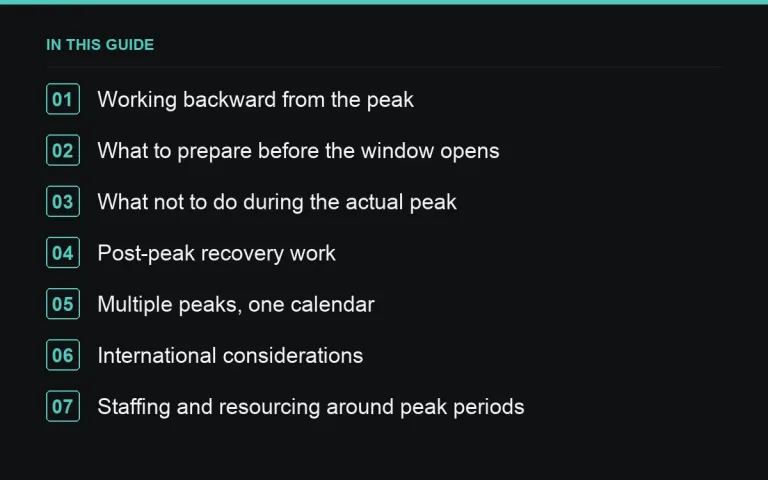
Working backward from the peak
- Identify every peak period relevant to your category across the year — not just the obvious winter holidays
- For each, find out roughly when publishers compile the relevant content (gift guides, seasonal roundups) — typically six to ten weeks ahead of the peak itself
- Schedule outreach, content publication and product seeding to land before that compilation window closes
This is the same timing logic covered in https://successtoroad.com/blog/gift-guides-seasonal-pr/, applied across the full calendar rather than a single holiday.
What to prepare before the window opens
| Asset | Should be ready by |
|---|---|
| Updated buying guides referencing current stock | Start of the outreach window |
| Seasonal product selections with pricing and images | Start of the outreach window |
| Reviewer/seeding shortlist and samples | 4-6 weeks before peak, allowing review lead time |
| Redirect or messaging plan for likely stockouts | Before the peak begins, not after items sell out |
What not to do during the actual peak
Once the peak season itself has arrived, most editorial calendars are locked and outreach response rates drop sharply — publishers are managing their own peak traffic and content, not taking new pitches. Shift effort during the peak itself toward operational readiness: making sure category and product pages that are about to get gift-guide traffic don’t show stockouts, broken links or slow load times.
Post-peak recovery work
Immediately after a peak season ends, review what sold out, what pages need redirecting or updating, and which press mentions from the season haven’t yet linked back — the same recovery process covered in https://successtoroad.com/blog/unlinked-brand-mentions-ecommerce/ and https://successtoroad.com/blog/out-of-stock-page-link-targets/. This window is also a good time to start building next year’s seasonal content updates while the current cycle is still fresh.
Multiple peaks, one calendar
Most e-commerce categories have more than one peak per year — a general retailer might plan around winter holidays, a spring or summer event, and a category-specific moment like back-to-school. Treat this as one continuous calendar rather than separate one-off projects, since assets and relationships built for one peak often carry over to the next with light updates.
International considerations
Stores selling into multiple markets need a separate peak calendar per market, since major shopping seasons and cultural moments don’t align across countries — see https://successtoroad.com/blog/international-ecommerce-language-targeting/ for building that out properly.
Staffing and resourcing around peak periods
| Task | When it needs staffing |
|---|---|
| Outreach and pitching | Weeks before the peak, well ahead of the busy operational period |
| Content and asset preparation | Before outreach begins, not in parallel with it |
| Site monitoring and stock updates | Throughout the peak itself, often needing daily attention |
| Post-peak recovery and reporting | Immediately after, while details are still fresh |
Trying to run outreach and operational monitoring with the same limited team at the same time during peak season usually means one of the two gets neglected — planning staffing around this split reduces that risk.
Learning from the previous cycle
Immediately after each peak, note what worked (which publishers responded, which content performed) and what didn’t (pitches that went unanswered, assets that weren’t ready in time), and feed that directly into next year’s plan while it’s still fresh. Treating each peak season as a one-off event rather than part of a repeating cycle means relearning the same lessons every year instead of building on what was learned previously.
Coordinating link building with other peak-season teams
| Team | Coordination point |
|---|---|
| Inventory and operations | Confirm stock levels for products being pitched before committing to outreach |
| Customer service | Flag expected traffic spikes so support capacity is ready for the increase |
| Paid marketing | Align messaging so PR coverage and paid campaigns tell a consistent story |
Link building and PR rarely operate in isolation during peak season — the plan works best when it’s built alongside the teams managing the operational side of the same period, not as a separate workstream that only intersects with them by accident.
Building a reusable peak-season playbook
Rather than starting the planning process from scratch each year, document the recurring elements as a reusable playbook: the publisher list that’s proven responsive, the lead times that worked, the assets that need preparing and by when. A new team member should be able to pick up the playbook and run the next cycle with only moderate guidance, rather than the process living entirely in one person’s head and needing to be rebuilt whenever that person moves on.
Where to go next
For the underlying seasonal PR mechanics, see https://successtoroad.com/blog/gift-guides-seasonal-pr/, and for the overall link building framework this planning sits inside, see https://successtoroad.com/blog/ecommerce-link-building-guide/. Browse relevant publisher inventory at https://successtoroad.com/marketplace/ and https://successtoroad.com/niche/shopping/.
Frequently asked questions
How far in advance should peak season link building start?
Typically six to ten weeks before the peak itself, since that's when most publishers are compiling seasonal roundups and gift guides — pitching during the peak is usually too late.
Should outreach continue during the peak season itself?
It's usually less effective, since editorial calendars are largely locked and publishers are focused on managing their own peak traffic. Shift effort toward operational readiness instead.
What should happen immediately after a peak season ends?
Review stockouts and redirects, follow up on unlinked press mentions from the season, and start preparing updated assets for the next relevant peak while the work is still fresh.
Do international stores need separate peak season calendars?
Yes — major shopping seasons and cultural moments vary by market, so a single global calendar based on one country's patterns will miss opportunities elsewhere.
Put it into practice
Filter 54,483 websites by DR, traffic, niche and price, and order with escrow — you pay only after the link is live.
Browse the marketplace