Measuring the Revenue Impact of E-commerce Link Building
Link counts and authority metrics are useful diagnostics, but revenue impact is the metric that actually justifies the program's budget.
Link building programs are frequently reported on in terms that don’t connect to revenue at all — links earned, average domain authority, referring domain growth. These are useful diagnostics, but they don’t answer the question a finance-minded stakeholder actually asks: did this make more money than it cost?
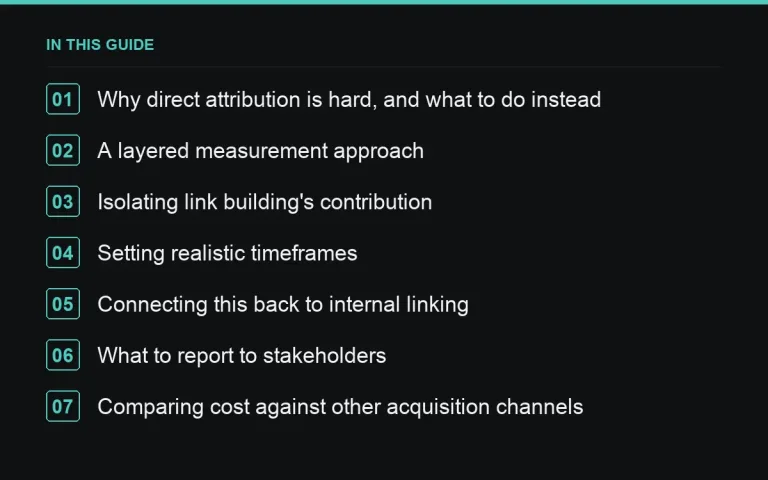
Why direct attribution is hard, and what to do instead
Link building rarely produces revenue in a way that’s directly attributable the way a paid ad click is — the mechanism runs through improved organic rankings, which then drive traffic, which then converts at the store’s normal rate. That indirection means the honest measurement approach is a before-and-after comparison at the category or page level, not a single attributable revenue number per link.
A layered measurement approach
- Link-level: referring domains, anchor text diversity, placement quality — leading indicators, not outcomes
- Ranking-level: organic position for target keywords tied to the pages receiving link equity
- Traffic-level: organic sessions to those specific category and product pages over time
- Revenue-level: organic revenue attributed to those pages, using your existing analytics attribution model
Reporting only the first layer while claiming credit at the fourth is the most common way link building programs lose stakeholder trust — the connection needs to be shown, not asserted.
Isolating link building’s contribution
| Approach | Trade-off |
|---|---|
| Before/after comparison on target pages | Simple, but doesn’t control for seasonality or other changes |
| Compare targeted vs untargeted similar pages | Better isolation, needs a reasonable comparison set |
| Correlate link velocity with ranking movement over time | Useful directionally, rarely proves causation alone |
None of these are perfect; combining more than one gives a more honest picture than relying on a single method.
Setting realistic timeframes
Link building’s effect on rankings and revenue typically shows up over months, not days or weeks. Reporting on a monthly cadence with quarterly reviews for real trend assessment tends to match the actual pace of change better than reporting weekly numbers that mostly reflect noise.
Connecting this back to internal linking
Revenue impact depends heavily on whether earned links actually reach commercial pages in the first place — see https://successtoroad.com/blog/internal-linking-earned-links-money-pages/. A program that earns links but doesn’t route them internally will show weak revenue correlation no matter how the measurement is structured, because the mechanism itself is broken upstream of the measurement.
What to report to stakeholders
Present the layered view rather than a single number — leading indicators (links, rankings) alongside the lagging outcome (revenue), with an honest note about the limits of attribution. This builds more durable trust in the program than a single inflated revenue claim that can’t be defended under scrutiny.
Comparing cost against other acquisition channels
| Channel | Typical cost pattern |
|---|---|
| Paid search/social | Ongoing cost per click or impression, stops the moment spend stops |
| Link building and PR | Upfront investment, compounding return that persists after spend stops |
| Affiliate | Cost tied directly to completed sales, no cost without conversion |
This comparison is useful context for stakeholders weighing where to allocate budget, even though it’s not a like-for-like comparison — link building’s slower, compounding return profile is a genuinely different kind of investment than a channel with immediate, direct attribution.
When to reconsider or cut a program
If, after a reasonable measurement period — generally six months to a year, given how slowly this channel moves — the layered metrics show no meaningful ranking or traffic movement on targeted pages despite consistent link building activity, it’s worth investigating why before continuing to spend at the same level. Common causes include weak internal linking (see https://successtoroad.com/blog/internal-linking-earned-links-money-pages/), placements on low-relevance publishers, or a category that’s simply too competitive for the current level of investment to move.
Reporting cadence that matches the pace of change
| Frequency | What it’s suited to |
|---|---|
| Weekly | Operational monitoring only — mostly noise for judging link building impact |
| Monthly | Tracking leading indicators (new links, placement activity) |
| Quarterly | Assessing genuine ranking and traffic trends |
| Annually | Full revenue attribution review against the program’s original goals |
Matching the reporting cadence to what each metric can actually tell you at that frequency avoids both under-reacting to a genuine problem and over-reacting to normal short-term noise.
Presenting uncertainty honestly to leadership
It’s tempting, under pressure to justify a budget, to present link building’s impact with more certainty than the data actually supports. A more durable approach is to be explicit about what’s known with confidence (rankings moved, traffic increased on targeted pages) versus what’s estimated (the revenue share attributable to that traffic versus other contributing factors). Leadership generally responds better to an honest, nuanced account over time than to a single confident number that later proves difficult to defend.
Where to go next
For the underlying framework and channels this measurement applies to, see https://successtoroad.com/blog/ecommerce-link-building-guide/, and for auditing what’s currently in place before setting a new baseline, see https://successtoroad.com/blog/ecommerce-link-audit/. Browse relevant publisher inventory at https://successtoroad.com/marketplace/.
Frequently asked questions
Can link building revenue impact be measured directly?
Not with full precision, since it works through improved rankings and traffic rather than a directly attributable click. A layered before-and-after approach at the page level is the more honest method.
How long does it take to see revenue impact from link building?
Typically months rather than weeks, since it depends on ranking movement first, then traffic, then conversion at the store's normal rate.
What metrics should be reported alongside revenue?
Referring domains, ranking movement and organic traffic to the specific pages targeted, so stakeholders can see the full chain rather than an isolated revenue claim.
Why might a link building program show weak revenue results?
Often because earned links aren't being routed internally to commercial pages — the program can be earning real links while the internal linking gap prevents that authority from reaching pages that sell anything.
Put it into practice
Filter 54,483 websites by DR, traffic, niche and price, and order with escrow — you pay only after the link is live.
Browse the marketplace