Getting Into Comparison and ‘Best Of’ Placements
Comparison and best-of content converts well and links directly to products, making it one of the highest-value placement types to chase.

“Best running shoes under $100”, “X vs Y compared” — this content format is everywhere because it converts well for the publisher and answers exactly what a near-purchase reader is searching. For a store, getting included is one of the highest-value placements available, since these pages link directly to specific products or categories and carry real commercial intent traffic alongside the link.
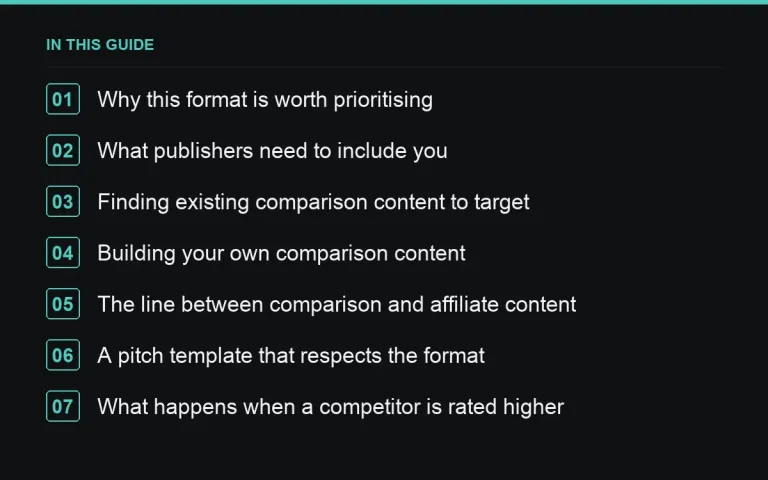
Why this format is worth prioritising
Unlike a general guest post, comparison and best-of content is inherently product-specific, so the resulting link goes exactly where you want it — a product or category page — with an anchor that’s naturally descriptive rather than commercial-sounding. Readers arriving from this kind of content also tend to be further along in the buying decision than readers of general blog content.
What publishers need to include you
- Accurate, current pricing — nothing kills inclusion faster than a price that’s wrong by the time the piece publishes
- A specific reason your product fits a sub-category within the comparison (best for beginners, best budget option, best for small spaces)
- Clean product images and specs they can reference without a lot of back-and-forth
- Honesty about where your product isn’t the best fit — publishers trust pitches more when they’re not universally self-serving
Finding existing comparison content to target
Search for “[category] comparison”, “best [category] for [use case]” and “[competitor] vs” queries to find pages already ranking. Existing pages are often updated periodically, which means there’s a real chance of being added to an already-ranking page rather than needing new content to be created from scratch — a much faster win.
Building your own comparison content
| Approach | Trade-off |
|---|---|
| Pitch inclusion in an existing third-party comparison | Faster, but you don’t control the outcome |
| Publish your own honest comparison page | Full control, but needs to be genuinely fair to earn trust and links itself |
The two aren’t mutually exclusive — a strong in-house comparison page, similar to a buying guide, can itself become a linkable asset. See https://successtoroad.com/blog/buying-guides-link-magnets/ for the format overlap.
The line between comparison and affiliate content
Many comparison and best-of publishers run affiliate links alongside editorial judgment, which is a normal and disclosed business model, not a red flag. Understanding this distinction helps set expectations for what kind of link you’ll actually get — see https://successtoroad.com/blog/affiliate-vs-editorial-links/ for how to treat these separately in reporting.
A pitch template that respects the format
Lead with the specific sub-category you’d fit (“best for small kitchens”, not “best overall”), include the facts the writer needs in the first few lines, and offer to answer follow-up questions quickly — comparison content often gets updated on tight timelines and a fast response can be the difference between inclusion and being skipped.
What happens when a competitor is rated higher
Genuine comparison content will sometimes rank a competitor above you for a specific use case, and that’s a sign the publisher is being honest rather than a reason to stop engaging with them. Pushing back on a fair, well-reasoned comparison usually damages the relationship more than it helps; a better use of the same energy is understanding why the competitor won that sub-category and whether it points to a real product gap worth addressing.
Building an ongoing relationship with comparison publishers
| Activity | Value |
|---|---|
| Notifying them of price or spec changes proactively | Keeps the page accurate and shows you’re a reliable source |
| Flagging when a new model or product line launches | Increases the chance of inclusion in the next update cycle |
| Providing quick, accurate answers to follow-up questions | Builds trust for future inclusion, even beyond the current piece |
Tracking which comparisons actually drive results
Not every comparison inclusion performs equally — some pages get meaningful ongoing search traffic and referral clicks, others were a one-time spike that faded quickly. Track referral traffic and conversion from each placement over a few months, and weight future outreach effort toward the publishers whose comparison content has proven durable rather than assuming every inclusion is equally valuable.
In-house comparison pages need the same honesty standard
If you build your own comparison page rather than relying solely on third-party inclusion, it needs to hold to the same standard a reader would expect from an independent source — acknowledging where a competitor genuinely wins on a specific criterion, rather than constructing every comparison to favour your own product regardless of the facts. A comparison page that reads as obviously biased earns fewer external links and less reader trust than one that’s demonstrably fair, even when it’s hosted on your own domain.
Refreshing comparison content as the market changes
Prices change, new competitors enter, products get discontinued — a comparison page that isn’t reviewed periodically will eventually contain outdated information that undermines its usefulness and its credibility as a link target. Set a review cadence tied to how fast the category moves, checking prices and availability at minimum, and updating the ranking or recommendation if the underlying facts have genuinely shifted.
Where to go next
Comparison placements work particularly well for competitive categories like https://successtoroad.com/blog/electronics-ecommerce-link-building/ and https://successtoroad.com/blog/fashion-ecommerce-link-building/, where “vs” searches are common. For the destination pages these links should point to, see https://successtoroad.com/blog/ecommerce-product-page-links/. Browse relevant publishers at https://successtoroad.com/niche/e-commerce/ and https://successtoroad.com/marketplace/.
Frequently asked questions
How do I find comparison articles to pitch for inclusion?
Search for the format directly — 'best [category] for [use case]' and '[category] comparison' — and note which pages already rank, since many are updated periodically rather than rewritten from scratch.
Is it better to be added to an existing page or get a new one written?
Being added to an already-ranking page is usually faster and lower-risk, since it doesn't depend on new content earning its own rankings first.
Do comparison placements usually include affiliate links?
Often, yes — many comparison publishers monetise through affiliate commission alongside editorial judgment, which is standard practice rather than a sign the content isn't genuine.
What information do publishers need to add a product quickly?
Current price, a one-line reason it fits a specific sub-category, and a usable image — publishers are more likely to add something that needs no further back-and-forth.
Put it into practice
Filter 54,483 websites by DR, traffic, niche and price, and order with escrow — you pay only after the link is live.
Browse the marketplace