Choosing the Right Word Count for a Guest Post
The right word count is the one that fully covers the topic and stops, not a fixed number applied to every brief.
Word count targets are useful as a floor to prevent thin content, but treating them as a fixed goal regardless of topic produces two common failures: genuinely simple topics padded past the point of usefulness, and genuinely complex topics cut short before the argument is actually made. The better question isn’t how many words but what the topic needs to be fully covered without filler.
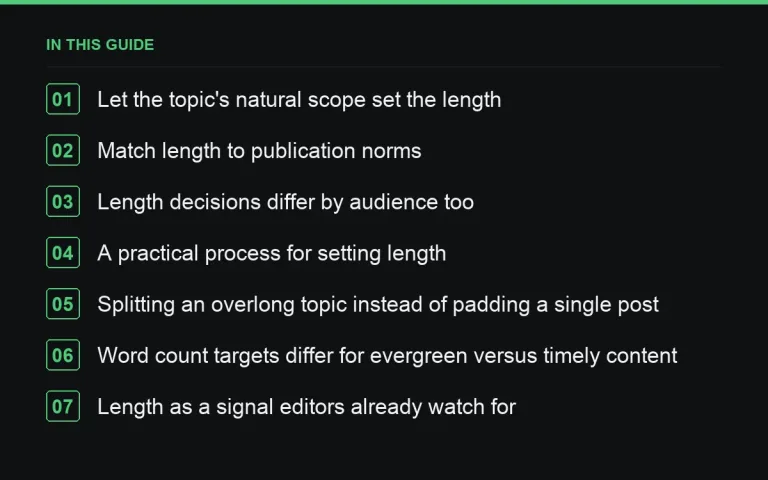
Let the topic’s natural scope set the length
A narrow, specific how-to question might be fully and usefully answered in 700 words; a topic with several genuine sub-questions, exceptions, or comparisons might need 1,500 to do it justice. Before drafting, sketch the actual headings the piece needs — the natural scope of the outline is a better length predictor than any target number decided in advance.
Watch for padding disguised as thoroughness
The most common way writers hit an inflated word count is by adding a paragraph restating the introduction’s point, a tangential section that doesn’t serve the reader’s actual question, or several redundant examples where one would do. If you’re adding content specifically to reach a number rather than because the topic needs it, that’s the moment to stop.
Match length to publication norms
Different host publications have different length expectations — a fast-news style site might want a tight 600-800 words, while a long-form industry blog might expect 1,500-2,000 for a comprehensive guide. Check https://successtoroad.com/blog/matching-tone-to-a-host-publication/’s process of reading recent articles, applied here to length rather than tone, before you commit to a target.
Marketplace and SEO minimums are a floor, not a target
A brief specifying a minimum word count is protecting against thin content, not asking you to hit exactly that number and stop regardless of whether the topic is fully covered. Treat stated minimums as the least acceptable length, and let genuine coverage decide anything above that floor.
Length decisions differ by audience too
An expert audience per https://successtoroad.com/blog/writing-for-expert-audiences/ may tolerate and even expect greater length if every paragraph adds real depth, while a consumer audience per https://successtoroad.com/blog/writing-for-consumer-audiences/ usually rewards a tighter piece that answers their specific question without excess ground-covering.
A practical process for setting length
- Outline the headings the topic genuinely requires before worrying about word count.
- Check the host publication’s typical length for similar topics.
- Draft to the outline’s natural length, then edit down rather than padding up.
- Compare the result against any stated minimum, and add genuine coverage, not filler, if it falls short.
Splitting an overlong topic instead of padding a single post
If your outline is naturally running well past a reasonable single-article length, consider whether the topic is actually two articles — a general overview and a deeper companion piece — rather than one bloated post trying to do both jobs. This is often a better reader experience and gives you a second linking opportunity between the two pieces.
Word count targets differ for evergreen versus timely content
A piece meant to rank and serve readers for years benefits from more thorough coverage than a fast-turnaround piece tied to a current, time-sensitive topic, where speed and relevance outweigh exhaustive depth. Recognising which category a given assignment falls into, before you start drafting, helps you allocate your own effort and word count more sensibly than applying the same standard to every piece regardless of its intended lifespan.
Length as a signal editors already watch for
Experienced editors reviewing submissions notice length mismatches quickly — a submission far longer than anything else the site publishes, or one so short it barely covers the topic, both read as a writer who didn’t research the outlet before drafting. Checking length norms alongside tone, as covered in https://successtoroad.com/blog/matching-tone-to-a-host-publication/, is one of the fastest ways to avoid an easily preventable rejection reason that has nothing to do with the quality of your actual writing.
Don’t let a brief’s minimum become an excuse to stop early
Writers sometimes treat a stated minimum as the actual goal and stop as soon as they cross it, even if the topic’s natural scope clearly calls for more. Use the minimum as a floor to check against once you’ve written to the topic’s real length, not as the target you’re writing toward from the start.
Length preferences can also be tested over time
If you place enough content with the same publication or on the same owned site, it’s worth noticing which lengths tend to perform better for a given topic type, rather than treating your first assumption as final. This is a slower, more empirical version of the same instinct behind checking https://successtoroad.com/blog/matching-tone-to-a-host-publication/ before drafting — both are about calibrating to real evidence rather than a fixed rule applied blindly across every piece.
Where to go next
Pair this with https://successtoroad.com/blog/readability-and-sentence-length/ since length decisions at the sentence level and the article level both come from the same instinct — serve the reader’s actual need, not an abstract target. For briefs that specify length requirements clearly, see https://successtoroad.com/blog/writing-a-guest-post-brief/, and browse https://successtoroad.com/services/writing/ or https://successtoroad.com/marketplace/ for writers and publishers comfortable adjusting length to genuine topic scope rather than padding to a number.
Frequently asked questions
Is there an ideal universal word count for guest posts?
No single number fits every topic and publication — 800 to 1,200 words is a common comfortable range for a well-covered single topic, but genuine scope should decide the actual length.
What's the risk of writing too short for a topic?
Readers and editors both sense incomplete coverage — unanswered sub-questions or missing context that make the piece feel like a draft rather than a finished article.
How can I tell if I'm padding a draft to hit a word count?
If you can delete a paragraph without losing any information the reader needs, it was padding. Read your draft looking specifically for sentences that restate an earlier point in new words.
Should I ask the host publication about preferred length before writing?
It's a reasonable question if their guidelines don't already state one, and it's better to ask than to guess and have to substantially cut or expand a finished draft.
Put it into practice
Filter 54,483 websites by DR, traffic, niche and price, and order with escrow — you pay only after the link is live.
Browse the marketplace