Briefing a Freelance Writer for Guest Post Content
A vague brief produces a vague draft; here is what a working freelance brief actually needs to contain.
Most disappointing freelance drafts trace back to a thin brief, not a weak writer — a writer given only a topic and a word count has to guess at audience, tone, angle, and depth, and guessing rarely matches what the person commissioning the piece actually had in mind. A properly built brief takes real time to write but saves far more time in revision rounds.
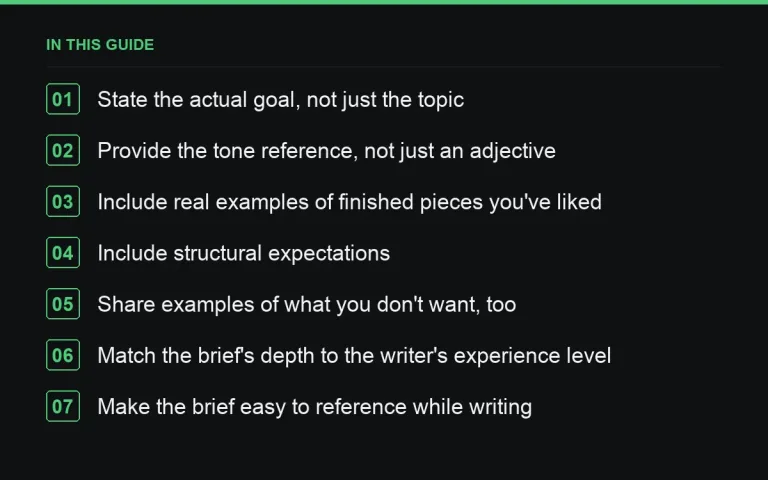
State the actual goal, not just the topic
“Write about link building outreach” is a topic. “Write a practical guide that gets a small business owner with no prior SEO experience comfortable sending their first ten outreach emails” is a goal, and it gives the writer enough to make good decisions about depth, examples, and tone without asking you first. Include the goal explicitly, every time, even if it feels obvious to you.
Name the audience specifically
Rather than a vague “general audience,” specify who’s actually going to read this — their existing knowledge level, their likely motivation for reading, and what decision or action they’re trying to make. This single piece of information does more to shape a usable first draft than almost anything else in the brief, connecting directly to the distinctions in https://successtoroad.com/blog/writing-for-expert-audiences/ and https://successtoroad.com/blog/writing-for-consumer-audiences/.
Provide the tone reference, not just an adjective
“Write it in a professional but friendly tone” means something different to every writer who reads it. Instead, link to two or three example articles — from the target publication if there is one, or from a comparable source — and say what specifically about them fits, using the same process described in https://successtoroad.com/blog/matching-tone-to-a-host-publication/.
Set boundaries on claims and sourcing upfront
Tell the writer explicitly whether statistics need to be sourced and linked, whether external links are allowed at all, and what to do if a claim can’t be verified. This heads off the fabrication risk described in https://successtoroad.com/blog/fact-checking-without-fabricating/ before it becomes a problem in a submitted draft, rather than catching it during review.
Include real examples of finished pieces you’ve liked
Beyond tone references from the target publication, sharing one or two examples of past pieces — yours or others’ — that hit the mark you’re aiming for gives a writer a concrete benchmark to work toward, which is often more useful than any amount of written description of what “good” looks like for this particular commission.
Include structural expectations
- Target word count, treated as a floor rather than an exact number to hit.
- Required sections or a suggested outline, if you have preferences.
- Whether an FAQ section, table, or list is expected.
- Internal or marketplace links that must be included, and how many.
A writer working from this level of detail produces a first draft that’s genuinely close to usable, rather than a rough guess that needs a full structural rewrite.
Share examples of what you don’t want, too
A brief that only shows positive examples sometimes still leaves ambiguity about what to avoid. If there’s a common failure mode you’ve seen before — too promotional, too padded, too generic — naming it directly saves a round of revision compared to hoping the writer avoids it by inference.
Match the brief’s depth to the writer’s experience level
A writer you’ve worked with many times needs a lighter brief than someone working with you for the first time, since much of the tone and structural expectation is already established through past feedback. Adjust the level of detail rather than sending an identically exhaustive brief to every writer regardless of how much shared context already exists between you.
Make the brief easy to reference while writing
A long brief buried in an email thread is harder to consult mid-draft than a single, well-organised document with clear headings the writer can return to at each stage of drafting. Format the brief itself with the same care you’d want in the finished article, since a poorly organised brief undermines its own usefulness regardless of how thorough its content actually is.
Revisit and refine your brief template over time
After a few commissions, note which parts of your brief consistently needed clarification in follow-up questions or produced drafts that missed the same kind of thing repeatedly. That pattern is a signal your template itself has a gap, not that any individual writer misunderstood — refine the template based on real recurring feedback rather than treating each miss as an isolated incident unrelated to the brief that produced it.
A brief is also a relationship-building tool
Writers who receive genuinely thoughtful, specific briefs tend to invest more care in the resulting draft, partly because a good brief signals that the commissioner values the work and has thought it through. This matters for building a reliable roster of writers you can return to for future content, rather than treating each commission as a one-off transaction.
Where to go next
Pair this with https://successtoroad.com/blog/reviewing-a-writers-draft/ for the other half of this working relationship, and https://successtoroad.com/blog/writing-a-guest-post-brief/ for the format specifically aimed at pitching editors rather than commissioning writers. If you’re hiring for ongoing content needs, https://successtoroad.com/services/writing/ connects you with writers experienced in working from detailed briefs, and https://successtoroad.com/marketplace/ helps you find the publications you’re ultimately writing for.
Frequently asked questions
How long should a brief be for a single guest post?
Long enough to cover goal, audience, tone reference, structural expectations, and sourcing rules — often half a page to a full page is enough for most single-article briefs.
Should I include competitor or comparable articles in the brief?
Yes, if they illustrate a tone, depth, or structure you want to reference — concrete examples communicate far more precisely than adjectives alone.
What if I don't know the exact structure I want in advance?
State the goal and audience clearly and leave structure to the writer's judgement, but be ready to give clear, specific feedback on the first draft rather than leaving them guessing indefinitely.
Is it worth writing a reusable brief template for recurring content needs?
Yes — a template covering goal, audience, tone, sourcing rules, and structural basics saves significant time across multiple commissions and improves consistency across writers.
Put it into practice
Filter 54,483 websites by DR, traffic, niche and price, and order with escrow — you pay only after the link is live.
Browse the marketplace