Deciding What to Stop Doing in Your Link Building Program
Retiring underperforming tactics deliberately frees budget for what's actually working, but requires honest evaluation criteria.
Link building programs tend to accumulate tactics over time — a channel that made sense two years ago, a page that seemed promising and never quite delivered, a publisher relationship kept alive out of habit rather than results. Deciding what to stop is as important a strategic decision as deciding what to start, and it’s the one most programs skip.
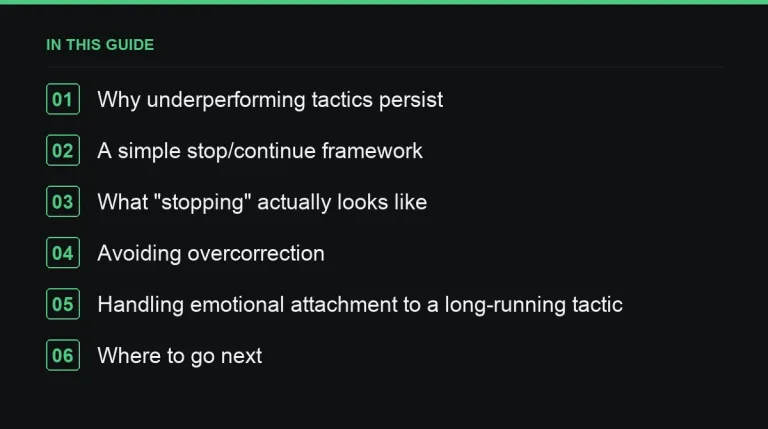
Why underperforming tactics persist
Stopping something feels like admitting a past decision was wrong, which creates a quiet bias toward continuing. There’s also genuine uncertainty — maybe it just needs more time — which makes “keep going a bit longer” the path of least resistance even when evidence doesn’t support it. Building an explicit evaluation point, as part of https://successtoroad.com/blog/quarterly-reviews/, counters this by forcing the question rather than leaving it to inertia.
Setting criteria before you need them
Decide in advance what “not working” looks like for a given tactic or page, rather than judging it in the moment when sunk cost bias is strongest. For example: a priority page that hasn’t moved despite two consecutive quarters of budgeted link building and a confirmed absence of technical or content issues is a reasonable candidate to deprioritise.
A simple stop/continue framework
| Signal | Likely action |
|---|---|
| Consistent movement matching or exceeding plan | Continue, possibly increase investment |
| Some movement, below expectations | Investigate cause before deciding, using ranking plateau diagnosis |
| No movement across multiple quarters, other factors ruled out | Stop or significantly deprioritise |
| Tactic no longer cost-effective relative to alternatives | Reallocate budget elsewhere |
What “stopping” actually looks like
Stopping rarely means abandoning a page or relationship entirely — it usually means removing it from the active, budgeted priority list and letting it continue on whatever baseline it has, while redirecting new investment elsewhere. https://successtoroad.com/blog/prioritising-pages-to-build-links-to/ is the natural place this decision gets implemented each quarter.
Retiring a publisher relationship or tactic type
The same logic applies above the page level — a tactic type (a certain kind of directory listing, a low-engagement guest post format) that consistently underperforms relative to alternatives deserves the same scrutiny as an individual page. Compare its cost and outcome against https://successtoroad.com/blog/combining-pr-content-and-placements/’s broader mix to see if budget would do more elsewhere.
Avoiding overcorrection
Don’t stop something after a single disappointing quarter without checking for a reasonable explanation first — an algorithm update, a content gap that’s since been fixed, or simply normal variance can all explain one weak period without indicating the underlying approach is flawed. https://successtoroad.com/blog/recovering-from-a-drop/ and https://successtoroad.com/blog/ranking-plateaus/ both offer diagnostic steps worth running before a stop decision.
Documenting the decision
Record why something was stopped, not just that it was — this prevents accidentally restarting the same underperforming tactic later without remembering why it was cut. A brief note in your strategy documentation, alongside https://successtoroad.com/blog/documenting-a-link-strategy-for-stakeholders/, is enough.
Handling emotional attachment to a long-running tactic
A tactic or publisher relationship that’s been part of the program for a long time can be harder to retire than a newer one, simply through familiarity, even when the evidence points toward stopping. Applying the same written criteria consistently, regardless of how long something has been running, helps counter this bias.
Reallocating freed budget deliberately
When budget is freed up from a stopped tactic, decide explicitly where it goes next rather than letting it default back into whatever’s easiest to spend on. This is a natural point to revisit your priority page list and direct the freed budget toward whatever currently scores highest.
Communicating a stop decision to a publisher relationship
If stopping means ending a recurring relationship with a specific publisher, a brief, courteous note explaining the change is worth the small effort, since link building circles are often smaller than they appear and a clean exit preserves the option to work together again later.
A note on partial stops
Stopping doesn’t have to be all-or-nothing — reducing investment in an underperforming tactic to a minimal maintenance level, rather than cutting it entirely, is a reasonable middle option when the evidence is mixed rather than clearly negative.
Finally, remember that stopping something well is itself a skill worth developing, not simply an admission that an earlier choice didn’t work out.
A brief annual look back at everything stopped that year is a useful gut check on whether the criteria being applied are actually reasonable.
None of this needs to feel harsh — framing a stop decision as reallocating effort toward better opportunities keeps the tone constructive rather than punitive.
Treat this discipline as an ongoing part of the programme’s health, not an occasional exercise reserved only for when something is obviously and badly failing.
Where to go next
Deliberately stopping what isn’t working frees real budget for what is, but only if the evaluation criteria are set in advance and applied honestly. Feed decisions from this process directly into https://successtoroad.com/blog/building-a-12-month-link-plan/ for the following quarter, and use https://successtoroad.com/marketplace/ to find better-fitting alternatives once you’ve freed up budget from an underperforming tactic.
Frequently asked questions
How long should an underperforming page be given before it's deprioritised?
There's no universal number, but two consecutive quarters of budgeted effort with no movement, after ruling out content, technical or algorithm-related causes, is a reasonable threshold for many sites.
Does stopping a tactic mean abandoning existing relationships or content entirely?
Not usually. It typically means removing it from the active, budgeted priority list rather than deleting or abandoning it outright, letting it continue on its existing baseline while new investment goes elsewhere.
Should a single bad quarter be enough to stop a tactic?
Generally not on its own. Check for a reasonable explanation — an algorithm update, a content issue, normal variance — before concluding the underlying approach itself is the problem.
Why document the reasoning behind a stop decision?
Without it, teams can accidentally restart the same underperforming tactic later, having forgotten why it was cut. A brief written record prevents repeating the same mistake.
Put it into practice
Filter 54,483 websites by DR, traffic, niche and price, and order with escrow — you pay only after the link is live.
Browse the marketplace