What Buyers Look For in a Publisher Listing
A rundown of what buyers actually check before clicking order on your listing.

Buyers scanning a marketplace move fast, and a listing has only a few seconds to convince them it’s worth a closer look. Understanding what they’re actually checking helps you build a listing that converts browsing into orders.
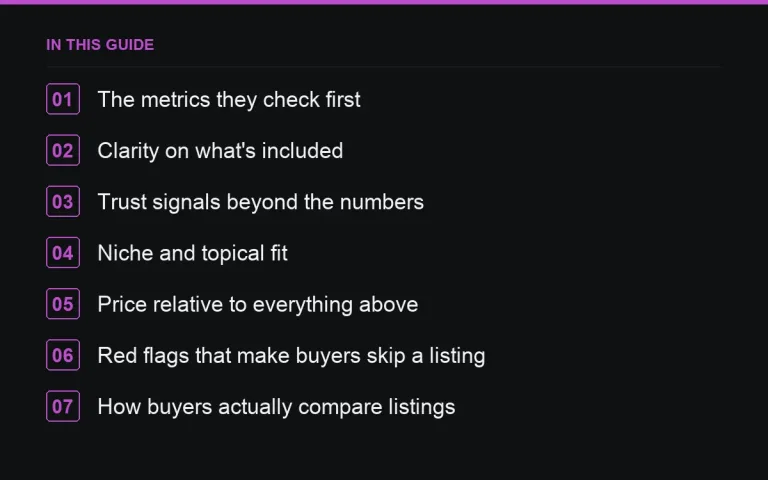
The metrics they check first
Domain authority, domain rating, referring domains, and organic traffic are usually the first filters applied on a marketplace like https://successtoroad.com/marketplace/. Buyers aren’t looking for perfection here, just plausibility: metrics that make sense together, without obvious inflation or a spam score that raises flags. If your numbers look inconsistent, buyers assume the worst and move on.
Clarity on what’s included
Buyers want to know, without asking, what they’re paying for: how many links, dofollow or nofollow, word count, turnaround time, and whether revisions are included. A vague listing forces a question before an order, and many buyers simply skip to a clearer competitor instead of asking. See https://successtoroad.com/blog/writing-a-listing-description-that-sells/ for how to structure this.
Trust signals beyond the numbers
- A track record of completed orders and positive ratings.
- Clear, specific editorial guidelines rather than a generic disclaimer.
- Fast, consistent turnaround time on past orders.
- Evidence the site is actively maintained, not abandoned with stale content.
Niche and topical fit
Buyers filter by niche because relevance matters more to them than raw size. A well-described, tightly niched site often outperforms a broad, generic one because buyers can be confident their content will fit. Make sure your listed niche and content actually match; mismatched listings get flagged or rejected mid-order.
Price relative to everything above
Price only becomes the deciding factor once a buyer has already confirmed relevance, metrics, and clarity look right. An underpriced listing with vague terms and thin metrics won’t win over a fairly priced, clearly described one. Refer to https://successtoroad.com/blog/pricing-your-guest-posts-on-your-site/ for setting a price that matches what you’re actually offering.
Red flags that make buyers skip a listing
Outdated screenshots or stats, no stated turnaround time, a mismatch between claimed niche and visible content, and an empty or missing editorial guidelines section all push buyers toward the next listing. Review https://successtoroad.com/blog/publisher-mistakes-that-lose-orders/ for a fuller list of avoidable errors.
How buyers actually compare listings
Most buyers running any real campaign look at several listings side by side rather than ordering from the first one they see, often using a compare tool to line up metrics from a handful of candidate sites at once. This means your listing isn’t just competing on its own merits; it’s being read next to two or three close alternatives. A listing that answers the obvious questions clearly, without forcing a buyer to click through and ask, has a real edge in that comparison.
What experienced buyers ignore
Buyers who’ve bought guest posts before tend to discount vague marketing language like “premium” or “high-authority” that isn’t backed by a specific number or example. They also tend to weight recent order history and ratings more heavily than a listing’s age alone, since an old listing with no recent activity can look neglected even if the site itself is fine.
Standing out once the basics are covered
Once your metrics, price, and terms are clear, small differentiators like a genuinely specific niche description, a stated revision policy, or evidence of consistent publishing can tip a close decision in your favour. See https://successtoroad.com/blog/writing-a-listing-description-that-sells/ for turning these signals into actual listing copy.
Different buyers, different priorities
An agency buying on behalf of several clients may weight consistency and communication most heavily, since they need a predictable partner across many repeat orders. A smaller in-house marketer running a single campaign may care more about price and a quick first impression. Recognising which type of buyer is likely browsing your specific niche can help you decide which parts of your listing deserve the most attention; see https://successtoroad.com/blog/monetize-your-website-guide/ for how these buyer types fit into the wider marketplace.
Using filters and comparison tools from the buyer’s side
It helps to occasionally look at your own listing the way a buyer would, using the same filters and comparison tools they’d use to shortlist sites in your niche. If your listing looks weak or incomplete next to two or three genuine competitors, that’s a clearer signal for what to improve than any general checklist, since it’s grounded in your actual competitive set rather than an abstract standard.
Balancing detail with clarity
It’s possible to overcorrect and pile every possible detail into a listing until it becomes hard to skim. Prioritise the handful of facts every buyer needs, price, terms, niche, and turnaround, over exhaustive detail about things few buyers actually ask about, and keep anything more niche or situational for a direct message once a buyer engages.
Where to go next
Once you know what buyers check, put it directly into your listing copy; see https://successtoroad.com/blog/writing-a-listing-description-that-sells/ next. For the full monetization path, return to https://successtoroad.com/blog/monetize-your-website-guide/, or see how top listings present themselves at https://successtoroad.com/top-publishers/.
Frequently asked questions
Do buyers care more about DA or traffic?
Both matter, but a mismatch between high authority and low traffic raises questions. Consistent, plausible numbers across metrics build more trust than any single high figure.
How important are reviews and order history?
Very. A track record of completed orders and ratings reduces perceived risk for a new buyer far more than claims in your listing text alone.
Should I list my site in more than one niche?
Only if the content genuinely covers those niches. A mismatched niche listing tends to get flagged or produce rejected briefs.
What's the single biggest listing mistake?
Vagueness. Buyers skip listings that don't clearly state price, turnaround, link policy, and word count up front.
Put it into practice
Filter 54,483 websites by DR, traffic, niche and price, and order with escrow — you pay only after the link is live.
Browse the marketplace