Taxes and Invoicing Basics for Publishers
General record-keeping and invoicing habits that make guest post income easier to manage at tax time.
Income from selling guest posts and link insertions is taxable income in most places, and good habits from day one make it far easier to handle at tax time. This is general guidance only; rules vary by country and you should confirm specifics with a local tax professional or authority.
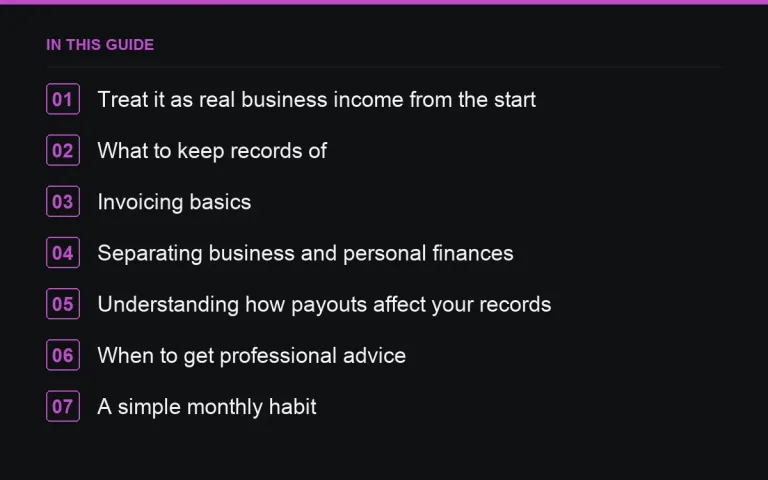
Treat it as real business income from the start
Even if guest post income starts small, treat it the same way you’d treat any other income stream: track it consistently rather than only looking at it once a year. This habit matters more the more sites or orders you’re managing; see https://successtoroad.com/blog/multi-site-publishers/.
What to keep records of
- Every payout received, with the date and amount.
- Any fees the marketplace deducts, since these often affect your reportable net income.
- Expenses related to running your site: hosting, any paid tools, contracted editorial help.
- Invoices or order confirmations tied to each payment, where the marketplace provides them.
Invoicing basics
Some marketplaces generate order confirmations or statements automatically; check what’s available before creating your own invoices from scratch. If you do need to issue your own invoice, include your details, the buyer or marketplace’s details, the amount, the date, and a clear description of the service provided.
Separating business and personal finances
Even as a solo publisher, using a separate account or clearly tagged records for guest post income makes tracking far simpler than mixing it with personal spending. This becomes especially useful once you’re running more than one listing.
Understanding how payouts affect your records
Because payouts run on a schedule rather than per individual order, reconcile your own order records against the payout amounts you actually receive to make sure nothing is missed; see https://successtoroad.com/blog/delivering-the-live-url-and-getting-paid/ for how the payout cycle works.
When to get professional advice
Rules on reporting thresholds, deductible expenses, and applicable taxes vary significantly by country and region, and this post intentionally avoids giving jurisdiction-specific guidance. Once your guest post income becomes meaningful, a local accountant or tax advisor can confirm exactly what applies to your situation.
A simple monthly habit
- Log each payout received, with date and amount, in a single spreadsheet or ledger.
- Note any related expenses for that month, such as hosting or editorial help.
- Reconcile the total against what your order records show was actually earned that period.
A short monthly habit like this takes far less time than reconstructing a full year of records at tax time, and it gives you a clear, ongoing picture of how much your monetization efforts are actually worth once basic costs are accounted for.
Records across multiple sites
If you run more than one listing, keep income and expenses tagged by site rather than lumped together. This makes it easier to see which properties are genuinely profitable once you factor in their specific costs, tying back to the broader portfolio view in https://successtoroad.com/blog/multi-site-publishers/.
Why this matters even at small scale
It’s tempting to skip formal record-keeping while income is still modest, but the habit is far easier to build early than to retrofit once volume grows. Publishers who start tracking from their very first payout tend to have a much easier time both at tax season and when deciding whether a given site or service is actually worth the effort it takes to run; see https://successtoroad.com/blog/growing-from-one-listing-to-a-publishing-business/ for how this fits into scaling up deliberately.
Working with a professional as you grow
Once your guest post income becomes a meaningful part of your overall earnings, the cost of a periodic check-in with a qualified accountant or tax advisor tends to be worth it, both for compliance and for spotting deductible expenses you might otherwise miss. This is a one-time or occasional cost rather than something you need for every single payout.
Keeping this in perspective
None of this needs to be complicated to be effective. A simple, consistently maintained spreadsheet beats an elaborate system you abandon after a few weeks. Start with the basics described here, and add complexity only once your actual order volume genuinely requires it.
Building the habit early
The publishers who find tax season painless are almost always the ones who built simple record-keeping into their routine from their very first payout, rather than those who tried to reconstruct a year of activity after the fact.
A final reminder
Good records aren’t just about compliance; they also give you a clear, honest picture of whether your monetization efforts are actually worth the time you’re putting into them, month after month and year after year, across every single site you happen to run as part of your growing publishing operation overall.
Where to go next
Good financial habits support everything else in running a sustainable publishing operation; see https://successtoroad.com/blog/growing-from-one-listing-to-a-publishing-business/ for the bigger picture. Return to https://successtoroad.com/blog/monetize-your-website-guide/ for the complete process, or check current earning opportunities at https://successtoroad.com/marketplace/.
Frequently asked questions
Is guest post income taxable?
In most places, yes, income from selling guest posts and link insertions counts as taxable income, though specific rules vary by country. Confirm details with a local tax professional.
What records should I keep for guest post income?
Track every payout, any marketplace fees deducted, related expenses, and any invoices or order confirmations tied to each payment.
Do I need to create my own invoices?
Check what your marketplace already provides first, such as automatic order confirmations or statements, before creating your own invoices from scratch.
Should I separate business and personal finances?
It's a good habit even as a solo publisher, since it makes tracking income and expenses far simpler, especially once you're managing more than one listing.
Put it into practice
Filter 54,483 websites by DR, traffic, niche and price, and order with escrow — you pay only after the link is live.
Browse the marketplace