Communicating With Buyers Through Order Messages
How to use order messaging to keep communication clear, professional, and free of unnecessary friction.

Order messaging is where most of the actual relationship with a buyer happens, from brief clarification through delivery and beyond. Using it well reduces disputes, speeds up orders, and builds the kind of trust that leads to repeat business.
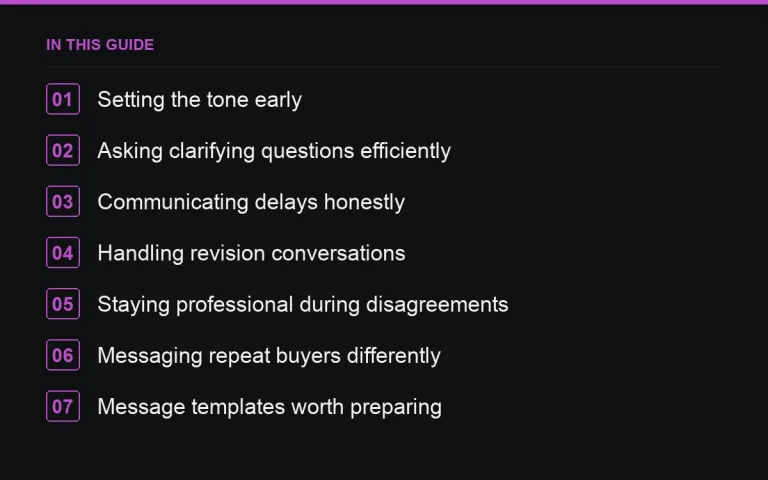
Setting the tone early
A brief, professional, and specific first response to a new order sets expectations for the rest of the interaction. Confirm what you understood from the brief and flag anything unclear immediately rather than assuming and finding out later; this connects directly to https://successtoroad.com/blog/accepting-and-rejecting-briefs/.
Asking clarifying questions efficiently
Ask specific, closed questions where possible rather than open-ended ones that require a long reply. “Should the link use exact-match anchor text or a branded anchor?” gets answered faster than “any preferences on the link?” and keeps your turnaround time on track; see https://successtoroad.com/blog/turnaround-time-and-why-fast-delivery-wins-orders/.
Communicating delays honestly
If you’re going to miss a stated deadline, say so before the buyer has to ask, with a specific new estimate rather than a vague “soon.” Buyers generally respond better to early, honest updates than to silence followed by a late delivery.
Handling revision conversations
When a revision request is vague, ask for specifics rather than guessing at the intended change; this reduces the number of back-and-forth rounds needed. See https://successtoroad.com/blog/handling-revision-requests/ for structuring the revision process itself.
Staying professional during disagreements
Even when a buyer’s message is frustrated or unfair, respond calmly and stick to the facts of the agreed brief and terms. Escalating tone rarely resolves a dispute faster and often makes the eventual resolution, through a formal dispute process if needed, harder for both sides; see https://successtoroad.com/blog/dealing-with-disputes-fairly/.
Messaging repeat buyers differently
With a known repeat buyer, a slightly more familiar tone is fine, but keep the same clarity and specificity you’d use with anyone new. This consistency is part of what makes repeat buyers trust the process; see https://successtoroad.com/blog/building-a-repeat-buyer-base/.
Message templates worth preparing
- A standard acknowledgment for a new brief, confirming receipt and your expected response time.
- A polite rejection template you can adapt with the specific reason, per https://successtoroad.com/blog/accepting-and-rejecting-briefs/.
- A proactive delay notice, with a space for a new specific estimate.
- A delivery confirmation once the live URL is submitted.
Having these ready as a starting point, rather than writing every message from scratch, speeds up your response time without making replies feel impersonal, as long as you still adapt each one to the specific order.
What not to do in order messages
Avoid making promises in a message that contradict your stated listing terms, since this creates confusion about which version applies if a dispute arises later; see https://successtoroad.com/blog/dealing-with-disputes-fairly/. Avoid long, unfocused replies that bury the actual answer to the buyer’s question in unnecessary detail.
Written communication as your working record
Because order messages typically stay attached to the order, they function as the record both sides can refer back to if a disagreement comes up later. Writing clearly and specifically isn’t just good manners; it’s also what makes that record actually useful, both for resolving a dispute fairly and for your own memory once you’re juggling many orders at once; see https://successtoroad.com/blog/multi-site-publishers/ for managing communication at that scale.
Balancing efficiency with a personal touch
Templates and quick, specific replies keep your process efficient, but every message should still read like it was written by a person paying attention to that particular order rather than a copy-pasted script. Buyers notice the difference, and it’s often the small, genuine touches in communication that turn a satisfactory order into the kind of experience that brings a buyer back; see https://successtoroad.com/blog/building-a-repeat-buyer-base/.
Reading between the lines of a buyer’s message
A short, terse message from a buyer isn’t necessarily a sign of frustration; some buyers simply communicate briefly by habit. Respond to the actual content of the message rather than reading tone into it that may not be there, and reserve a more careful, de-escalating tone for messages that are genuinely and explicitly frustrated.
The cumulative effect of good messaging
No single message makes or breaks a buyer relationship, but the accumulated pattern across many orders does. Publishers who communicate clearly and promptly as a matter of habit tend to build a noticeably stronger reputation over time than those who only make the effort occasionally.
A final reminder
Clarity and promptness cost nothing extra to provide, yet they’re consistently among the things buyers mention most when explaining why they keep coming back to a particular publisher.
Closing thought
Good communication is one of the few parts of this business that costs nothing but attention, which makes it one of the easiest places to consistently stand out from other listings, regardless of your price or metrics.
Where to go next
Good communication supports nearly every other part of monetization covered in this guide; return to https://successtoroad.com/blog/monetize-your-website-guide/ for the full picture, or review current order activity at https://successtoroad.com/marketplace/.
Frequently asked questions
How quickly should I respond to order messages?
As quickly as your stated turnaround allows. Fast, specific responses keep orders moving and reduce the risk of a buyer losing patience.
What's the best way to ask a clarifying question?
Ask specific, closed questions where possible, since they get answered faster than open-ended ones and keep the order on schedule.
Should I message a buyer before I miss a deadline?
Yes, always. An early, honest update with a specific new estimate is received far better than silence followed by a late delivery.
How should I respond to a frustrated buyer message?
Stay calm and stick to the facts of the agreed brief and terms. Escalating tone rarely speeds up resolution and can make disputes harder to settle.
Put it into practice
Filter 54,483 websites by DR, traffic, niche and price, and order with escrow — you pay only after the link is live.
Browse the marketplace