Growing From One Listing to a Publishing Business
How to move from one profitable listing to running a proper small publishing business across several sites.

Many publishers start with a single site and, once it’s earning steadily, wonder what scaling up actually looks like. Growing into a small publishing business is less about any single trick and more about turning ad hoc habits into repeatable systems.
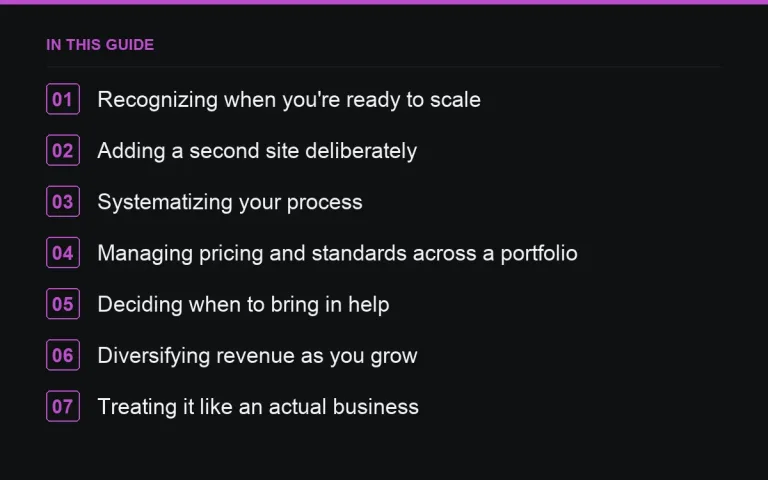
Recognizing when you’re ready to scale
Signs you’re ready to expand include a consistent flow of orders on your existing listing, a clear and repeatable process for evaluating and delivering briefs, and enough spare time or resources to take on more without letting your existing site’s quality slip. Scaling too early, before your first site’s process is solid, usually just spreads the same problems across more properties.
Adding a second site deliberately
Choose a second site based on genuine niche or audience logic, not just because it’s available or cheap to acquire. Go through https://successtoroad.com/blog/the-free-listing-process/ and https://successtoroad.com/blog/verifying-site-ownership/ for the new listing just as carefully as you did the first time.
Systematizing your process
- A written editorial checklist you apply to every brief, across every site; see https://successtoroad.com/blog/editorial-standards-that-protect-your-rankings/.
- A shared tracker for turnaround deadlines across all your listings.
- A consistent messaging style and response-time standard, per https://successtoroad.com/blog/communicating-with-buyers-through-order-messages/.
- A regular schedule for reviewing pricing across sites, per https://successtoroad.com/blog/raising-prices-as-your-metrics-grow/.
Managing pricing and standards across a portfolio
Each site keeps its own price and content mix, covered in https://successtoroad.com/blog/multi-site-publishers/, but your underlying standards for quality, disclosure, and dispute handling should stay uniform across every property you run.
Deciding when to bring in help
As order volume grows across multiple sites, some publishers bring in help for editorial review or order communication rather than doing everything solo. Whoever helps needs to apply the same standards you would, so document your process clearly enough that it’s teachable.
Diversifying revenue as you grow
A mature publishing business often layers guest post revenue with other monetization methods across its properties, from advertising to affiliate partnerships; see https://successtoroad.com/blog/diversifying-beyond-sponsored-posts/ for how these fit together without undercutting your link sales.
Treating it like an actual business
Once you’re running several sites with regular order volume, it’s worth formalising the parts of the operation that were previously informal: clear records of income and expenses per site, a documented editorial checklist everyone involved follows, and a regular schedule for reviewing pricing and performance across the portfolio; see https://successtoroad.com/blog/taxes-and-invoicing-basics-for-publishers/ for the financial side of this shift.
Common pitfalls when scaling
- Growing order volume faster than your ability to maintain turnaround and quality.
- Letting standards drift as more people or more sites get involved.
- Underpricing a strong new site simply because it’s newer, rather than pricing it on its own merits.
Slow, deliberate growth tends to outperform rapid expansion that later has to be walked back.
What success looks like at this stage
A mature guest post publishing operation typically has predictable monthly order volume, a track record of strong ratings across its properties, financial records that make tax time straightforward, and a small set of repeat buyers who account for a meaningful share of revenue. Reaching that point isn’t about any single tactic; it’s the accumulated result of the habits covered throughout this guide, applied consistently over time.
Staying grounded as you grow
It’s easy to chase growth for its own sake once a business is working, but the fundamentals stay the same at any size: clear listings, fair pricing, consistent standards, fast and honest communication, and reliable delivery. A ten-site operation built on those fundamentals will outlast one built purely on rapid acquisition without the underlying process to support it.
Knowing when to stop growing
Not every publisher needs or wants to run a large portfolio, and there’s nothing wrong with deciding that one or two well-run, profitable sites is the right size for your goals. Growth is a choice to make deliberately based on what you actually want from the business, not an obligation just because scaling further is technically possible.
A summary of the path
From a single verified listing to a small, deliberately built portfolio, the underlying habits stay the same throughout: clear terms, consistent standards, honest communication, and reliable delivery, simply applied at whatever scale suits you.
A final word
Whatever size operation you end up running, the businesses that last are the ones built patiently on those fundamentals rather than on any single shortcut.
Closing note
There’s no rush to reach any particular size; steady, well-managed growth beats a fast expansion that later has to be unwound at real cost. Whatever pace you choose, keep the fundamentals covered throughout this guide at the center of every decision you make along the way, starting from your very first listing all the way onward.
Where to go next
This is the natural end point of the process covered across this guide; revisit https://successtoroad.com/blog/monetize-your-website-guide/ for the full framework from the very first listing onward, or explore current opportunities across niches at https://successtoroad.com/marketplace/.
Frequently asked questions
How do I know I'm ready to add a second site?
Consistent order flow, a repeatable and reliable process on your first listing, and spare capacity to take on more without letting quality slip are the main signals.
Should I buy an existing site to scale faster?
You can, but verify its metrics and history carefully first, and go through full ownership verification just as you would with a site you built yourself.
What's the biggest risk when scaling to multiple sites?
Spreading inconsistent standards or slow turnaround across more properties, which can damage your reputation on all of them rather than growing revenue cleanly.
Should every site in my portfolio use the same price?
No. Price each site on its own metrics and demand, while keeping your underlying quality, disclosure, and dispute-handling standards uniform across all of them.
Put it into practice
Filter 54,483 websites by DR, traffic, niche and price, and order with escrow — you pay only after the link is live.
Browse the marketplace