Seasonality in Guest Post Demand
How guest post demand shifts across the year, and how to plan pricing and capacity around it.

Demand for guest posts and sponsored placements isn’t constant throughout the year; it tends to follow broader marketing and budget cycles. Understanding this pattern helps you plan pricing, turnaround promises, and even when to take time off.
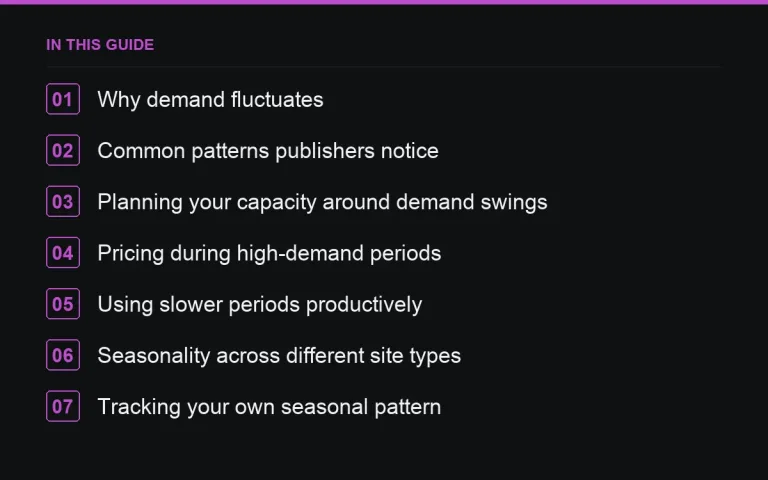
Why demand fluctuates
Marketing and SEO budgets often follow a company’s fiscal calendar, with spending sometimes concentrated toward the end of a budget cycle or scaled back during slower business periods. Agencies planning campaigns for their clients around major shopping or industry events also tend to increase outreach ahead of those dates.
Common patterns publishers notice
- A pickup in briefs ahead of major shopping seasons in relevant niches like https://successtoroad.com/niche/e-commerce/ or https://successtoroad.com/niche/shopping/.
- Slower periods during widely observed holiday stretches when buyer teams are smaller or out of office.
- Bursts of activity tied to budget cycles, which vary by company and region rather than a single universal date.
Planning your capacity around demand swings
During anticipated busier periods, consider whether your stated turnaround time is still realistic given higher order volume, and communicate any change clearly rather than letting quality slip; see https://successtoroad.com/blog/turnaround-time-and-why-fast-delivery-wins-orders/.
Pricing during high-demand periods
Some publishers adjust prices slightly upward during predictable high-demand windows, similar in principle to any market responding to demand, then return to standard pricing afterward. If you do this, be transparent about it in your listing rather than surprising buyers mid-order.
Using slower periods productively
Quieter stretches are a good time to update your listing description, review and refresh older content on your own site, or work through the metrics improvements covered in https://successtoroad.com/blog/improving-your-sites-metrics-to-earn-more/, rather than treating them purely as lost revenue time.
Seasonality across different site types
A niche blog tied to a seasonal topic will see different demand patterns than a general business or finance site; see https://successtoroad.com/blog/monetizing-a-niche-blog/ for thinking through your specific niche’s rhythm.
Tracking your own seasonal pattern
Rather than relying on general assumptions about the market, keep a simple record of your own order volume by month over a full year or two. Your specific niche, audience, and buyer mix may follow a different rhythm than the broad pattern other publishers describe, and your own data will tell you far more reliably where your slow and busy stretches actually fall.
Planning around known busy periods
- Clear your revision and messaging backlog before a period you expect to get busier.
- Consider whether you need to temporarily adjust your stated turnaround time to stay realistic under higher volume.
- Avoid launching a major site redesign or content cleanup right before your busiest period.
Communicating seasonal changes to buyers
If you do adjust turnaround time or pause new bookings during a particularly busy stretch, say so clearly in your listing and through order messaging rather than letting buyers discover a slower response time on their own; see https://successtoroad.com/blog/communicating-with-buyers-through-order-messages/.
Using quiet periods to prepare for busy ones
A predictable slow stretch is a good time to build a small backlog of prepared message templates, refresh your listing description, or get ahead on any content maintenance work described in https://successtoroad.com/blog/improving-your-sites-metrics-to-earn-more/, so you’re not trying to do all of that while also handling a spike in incoming briefs.
Seasonality across a multi-site portfolio
Different sites in a portfolio can peak at different times depending on their niche, which can actually help smooth out your overall workload if you plan for it rather than being surprised by it each time; see https://successtoroad.com/blog/multi-site-publishers/ for coordinating capacity across several properties with different seasonal rhythms.
Avoiding overreaction to short-term swings
A single slow week doesn’t necessarily mean a seasonal downturn has started, just as a single busy week doesn’t confirm a lasting demand shift. Look at trends over several weeks or months before making a significant decision, such as a price change or a pause in new bookings, based on what you’re seeing.
Turning seasonal awareness into an advantage
Publishers who understand their own demand rhythm can plan capacity, pricing, and even personal time off around it, turning what feels like an unpredictable ebb and flow for less experienced publishers into a manageable, expected part of running the business.
A last practical note
Write down what you observe about your own seasonal pattern as you notice it, rather than trusting memory alone; a year from now, that record will be far more useful than a general impression.
Closing thought
Seasonality isn’t something to fight against; it’s simply another variable to plan around, the same way you plan around pricing, standards, and turnaround time. Publishers who anticipate it tend to feel far less thrown off by a quiet month than those who treat every single dip in orders as an unexpected surprise worth panicking over.
Where to go next
Understanding seasonality feeds directly into pricing decisions covered in https://successtoroad.com/blog/raising-prices-as-your-metrics-grow/ and https://successtoroad.com/blog/pricing-your-guest-posts-on-your-site/. Return to https://successtoroad.com/blog/monetize-your-website-guide/ for the complete process, or check current demand at https://successtoroad.com/marketplace/.
Frequently asked questions
Does guest post demand really change across the year?
Yes, it tends to follow marketing and SEO budget cycles as well as broader business activity, with noticeable busier and quieter stretches.
Should I raise prices during busy periods?
Some publishers do, similar to how any market responds to demand, as long as the pricing approach is stated transparently rather than sprung on buyers mid-order.
What should I do during a slow period?
Use quieter stretches to update your listing, refresh older site content, or work on the broader metrics improvements that support future pricing.
Does seasonality affect every niche the same way?
No. Different niches follow different rhythms, so it's worth tracking your own site's demand pattern rather than assuming a universal calendar applies.
Put it into practice
Filter 54,483 websites by DR, traffic, niche and price, and order with escrow — you pay only after the link is live.
Browse the marketplace