Setting a Link Building Risk Appetite Framework
A written risk appetite framework sets link building boundaries in advance so pressure moments don't produce ad hoc bad decisions.
Every link building decision carries some level of risk, from very low (a well-earned editorial mention) to considerably higher (aggressive, high-volume tactics). Most sites make these calls ad hoc, tactic by tactic, under time pressure. A written risk appetite framework, decided calmly in advance, produces more consistent and defensible decisions.
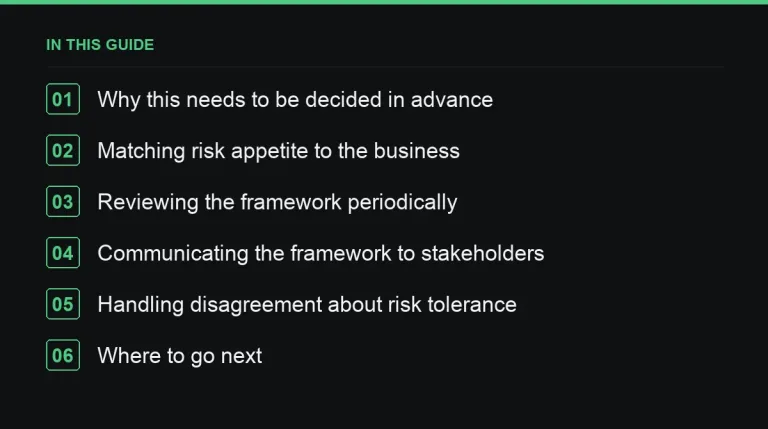
Why this needs to be decided in advance
Decisions made under pressure — a competitor seems to be winning, a stakeholder wants faster results, a slow month needs a boost — tend to skew riskier than decisions made with time to think. A framework agreed on beforehand, ideally with sign-off from whoever owns the business risk, removes the need to re-litigate risk tolerance every time a tempting but questionable opportunity appears.
What a framework actually covers
- What categories of tactics are acceptable, conditionally acceptable, or off the table entirely
- How much of the link profile can reasonably come from any single tactic or source type
- Pace limits — how much link acquisition in a given period is considered normal versus unusually fast
- Who has authority to approve an exception to the framework, and under what circumstances
Matching risk appetite to the business
A small, low-margin business with little to lose from a setback may reasonably tolerate more risk than an established brand where a ranking penalty would be genuinely damaging to revenue or reputation. There’s no universally correct risk level — the framework should reflect what the specific business can actually afford if a riskier approach doesn’t pay off.
A simple tiering example
| Tier | Example tactics | Approval needed |
|---|---|---|
| Low risk | Editorial mentions, relevant guest posts on vetted sites | Standard process |
| Medium risk | High-volume placements on less-vetted sites | Explicit sign-off |
| Off the table | Clearly manipulative link schemes | Not approved regardless of pressure |
Reviewing the framework periodically
Risk tolerance can reasonably shift as a business matures, as its dependence on organic traffic grows, or as the broader link building landscape changes. Build a review of the framework itself into https://successtoroad.com/blog/quarterly-reviews/, rather than treating it as a document written once and forgotten.
How this interacts with vetting individual opportunities
A framework sets the boundaries; you still need judgment to evaluate specific opportunities within them. https://successtoroad.com/blog/link-gap-analysis-method/ and ordinary publisher vetting still apply within whichever risk tier a given opportunity falls into — the framework just narrows the decision rather than replacing it entirely.
Communicating the framework to stakeholders
A written framework is also a useful tool for managing expectations upward — if a stakeholder pushes for faster results through riskier tactics, having an agreed framework to point to makes the conversation about the framework itself, not a personal judgment call each time. https://successtoroad.com/blog/documenting-a-link-strategy-for-stakeholders/ covers presenting this kind of document well.
What happens without a framework
Sites without an explicit risk appetite tend to drift toward whatever tactic is being discussed most loudly at the time, which produces an inconsistent link profile and, occasionally, decisions made in a pressured moment that look clearly unwise in hindsight. A framework doesn’t eliminate judgment calls, but it makes them more consistent and easier to explain after the fact.
Handling disagreement about risk tolerance
It’s common for different stakeholders to have genuinely different risk tolerances — a founder might be more willing to take risks than a marketing lead who’s seen a previous setback. Surface this disagreement explicitly when setting the framework rather than letting it resurface repeatedly during individual tactic discussions, where it’s harder to resolve calmly.
Documenting exceptions when they happen
If an exception to the framework is approved for a specific opportunity, record why, so it doesn’t quietly become the new normal through repetition. A framework that erodes through undocumented exceptions stops being useful as a genuine boundary.
Applying the framework to new team members
When onboarding anyone new to link building work, walk them through the framework directly rather than assuming they’ll absorb it informally over time — this is one of the more effective ways to keep decisions consistent as a team grows.
A note on external vendors and agencies
If any part of link building is outsourced to an agency or freelancer, make sure they’re given the framework directly and asked to work within it explicitly, rather than assuming an external party will independently share your same risk tolerance.
Finally, treat the framework as a living agreement rather than a static rulebook, revisited deliberately rather than left to quietly drift out of relevance.
A short annual read-through with whoever owns business risk keeps the framework a genuine shared agreement rather than a forgotten document.
Where to go next
Deciding risk tolerance calmly, in writing, before pressure moments arise leads to better decisions than improvising each time. Pair this with https://successtoroad.com/blog/link-building-during-algorithm-updates/ for the specific pressure of a volatile update period, and use https://successtoroad.com/marketplace/’s filtering by authority and quality metrics to source opportunities that fit comfortably within your agreed low-risk tier.
Frequently asked questions
How risk-tolerant should a link building strategy be?
It depends on the business — how much it can afford to lose from a setback, how dependent it is on organic traffic, and its general risk culture. There's no universal correct answer, only what's appropriate for a specific site.
Who should be involved in setting a risk appetite framework?
Whoever ultimately owns the business risk, not just whoever executes the link building day to day. This ensures the framework reflects genuine organisational tolerance, not just individual preference.
Does a framework remove the need for judgment on individual opportunities?
No, it narrows the decision rather than replacing it. You still need to vet specific opportunities, but within boundaries that were agreed calmly rather than decided under pressure.
How often should the framework be reviewed?
At least as often as your broader strategy review, commonly quarterly or annually, and also whenever the business's circumstances or dependence on organic traffic changes meaningfully.
Put it into practice
Filter 54,483 websites by DR, traffic, niche and price, and order with escrow — you pay only after the link is live.
Browse the marketplace