When and How to Raise Your Guest Post Prices
How to time a price increase on your listing without losing the buyers you already have.
Publishers often stay at their launch price long after their site has clearly grown past it. Raising prices at the right moments captures the value you’ve actually built, but doing it clumsily can cost you buyers who were happy at the old rate. Here’s how to approach it.
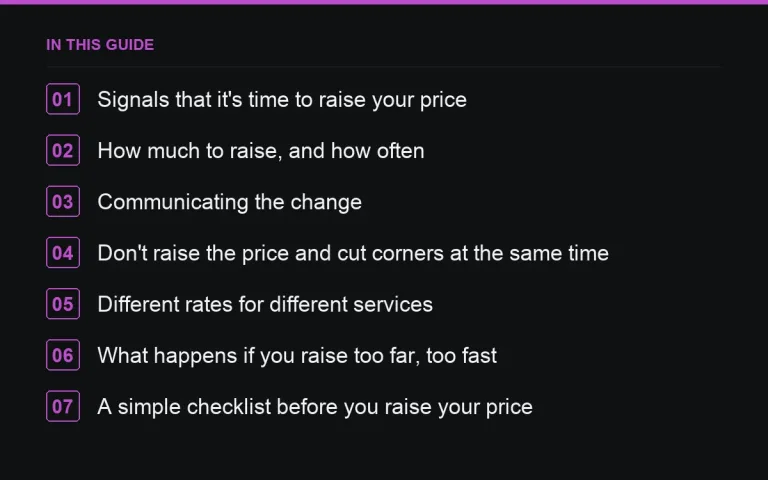
Signals that it’s time to raise your price
- Your domain authority or domain rating has moved up a meaningful tier since you last set your price.
- Your organic traffic has grown and stayed steady, not just spiked briefly.
- You’re consistently fully booked or turning down orders because you’re at capacity.
- Buyers are accepting your price with no negotiation, which usually means you’re underpriced relative to demand.
How much to raise, and how often
Small, periodic increases are easier for the market to absorb than one large jump. A modest increase every few months, tied to a specific metric improvement, is easier to justify to returning buyers than an unexplained jump. Compare yourself again against similar listings at https://successtoroad.com/marketplace/ before settling on a new number, using the same method described in https://successtoroad.com/blog/pricing-your-guest-posts-on-your-site/.
Communicating the change
If you have repeat buyers, a short heads-up through order messaging before their next order lands much better than a silent price change they discover mid-checkout. Frame it around what’s improved: more traffic, better editorial turnaround, or a cleaner link profile. See https://successtoroad.com/blog/communicating-with-buyers-through-order-messages/ for tone and timing.
Don’t raise the price and cut corners at the same time
A price increase only sticks if quality and service stay consistent or improve. If turnaround time slows down or editorial standards slip right when you raise prices, buyers will notice and go elsewhere. Keep https://successtoroad.com/blog/turnaround-time-and-why-fast-delivery-wins-orders/ and https://successtoroad.com/blog/editorial-standards-that-protect-your-rankings/ in mind as you scale up pricing.
Different rates for different services
You don’t have to raise every price line at once. If your insertions are in higher demand than full guest posts, raise that rate first; see https://successtoroad.com/blog/pricing-link-insertions/. If you run several sites, treat each one’s price independently based on its own trajectory, as covered in https://successtoroad.com/blog/multi-site-publishers/.
What happens if you raise too far, too fast
Orders drying up after a price change is a clear signal you’ve overshot the market. It’s fine to step back down slightly rather than treat the higher price as fixed. Track order volume for a few weeks after any change before deciding whether to hold, adjust, or reverse it.
A simple checklist before you raise your price
- Has a specific metric (traffic, authority, referring domains) genuinely improved since your last price was set?
- Are you regularly turning down orders because you’re at capacity?
- Have you checked current comparable listings to confirm the new price is still realistic?
- Do you have a plan for communicating the change to existing repeat buyers?
If most of these are true, a price increase is likely to hold. If none are, it’s worth waiting until the underlying value has actually shifted.
Tracking the results of a price change
Keep a simple record of your order volume and average order value before and after any price change, so you’re making the next decision from evidence rather than impression. This is especially useful if you manage more than one listing and want to compare how different sites respond to similar increases; see https://successtoroad.com/blog/multi-site-publishers/.
Raising prices for new services separately
If you introduce a new service, such as a rush turnaround option or a premium insertion into a flagship page, it’s easier to price that correctly from the start than to raise an existing price later. Treat each new offering as its own pricing decision, informed by the same comparable-listing research described in https://successtoroad.com/blog/pricing-your-guest-posts-on-your-site/, rather than anchoring it arbitrarily to your existing rate.
Long-term pricing discipline
Publishers who review pricing on a fixed schedule, rather than reactively whenever they happen to think about it, tend to capture value more consistently over time. Pair a periodic pricing review with your periodic listing review, described in https://successtoroad.com/blog/writing-a-listing-description-that-sells/, so both stay aligned with your site’s current reality.
What a price increase signals to the market
A rising price, communicated clearly and tied to genuine improvement, tells both new and repeat buyers that your site is actively growing rather than stagnant. Left unexplained, the same increase can just as easily read as arbitrary. The difference is almost entirely in how you frame it, which is why pairing every increase with a specific, honest reason matters as much as the number itself.
A note on patience
It can be tempting to raise prices the moment a metric ticks up, but a brief, sustained improvement is a stronger basis for a lasting increase than a single good month. Waiting for a trend to hold for a few consecutive review periods, rather than reacting to the first sign of growth, reduces the chance you’ll need to walk the price back shortly afterward.
Where to go next
Pair this with https://successtoroad.com/blog/improving-your-sites-metrics-to-earn-more/ to understand what actually moves your metrics upward in the first place, and revisit https://successtoroad.com/blog/monetize-your-website-guide/ for the full picture. Update your live listing whenever you change price at https://successtoroad.com/become-a-seller/.
Frequently asked questions
How often should I raise my prices?
Small, periodic adjustments tied to real metric or traffic improvements work better than infrequent large jumps.
Will raising prices lose me buyers?
Some, especially highly price-sensitive ones, but a well-timed increase tied to genuine improvements usually keeps your best repeat buyers.
Should I warn returning buyers before a price change?
Yes, a brief note through order messaging before their next order is good practice and reduces friction.
What if orders stop after I raise prices?
Treat that as market feedback. It's fine to lower the price slightly rather than holding a rate the market won't pay.
Put it into practice
Filter 54,483 websites by DR, traffic, niche and price, and order with escrow — you pay only after the link is live.
Browse the marketplace