Pitching Expert Comment and Quotes to Journalists
How to become a source journalists actually want to quote, and how to pitch that offer effectively.
Being quoted as an expert source is one of the most durable forms of outreach-driven coverage, since a journalist who finds you useful once often returns for future stories on the same beat. This post covers how to position yourself credibly and pitch the offer of comment.
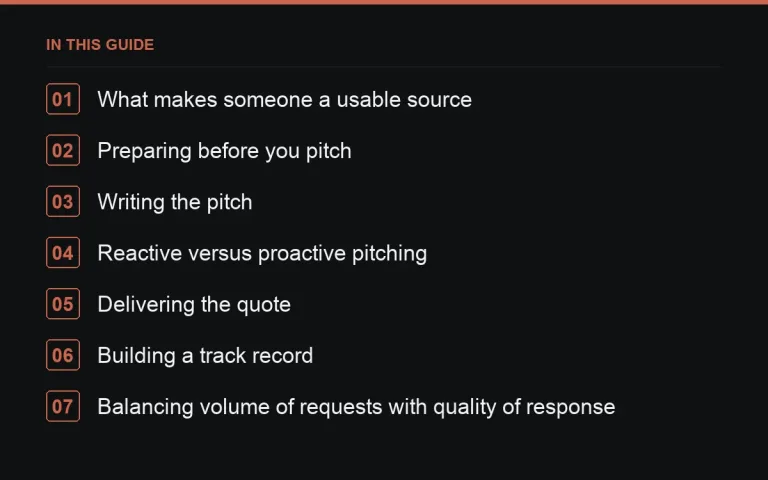
What makes someone a usable source
Journalists want a source who can explain something clearly, quickly, and with genuine expertise, not marketing language. A specific, defensible point of view, stated plainly, is far more usable in an article than a vague statement that could apply to any company in the space.
Preparing before you pitch
- Have a clear, one-line statement of your actual expertise, not a job title alone.
- Prepare two or three specific opinions or observations on current topics in your field, ready to offer rather than invent on the spot.
- Keep a short, factual bio ready to send, avoiding marketing-style self-description.
Writing the pitch
State plainly what you can speak to, why you are a credible source on that specific topic, and offer a short quote or availability for a call, whichever suits the journalist’s usual working style. Avoid a long pitch; journalists on deadline want to know quickly whether you are useful for the specific piece they are working on right now.
Reactive versus proactive pitching
| Approach | How it works |
|---|---|
| Reactive (responding to a live request) | Journalist or platform posts a specific query; you respond directly and quickly with a relevant quote. |
| Proactive (cold pitch) | You identify a journalist’s beat and offer general availability as a source for future stories. |
Reactive pitching through journalist request platforms tends to have a faster and more predictable response cycle, since the journalist has already signalled they need a source right now.
Delivering the quote
Once a journalist responds, reply quickly, journalists work on deadlines and slow responses often mean missing the piece entirely, and give a quote that is quotable as written, not a long paragraph they have to edit down themselves. A tight, well-formed sentence or two is more likely to be used verbatim.
Building a track record
Each successful quote is worth keeping a note of, in your tracker (see https://successtoroad.com/blog/tracking-outreach-in-a-spreadsheet-or-crm/), both as a portfolio you can reference in future pitches and as a record of which journalists and beats respond best to your specific expertise.
Balancing volume of requests with quality of response
Responding to a large number of journalist requests with rushed, generic answers tends to produce fewer usable quotes than responding to fewer, better-matched requests with genuinely thoughtful, specific answers. Prioritise fit and quality of response over sheer volume of requests answered.
Being available on short notice
Many journalist requests come with a same-day or next-day deadline, and being genuinely reachable, checking email or a request platform regularly rather than once a week, meaningfully increases how often you are actually able to respond in time to be considered as a source.
Handling a quote that gets edited before publication
Occasionally a published quote is trimmed or lightly reworded from what you originally sent, which is a normal part of editorial process rather than something to dispute unless the meaning has been genuinely changed. If an edit does meaningfully misrepresent what you said, a polite, prompt note to the journalist asking for a correction is reasonable; raising a minor phrasing difference is usually not worth the friction it creates.
Preparing colleagues to be pitched as sources too
If you are pitching on behalf of a company rather than yourself personally, it helps to identify two or three colleagues with genuinely distinct areas of expertise, rather than routing every request through a single spokesperson. This gives you more flexibility to respond to a wider range of journalist requests and avoids overloading one person with every incoming ask, while keeping each pitch grounded in someone’s actual, specific knowledge rather than a generic company position.
What a strong source relationship looks like over time
A journalist who quotes you once and finds the experience easy, a fast, well-formed, accurate quote, is likely to reach out again directly for future stories on the same beat, sometimes without you needing to pitch at all. This is one of the more durable outcomes of doing expert-comment outreach well, and worth investing in beyond the value of any single mention. For a general route to relevant links alongside this slower-building channel, https://successtoroad.com/marketplace/ offers a way to secure placements while a source reputation develops over time.
Avoiding over-pitching
Offering comment on topics genuinely outside your expertise, just to get coverage, tends to produce weak quotes that do not get used, and can damage your credibility with a journalist for future, more relevant opportunities. Stay within your actual area of knowledge.
Where to go next
See https://successtoroad.com/blog/pitching-data-and-original-research/ for a complementary pitch type, and https://successtoroad.com/blog/journalists-vs-bloggers-outreach-differences/ for how this approach should be tailored to the recipient. For the wider process, see https://successtoroad.com/blog/link-outreach-guide/.
Frequently asked questions
How do journalist request platforms work?
Journalists post specific requests for sources on a topic, and you respond directly if you are relevant and available, which tends to be faster than a cold, proactive pitch.
Should I write the full quote myself or let the journalist paraphrase?
Offering a tight, ready-to-use quote is usually more effective, since it reduces the journalist's editing work and increases the odds it is used as given.
What if I am not quoted after responding to a request?
This is common and not a sign of failure; journalists receive many responses per request and can only use a limited number of sources per piece.
Can a smaller or newer business still get expert-comment coverage?
Yes, credibility comes from the specificity and quality of what you say, not company size; a sharp, well-informed comment from a small business can be just as usable as one from a large one.
Put it into practice
Filter 54,483 websites by DR, traffic, niche and price, and order with escrow — you pay only after the link is live.
Browse the marketplace