Personalisation at Scale: Outreach Without the Grind
A workable middle ground between fully custom emails and a mail-merge that gets ignored.
Fully custom emails, written from scratch for every prospect, do not scale past a small list. A pure mail-merge with a name swapped in does not get replies at any scale. The workable middle ground is a template built around two or three variable slots, each of which forces you to actually look at the site before sending. This post covers how to build that template.
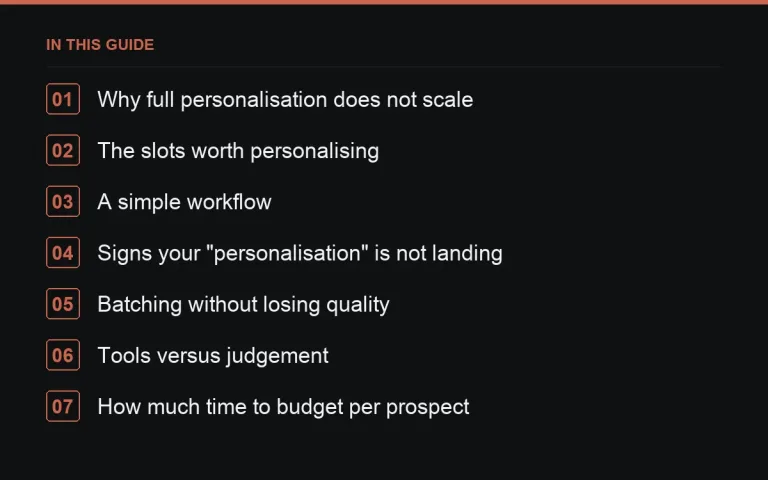
Why full personalisation does not scale
Writing a genuinely unique email for eighty prospects takes far longer than most campaigns can afford, and quality drops as fatigue sets in around email thirty. A structured template with real variable content solves the time problem while keeping the substance a fully generic email lacks.
The slots worth personalising
- The specific reference — the exact post, page or section you are writing about. This cannot be faked without reading the page.
- The reason it fits — one sentence connecting your resource or angle to something specific already on their site.
- Optionally, a shared context — how you found them, a mutual connection, or a relevant detail about their niche.
Everything else, the ask, the sign-off, the general shape, can be identical across every email in the batch without the message reading as generic, because the two or three filled-in details carry the weight.
A simple workflow
- Open the prospect’s site and find the single most relevant page.
- Write one sentence referencing something specific on that page.
- Write one sentence connecting it to your ask.
- Drop both sentences into the fixed template and send.
This keeps the research honest, you cannot write a specific sentence about a page you have not opened, while keeping per-email time to a few minutes.
Signs your “personalisation” is not landing
| Symptom | Likely cause |
|---|---|
| Replies say “this isn’t relevant to us” | The variable slot was filled with something generic rather than genuinely specific. |
| No replies at all across many sends | The template’s fixed parts may be too salesy or too long, masking the personalised detail. |
| Replies flag the wrong site name or detail | A merge-field error; always proofread before sending, especially in the first batch. |
Batching without losing quality
Group prospects by similarity, sites in the same niche, or the same type of ask, so the fixed template needs fewer adjustments across a batch and the personalised sentences come faster once you are in the rhythm of that niche’s content.
Tools versus judgement
Software can help surface a prospect’s recent content or social activity faster, but no tool can write the “why this fits” sentence for you if you have not actually decided why it fits. Treat any tool as a research shortcut, not a substitute for the sentence itself.
How much time to budget per prospect
As a rough planning guide, treat research and personalisation as a fixed, small slice of your total campaign time per prospect, not an open-ended task. If a single prospect is taking far longer than the rest of your list without a clear reason, either the site is genuinely worth the extra effort, or you have drifted into over-researching a target that does not warrant it. Recognising which case you are in keeps a campaign moving at a sustainable pace.
Reusing research across similar prospects
Sites within the same niche often share enough in common, similar content formats, similar audience, similar concerns, that research done for one prospect can partially inform the variable sentence for the next, as long as you still verify the specific detail on each individual page before sending. This is different from copying the sentence outright; it simply means the research phase gets faster with practice within a niche.
When personalisation matters less
For very high-authority targets or unusually good-fit opportunities, invest real, individual time. For the long tail of a large list, the templated-with-slots approach is a reasonable trade-off, and is far better than skipping personalisation altogether, which shows up immediately in reply quality.
Training a new team member to personalise consistently
When bringing a new person onto an outreach effort, walk them through several real, sent examples of the variable slots done well versus done poorly, rather than only describing the concept abstractly. Seeing the difference concretely, a genuinely specific sentence next to a vague one, tends to build the right instinct faster than a written rule alone, and shortens the time before their own personalised sentences reach a consistent standard.
Reviewing personalisation quality across a campaign
Every so often, pull a handful of sent emails at random and read them back as if you were the recipient. This spot-check is one of the fastest ways to catch a template that has quietly drifted toward generic phrasing, or a variable slot that has been filled in lazily under time pressure. Treat it as a routine part of running any campaign of meaningful size, not a one-time setup step.
Where to go next
Pair this with https://successtoroad.com/blog/outreach-first-email-structure/ for the shape of the email itself, and https://successtoroad.com/blog/outreach-subject-lines-that-get-opened/ for the line that gets it opened. See https://successtoroad.com/blog/link-outreach-guide/ for the full process. If even templated personalisation is more manual work than a campaign has time for, https://successtoroad.com/marketplace/ lets you go straight to publishers with transparent terms instead.
Frequently asked questions
How long should personalising one email take?
A few minutes once you have a rhythm; if it is taking much longer than that per email, you are likely over-researching for the scale you are working at.
Can I use AI to help draft the personalised sentence?
It can help draft a first attempt, but always verify the specific claim against the actual page before sending, since a wrong detail is worse than no personalisation at all.
Does personalising the subject line matter as much as the body?
It helps but is less critical than a personalised opening sentence in the body, since the subject line's job is only to get the open, not to carry the whole pitch.
Is name personalisation alone enough?
No. A name swap with no other specific detail reads as generic to most experienced editors and rarely improves reply rates on its own.
Put it into practice
Filter 54,483 websites by DR, traffic, niche and price, and order with escrow — you pay only after the link is live.
Browse the marketplace