Outreach Mistakes That Get You Blacklisted
The specific mistakes that get outreach senders blocked, ignored permanently, or reported as spam.
Some outreach mistakes cost you a single reply. Others get your domain, or you personally, blocked or blacklisted by a publisher or a wider community of editors who talk to each other. This post covers the mistakes worth actively avoiding, not just the ones that merely underperform.
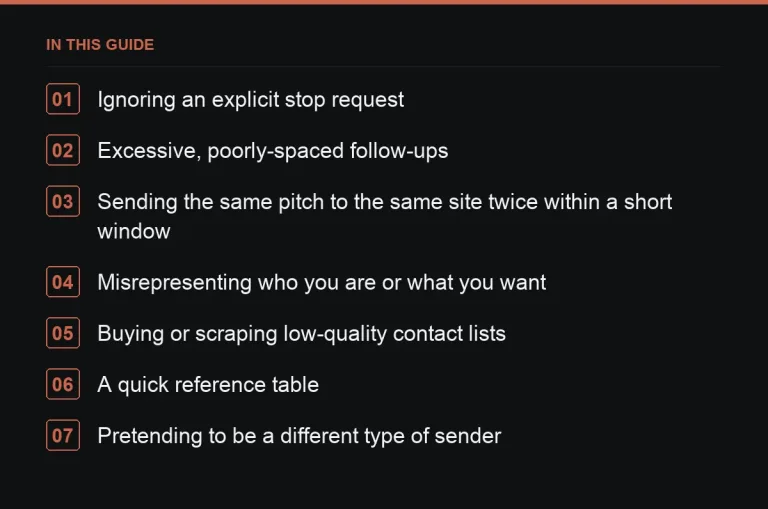
Ignoring an explicit stop request
Continuing to email someone after they have asked you to stop is the single fastest way to get reported as spam and blocked outright. Honour every stop request immediately and permanently; see https://successtoroad.com/blog/outreach-legal-and-etiquette/ for the broader consent principle this sits under.
Excessive, poorly-spaced follow-ups
Sending more than two or three follow-ups to an unresponsive contact, or spacing them too closely together, reads as harassment rather than persistence. Stick to the cadence in https://successtoroad.com/blog/outreach-follow-up-cadence/ and stop once it has run its course.
Sending the same pitch to the same site twice within a short window
This usually happens when outreach is uncoordinated across a team, or a tracker is not checked before adding a new prospect. It reads as sloppy at best and as spam at worst. See https://successtoroad.com/blog/tracking-outreach-in-a-spreadsheet-or-crm/ for the process that prevents it.
Misrepresenting who you are or what you want
Pretending a paid placement pitch is purely editorial interest, or claiming a relationship or credential you do not have, tends to be discovered eventually, editors compare notes within a niche more than senders expect, and the reputational damage extends beyond the single site involved.
Buying or scraping low-quality contact lists
Lists assembled without clear consent tend to produce high bounce rates and spam complaints, damaging your sending domain’s reputation across every future campaign, not just the one using the bad list. See https://successtoroad.com/blog/outreach-deliverability-basics/ for how this compounds over time.
A quick reference table
| Mistake | Consequence |
|---|---|
| Ignoring a stop request | Spam report, potential blacklist |
| Over-following-up | Blocked or ignored permanently by that contact |
| Duplicate outreach across a team | Looks unprofessional, damages trust |
| Misrepresenting the pitch | Reputational damage across a niche, not just one site |
| Bought or scraped lists | High bounce and complaint rates, domain-wide deliverability harm |
Pretending to be a different type of sender
Disguising a commercial outreach email as if it came from an ordinary individual reader, with no mention of the business or role behind it, is a form of misrepresentation that tends to be discovered and resented once noticed. Being upfront about who you are and what organisation you represent, even in a brief line, is a small cost that avoids a larger reputational risk later.
Scraping content or images without permission
Using a site’s own images, text, or design elements without permission, in a pitch or in the content offered as part of an exchange, is both a mistake in etiquette and, depending on jurisdiction, a real legal risk. Always ask before using anything drawn directly from the recipient’s own site, and prepare original material for your own pitches instead of leaning on someone else’s assets to strengthen the ask.
Aggressive or manipulative negotiation tactics
Threatening a negative review, implying a consequence unrelated to the actual pitch, or pressuring a contact with false urgency (“this offer expires today”) are recognised as manipulative tactics and tend to damage trust quickly once noticed, even if they occasionally produce a short-term result. These tactics also tend to be remembered and shared informally among editors in a niche, compounding the damage well beyond the single interaction.
Pretending an automated email is personal
Claiming, explicitly, that an email was written specifically for the recipient when it is plainly a mail-merge with a name inserted is a small dishonesty that, once spotted, undermines trust in everything else the sender says. It is better to let a well-personalised email speak for itself than to claim a level of individual attention that is not actually there.
Recovering from a mistake
If you realise you have made one of these mistakes, a brief, genuine acknowledgment and correction, stopping immediately, apologising once, without over-explaining, is usually the best available response. Defensive or lengthy justification tends to make the situation worse, not better.
Why this matters more than it might seem
A damaged sender reputation or a reputation for poor etiquette within a niche affects every future campaign, not just the current one. The extra care these points require is small relative to the cost of losing access to a whole community of publishers because of avoidable mistakes.
Training a wider team on these standards
As more people on a team run outreach independently, the risk of one of these mistakes happening somewhere in the organisation rises, even if any individual sender is careful. A short onboarding checklist covering stop-request handling, follow-up limits, and list sourcing standards, reviewed with anyone new to running outreach, is a small investment that prevents most of the damage described in this post before it ever happens.
Where to go next
See https://successtoroad.com/blog/outreach-legal-and-etiquette/ for the underlying consent principles, and https://successtoroad.com/blog/outreach-deliverability-basics/ for the technical side of protecting your sending reputation. For the full process, see https://successtoroad.com/blog/link-outreach-guide/. If avoiding these risks entirely sounds appealing, https://successtoroad.com/marketplace/ works through agreed, transparent terms rather than cold contact.
Frequently asked questions
What is the single most damaging outreach mistake?
Ignoring an explicit request to stop contacting someone; it is the fastest route to a spam report and reputational damage that extends beyond the one relationship.
Can one bad campaign affect future, unrelated campaigns?
Yes, particularly through damaged sender reputation at the domain level, and through word of mouth among editors within a niche who compare notes.
Is it recoverable if I have already made one of these mistakes?
Often yes, with a brief, genuine correction and by immediately stopping the behaviour; the damage compounds mainly when the mistake continues unaddressed.
Are duplicate emails from different team members really that harmful?
They tend to look unprofessional and can irritate a recipient enough to disengage from the relationship entirely, so they are worth preventing with a shared tracker.
Put it into practice
Filter 54,483 websites by DR, traffic, niche and price, and order with escrow — you pay only after the link is live.
Browse the marketplace