Link Building in a New Site’s First 90 Days
New sites should prioritise foundations and a handful of quality links over volume in the first 90 days.
A brand-new site has no history, no existing rankings and usually very little authority, which changes what link building should look like in the first three months compared to an established site. Chasing volume early is one of the most common mistakes; the first 90 days are better spent on foundations that make later link building work harder.
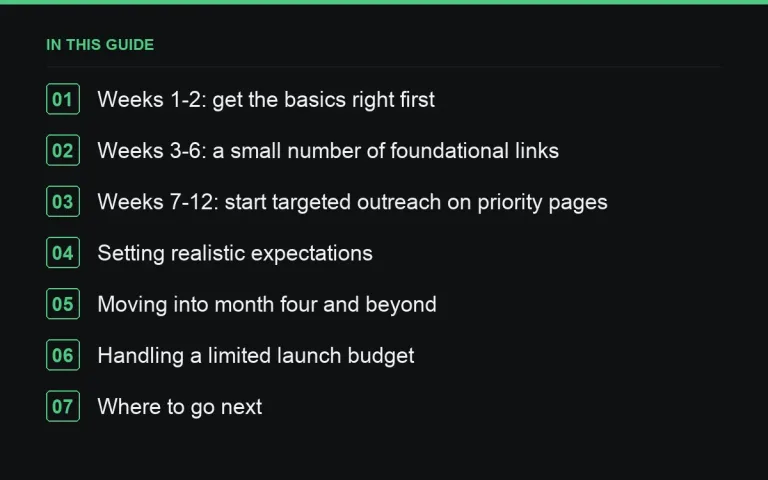
Weeks 1-2: get the basics right first
Before any outreach, confirm the site is actually indexable, has no major technical blockers, and that your priority pages are reasonably well structured. https://successtoroad.com/blog/technical-seo-before-links/ is worth working through in full here — links to a page search engines can’t properly crawl or that has thin content won’t produce the ranking gains you’re expecting.
Set up measurement before you need it
It’s much harder to measure link impact retroactively than to set up tracking from day one. Decide now which pages you’ll monitor and consider setting aside a few comparable pages as an informal control group — see https://successtoroad.com/blog/measuring-link-impact-with-control-pages/ for how this works in practice.
Weeks 3-6: a small number of foundational links
Early links should establish that the site is real and topically legitimate rather than chase rankings directly — a listing in a relevant, real industry directory, a mention from a partner or supplier, a profile on platforms relevant to your niche. Quality and relevance matter more than volume at this stage, and a small number of clearly legitimate links is safer than a fast batch of anything available.
Avoid a sudden spike
A brand-new domain that suddenly acquires a large batch of links looks unusual and can draw more scrutiny than it’s worth. Build gradually — a steady trickle over the full 90 days is safer and more sustainable than trying to “catch up” to competitors immediately.
Weeks 7-12: start targeted outreach on priority pages
By this point you should have a short list of priority pages — use https://successtoroad.com/blog/prioritising-pages-to-build-links-to/ to build it — and can start more deliberate outreach or guest posting toward them. This is also a reasonable point to browse https://successtoroad.com/marketplace/ for relevant publishers in your niche, since you now have specific pages and a modest budget to direct at them rather than acquiring links speculatively.
What to deliberately postpone
- Large-scale guest posting campaigns before you know which pages actually perform
- Competitive, high-volume link building on terms you haven’t validated with early data
- Anchor text diversity strategies that assume a larger existing link base than you have
Setting realistic expectations
New sites take time to accumulate the trust signals that make link building pay off in rankings, and the first 90 days rarely produce dramatic movement even when done well. Treat this period as foundation-laying rather than results-chasing, and set stakeholder expectations accordingly — https://successtoroad.com/blog/documenting-a-link-strategy-for-stakeholders/ is useful if you need to explain this timeline to someone else.
A simple 90-day structure
| Period | Focus |
|---|---|
| Weeks 1-2 | Technical foundations, measurement setup |
| Weeks 3-6 | A small number of foundational, clearly legitimate links |
| Weeks 7-12 | Targeted outreach toward prioritised pages |
Moving into month four and beyond
Once the foundation is in place, the site can move onto a fuller annual structure — https://successtoroad.com/blog/building-a-12-month-link-plan/ picks up naturally from where the first 90 days leave off, with quarterly targets and a real budget rather than the cautious, foundational pace of the launch period.
Handling a limited launch budget
Many new sites launch with a modest budget that can’t stretch across technical fixes, content and link building simultaneously. If forced to choose, technical foundations and core content usually deserve priority over the first wave of link acquisition, since links to a page with unresolved technical issues or thin content underperform regardless of their own quality.
What early success actually looks like
Resist judging the first 90 days purely by rankings, which rarely move dramatically this early. A more realistic marker of success is whether the technical foundation is solid, whether a handful of legitimate early links are in place, and whether measurement is properly set up — these set up the following months rather than being an end in themselves.
Handling stakeholder impatience early on
Founders and early investors often expect visible SEO progress faster than is realistic for a new site. Setting the 90-day expectation explicitly and in writing before the clock starts avoids a difficult conversation in week six about why rankings haven’t moved yet.
Documenting the launch period itself
Keep a simple log of what was done each week during these first 90 days. This becomes a genuinely useful reference later when planning a second site launch, or when explaining to a new team member why certain early decisions were made the way they were.
Where to go next
New sites benefit from patience: fix the technical basics, earn a small number of clearly legitimate links, then scale into targeted outreach once you have real data on which pages perform. See https://successtoroad.com/blog/eeat-for-small-sites/ for the trust-building side of this same early period.
Frequently asked questions
How many links should a brand-new site aim for in the first month?
Fewer than most people expect — a small number of clearly legitimate, relevant links is safer and more useful than a large batch acquired quickly, which can look unusual for a new domain.
Should a new site do guest posting right away?
It's reasonable to start modestly, but large-scale campaigns are better postponed until you have some data on which pages and topics are actually performing, usually after the first month or two.
Is it normal to see no ranking movement in the first 90 days?
Yes, this is common for new sites. Rankings for a new domain typically take time to develop regardless of link building quality, so set expectations around foundation-building rather than immediate results.
When should a new site move from foundational links to a full link building plan?
Once technical basics are solid and you have early performance data on priority pages, often around the three-month mark, moving into a structured annual plan makes sense.
Put it into practice
Filter 54,483 websites by DR, traffic, niche and price, and order with escrow — you pay only after the link is live.
Browse the marketplace