Running Multiple Sites as a Guest Post Publisher
How to manage pricing, standards, and buyer relationships across more than one monetized site.

Once a publisher has one site earning steadily from guest posts, adding a second or third site is a natural next step. Managing several listings well takes more organization than running one, but the underlying principles stay the same.
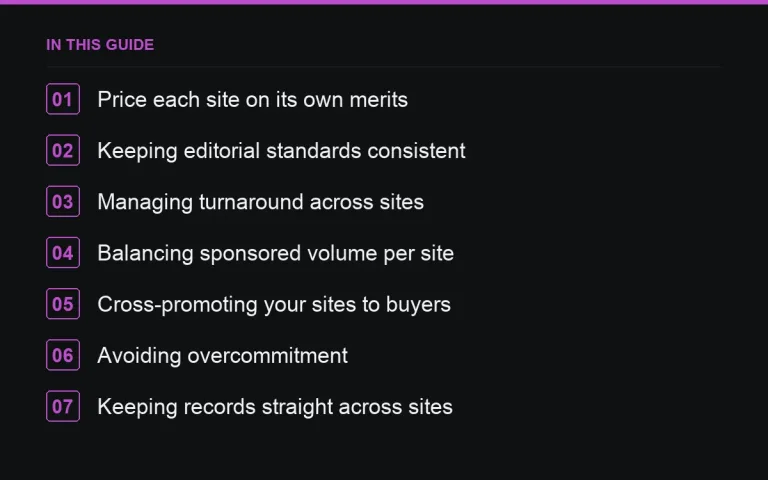
Price each site on its own merits
Don’t apply one blanket price across all your sites; each has its own metrics, traffic, and niche demand, and should be priced accordingly using the framework in https://successtoroad.com/blog/pricing-your-guest-posts-on-your-site/. A flagship site with strong traffic can command a very different price than a smaller companion site.
Keeping editorial standards consistent
Even if prices differ, apply the same underlying editorial rigor across every site you manage. A buyer who has a bad experience on one of your smaller sites will likely distrust your bigger one too, since they may not distinguish between your properties as clearly as you do.
Managing turnaround across sites
As order volume grows across multiple listings, turnaround time can slip if you’re not tracking deadlines carefully across properties. A simple shared system, even a basic spreadsheet or calendar, for tracking brief acceptance dates and delivery deadlines across all your sites keeps you from missing commitments; see https://successtoroad.com/blog/turnaround-time-and-why-fast-delivery-wins-orders/.
Balancing sponsored volume per site
Each site needs its own sensible ratio of sponsored to original content; see https://successtoroad.com/blog/how-many-sponsored-posts-is-too-many/. A niche blog and a broader site in your portfolio may support very different volumes without either looking diluted.
Cross-promoting your sites to buyers
Some buyers running a wider campaign may want placements across several relevant sites at once. If your properties span different niches, you may be able to serve a single buyer’s broader campaign, as long as each site’s content stays genuinely on-topic for its own audience.
Avoiding overcommitment
Taking on more listings than you can properly manage leads to slower turnaround, weaker editorial review, and eventually a reputation problem across all your sites, not just the neglected one. Scale deliberately, and only add a new listing once your existing ones are running smoothly.
Keeping records straight across sites
Separate income, orders, and expenses by site, even if they all ultimately feed into the same personal or business accounts. This makes it far easier to see which sites are actually worth your time and which are underperforming relative to the effort they take, and it simplifies the record-keeping covered in https://successtoroad.com/blog/taxes-and-invoicing-basics-for-publishers/.
When to retire an underperforming listing
Not every site you add will earn steadily. If a listing consistently gets little interest despite a fair price and clear description, it may be better to pause it and focus attention on your stronger properties rather than splitting effort across a site that isn’t earning its keep.
Coordinating standards across a small team
Once a portfolio grows large enough that you’re not personally reviewing every brief, write down your editorial checklist in enough detail that someone else could apply it consistently, referencing the same rules described in https://successtoroad.com/blog/editorial-standards-that-protect-your-rankings/. A portfolio’s reputation rests on every site meeting the same bar, not just the ones you personally oversee most closely.
Comparing performance across your portfolio
Once you’re running several sites, it’s worth periodically comparing order volume, average price, and rating trends across them side by side. This kind of comparison often reveals which types of sites, niches, or content approaches are actually working best for you, informing where to focus future effort or whether to add another similar site; see https://successtoroad.com/blog/growing-from-one-listing-to-a-publishing-business/.
Deciding which site gets your attention first
When time is limited, prioritise the site with the strongest current momentum, whether that’s order volume, ratings, or metric growth, rather than spreading equal effort across every property regardless of how it’s performing. A struggling secondary site can wait for a slower period while your strongest listing keeps compounding its advantage.
The underlying discipline
Running several sites well ultimately comes down to the same discipline as running one: clear terms, consistent standards, and honest communication, simply repeated across more properties and tracked a little more carefully so nothing falls through the cracks.
A practical starting point
If you’re weighing a second listing, get comfortable with your first site’s process before adding complexity; a second site rarely fixes problems that already existed on the first one, and often just multiplies them.
Final thought
A well-run single site is a stronger foundation than a poorly managed portfolio of several, and it’s always the better place to start before adding any more properties to the mix. Take the time to get the fundamentals right first, and scaling up will feel far less risky and far more manageable when you eventually decide to do it.
Where to go next
If you’re considering a second listing, review https://successtoroad.com/blog/the-free-listing-process/ and https://successtoroad.com/blog/verifying-site-ownership/ for what’s needed to add a new site. Return to https://successtoroad.com/blog/monetize-your-website-guide/ for the full process, or list an additional site at https://successtoroad.com/become-a-seller/ and check demand across niches at https://successtoroad.com/marketplace/.
Frequently asked questions
Should all my sites be priced the same?
No. Price each site based on its own metrics, traffic, and niche demand rather than applying a single rate across your whole portfolio.
How do I keep turnaround consistent across multiple sites?
A simple shared tracking system for brief acceptance dates and delivery deadlines across all your properties helps prevent missed commitments.
Can one buyer order across several of my sites?
Yes, as long as each site's content genuinely fits the buyer's brief and stays on-topic for its own audience.
How many sites can one publisher realistically manage?
It depends on your available time and process, but it's better to run fewer sites well than to overcommit and let turnaround and quality slip across all of them.
Put it into practice
Filter 54,483 websites by DR, traffic, niche and price, and order with escrow — you pay only after the link is live.
Browse the marketplace