Link Building Strategy for Long-Tail vs Head Terms
Head terms usually need sustained link investment while long-tail terms often rank on content quality with fewer or no dedicated links.
Not every page needs the same link building treatment, and one of the clearest dividing lines is whether a page targets a short, highly competitive head term or a longer, more specific long-tail query. Applying a uniform link strategy across both wastes effort in one direction or the other.
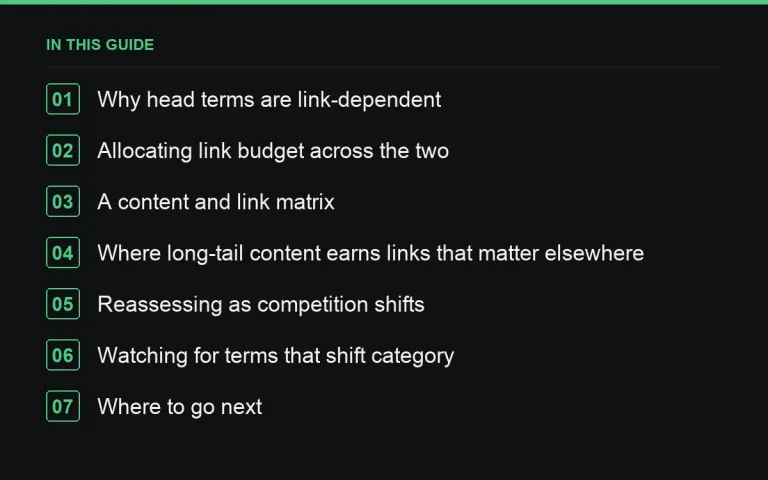
Why head terms are link-dependent
Short, high-volume, commercially valuable terms are contested by many sites, often including large, well-resourced competitors with substantial existing link profiles. Ranking competitively for these terms without a genuine link building effort is rare — content quality alone typically isn’t enough to overcome an authority gap at this level of competition. https://successtoroad.com/blog/forecasting-link-needs-from-serp-competition/ is particularly useful here, since head-term SERPs usually show a clear, sizeable link gap to close.
Why long-tail terms are often different
Longer, more specific queries tend to have less competition, partly because fewer sites bother targeting them directly and partly because search intent is narrower and easier to satisfy precisely. A well-written page answering a specific long-tail query can often rank reasonably well with a modest link profile or sometimes very few dedicated links at all, provided the site has some general baseline authority.
Allocating link budget across the two
- Concentrate deliberate, budgeted link building on your head-term priority pages, where the competitive gap genuinely requires it
- Let long-tail pages benefit from general site authority and internal linking rather than dedicated campaigns for each one
- Use long-tail content itself as a way to earn links that indirectly support head-term pages through https://successtoroad.com/blog/internal-linking-to-distribute-earned-authority/
A content and link matrix
| Term type | Content approach | Link approach |
|---|---|---|
| Head term | Comprehensive, competitive with current top results | Deliberate, budgeted, ongoing |
| Long-tail | Precise, directly answers the specific query | Mostly internal linking and general site authority |
Where long-tail content earns links that matter elsewhere
A genuinely useful long-tail page — a specific how-to, a niche comparison, a detailed answer to an unusual question — can become a linkable asset in its own right, attracting links because it’s useful, not because you pitched it. https://successtoroad.com/blog/content-that-earns-links/ covers building this kind of content deliberately, and the resulting links, routed through internal linking, can support your head-term pages indirectly.
Avoiding wasted effort on either end
The most common mistake is running dedicated outreach campaigns for long-tail pages that would likely rank fine without it, spreading budget thin across too many pages. The second most common is under-investing in head terms because “content should be enough,” which is rarely true in genuinely competitive spaces. https://successtoroad.com/blog/prioritising-pages-to-build-links-to/ helps avoid both by forcing an explicit judgment on which pages actually need dedicated link investment.
Reassessing as competition shifts
A long-tail term can become more competitive over time as more sites start targeting it, at which point it may need to move into the “requires dedicated links” category. Periodically re-checking your long-tail pages’ competitive landscape, alongside https://successtoroad.com/blog/quarterly-reviews/, catches this shift before a page that used to rank comfortably starts slipping.
Watching for terms that shift category
A term can move from long-tail to effectively head-term competitiveness as a topic becomes more mainstream or commercially attractive, and the reverse can also happen as interest in a niche topic fades. Periodically re-checking where your priority terms actually sit on this spectrum avoids continuing to treat a term as low-effort once it no longer is.
Mixed pages that don’t fit neatly either category
Some pages target a moderately competitive term that isn’t clearly head or long-tail. For these, a lighter, more measured link building effort than a full head-term campaign, but more deliberate than none at all, is often the right middle path — use the gap analysis and forecasting methods to judge the actual scale needed rather than defaulting to either extreme.
Bundling long-tail pages into reporting
Rather than tracking dozens of individual long-tail pages separately, group them for reporting purposes and watch the aggregate trend, which is more manageable and still gives a useful signal about whether this segment of the site is performing as expected.
A note on question-based long-tail queries
Long-tail queries phrased as direct questions are often particularly well suited to ranking on content quality alone, since they reward a page that answers the specific question clearly, which is a useful pattern to look for when deciding where dedicated link building isn’t necessary.
Finally, revisit your term classifications periodically as part of routine review, since the boundary between long-tail and head term shifts as search behaviour and competition evolve.
A brief periodic scan of your long-tail page group for any that have quietly become more competitive keeps this classification honest over time.
Where to go next
Match the link building effort to the actual competitiveness of the term, not a uniform policy across the whole site. Read https://successtoroad.com/blog/keyword-research-for-link-targets/ to build this distinction into your page prioritisation from the start, and use https://successtoroad.com/marketplace/ to source the more deliberate link building your head-term pages need.
Frequently asked questions
Do long-tail pages ever need dedicated link building?
Sometimes, particularly if the term becomes more competitive over time or if the page is commercially important despite low search volume. It's worth periodically rechecking rather than assuming it will never need attention.
Is content quality alone usually enough to rank for head terms?
Rarely in genuinely competitive spaces. Head terms are typically contested by sites with substantial existing authority, and closing that gap usually requires deliberate link building alongside strong content.
Should I run outreach campaigns for every long-tail page?
Generally no — this spreads budget thin across pages that likely don't need dedicated links. Reserve deliberate outreach for pages where competitive analysis actually shows a meaningful link gap.
Can long-tail content help head-term pages indirectly?
Yes, through internal linking. A long-tail page that earns links on its own can pass some of that authority to related head-term pages if the internal link structure connects them well.
Put it into practice
Filter 54,483 websites by DR, traffic, niche and price, and order with escrow — you pay only after the link is live.
Browse the marketplace