How Links Influence Brand Search Volume
Coverage that earns links also drives brand awareness, and brand search volume itself feeds back into overall site trust.
Link building and brand search are often managed by different people or treated as unrelated metrics, but they influence each other more directly than most reporting reflects. Coverage that earns a link usually also exposes your brand name to a new audience, some of whom later search for you directly.
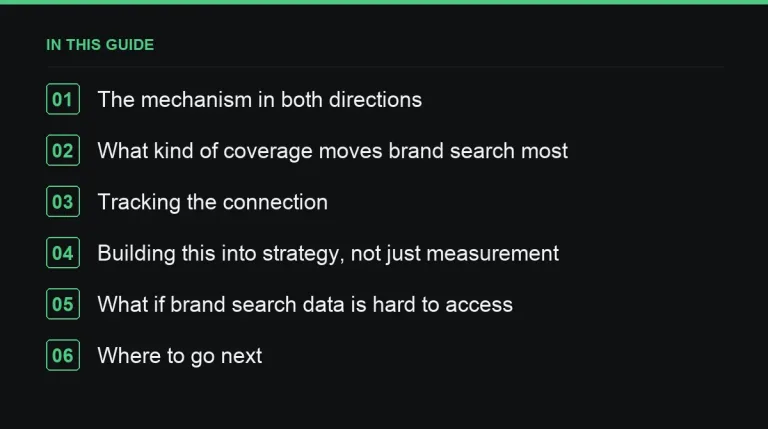
The mechanism in both directions
Being mentioned and linked from a relevant, well-read publication puts your brand name in front of readers who weren’t previously aware of you; some portion of them later search your brand name directly rather than clicking through immediately. Separately, brand search volume itself is understood to be one signal among many that search engines use to gauge a site’s overall recognition and trust, which can support rankings even on unrelated, non-branded terms.
Why this matters for how you measure link building
A guest post or piece of coverage that produces very little direct referral traffic can still be valuable if it moves brand search volume, and standard link-building ROI reporting often misses this because it only tracks direct clicks. https://successtoroad.com/blog/measuring-link-building-roi/ is worth revisiting with brand search volume as an additional metric rather than relying solely on referral traffic and rankings.
What kind of coverage moves brand search most
- Coverage in outlets your actual target audience reads regularly, not just high-authority sites generally
- Being named and described clearly, not just linked in passing without brand context
- Repeated mentions over time build recognition more than a single large placement
- Coverage tied to something genuinely newsworthy or useful, which readers are more likely to remember
Tracking the connection
Compare brand search volume trends against your coverage and placement timeline. It’s not always a clean one-to-one correlation, since brand search is affected by many things beyond link building, but a pattern of brand search upticks following notable coverage is a reasonable signal that the connection exists for your specific brand and audience.
A simple tracking approach
| Month | Notable coverage/placements | Brand search volume trend |
|---|---|---|
| Month 1 | Feature in a relevant industry outlet | Modest increase |
| Month 2 | Quiet month, routine placements only | Flat |
Building this into strategy, not just measurement
If brand search matters to your overall SEO health — see https://successtoroad.com/blog/brand-search-and-seo/ for why it does — it’s worth weighting outreach targets partly by audience overlap with your actual customers, not purely by domain authority. A site with a slightly lower authority score but a highly overlapping, engaged readership may move brand search more than a bigger, more generic site.
Digital PR’s role here specifically
Campaigns designed for broad coverage rather than a single placement tend to have an outsized effect on brand search, since the goal is deliberately reaching many relevant readers rather than one deep placement. https://successtoroad.com/blog/data-driven-pr-campaigns/ and https://successtoroad.com/blog/digital-pr-campaign-ideas/ are worth reviewing if brand search growth is a stated goal alongside links.
What if brand search data is hard to access
Not every site has easy access to detailed brand search volume trends. Where this data is limited, a rougher proxy — direct traffic trends, or simple periodic manual searches for your brand name to gauge visibility — can still give a general sense of whether coverage is moving the needle, even without precise volume figures.
Setting expectations about timing
Brand search upticks following coverage don’t always appear immediately — sometimes it takes weeks for enough of a publication’s audience to actually see and act on a piece for the effect to show up in search data. Give a reasonable window before concluding a placement had no brand search impact.
Separating branded and unbranded traffic in reporting
Make sure your analytics setup distinguishes branded from unbranded search terms clearly, since conflating the two can hide a genuine brand search increase within overall traffic figures that look flat for other reasons.
A note on smaller brands
Even a small, locally known brand has a meaningful brand search baseline worth tracking, and the same logic connecting coverage to brand search applies at a smaller scale, not just to nationally recognised names.
Finally, be patient with this metric, since brand search tends to build gradually across many smaller mentions rather than jumping dramatically after any single piece of coverage.
A simple shared record linking coverage dates to brand search trends, even informally, becomes a genuinely useful internal reference over time.
None of this requires sophisticated tooling — a simple spreadsheet cross-referencing dates is often sufficient to spot the pattern.
Treat this as an ongoing habit rather than a one-time analysis, since the value comes from watching the pattern across many placements over a long stretch of time.
Where to go next
Treat brand search as a genuine, if imperfectly measurable, output of link building and digital PR work, not a separate unrelated metric. Combine https://successtoroad.com/blog/journalist-outreach/ with an eye toward audience overlap rather than authority alone, and use https://successtoroad.com/marketplace/ to find publishers whose readership genuinely matches your target customer base.
Frequently asked questions
Can I directly attribute a rise in brand search to a specific piece of coverage?
Rarely with full certainty, since many factors affect brand search, but a pattern of brand search rising after notable coverage over time is a reasonable, if imperfect, signal of a real connection.
Does brand search volume actually affect rankings on unrelated terms?
It's understood to be one of several trust and recognition signals that can support overall site credibility, though it's not the only factor and shouldn't be relied on as a primary ranking lever on its own.
Should I prioritise reach over authority when picking coverage targets for brand search?
It's worth weighing both. A site with strong audience overlap with your actual customers can move brand search meaningfully even without being the highest-authority option available.
Is brand search volume worth reporting alongside traditional link building metrics?
Yes, especially for coverage or campaigns aimed at broad reach rather than a single high-authority link, since referral traffic and rankings alone can understate that kind of placement's actual value.
Put it into practice
Filter 54,483 websites by DR, traffic, niche and price, and order with escrow — you pay only after the link is live.
Browse the marketplace