Link Building for Software Development Companies
A guide to earning backlinks for software development agencies and custom-build companies through technical content and open source.
Software development companies — agencies and consultancies building custom software rather than selling a single product — earn links differently from SaaS brands. The content that works here is technical writing that showcases genuine engineering judgement, not marketing copy about “innovative solutions.”
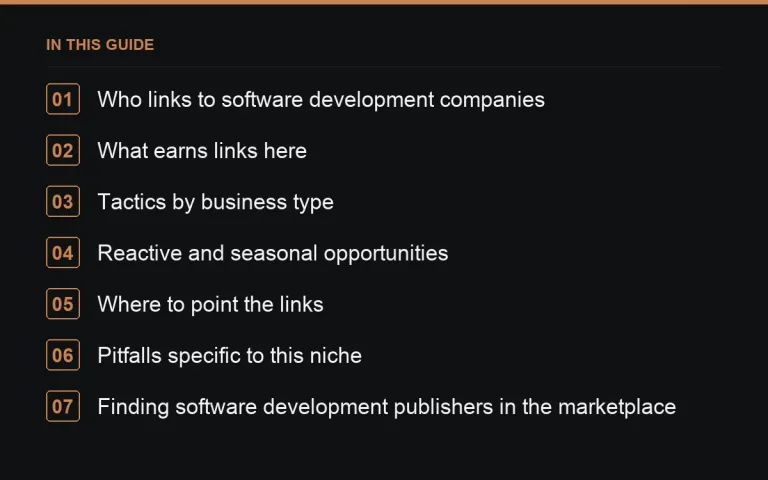
Who links to software development companies
Developer-focused publications and newsletters, open-source project maintainers and contributors, technical Q&A and community platforms, and industry analyst sites covering software vendors and consultancies make up the relevant publisher base. Individual developers with personal technical blogs are also a meaningful source, particularly for niche technology stacks.
What earns links here
- Detailed technical write-ups of real engineering problems and how they were solved
- Open-source libraries or tools that other developers adopt and reference
- Honest architecture or technology-choice explainers, including trade-offs considered
- Contributions to technical communities that build a reputation over time, not a single pitch
A well-maintained changelog or migration guide for a widely used dependency, even one you don’t own, can become a genuinely useful community reference if official documentation is thin, and this kind of contribution tends to earn goodwill and citations from developers dealing with the same upgrade path.
Tactics by business type
| Business type | Best-fit tactic | Notes |
|---|---|---|
| Custom software agency | https://successtoroad.com/blog/link-building-for-consultants/ | Much of the guidance for consultants applies directly to dev agencies |
| Open-source-first company | https://successtoroad.com/blog/community-and-forum-links/ | Genuine project usefulness drives organic links from adopters |
| Specialist tech-stack shop | https://successtoroad.com/blog/resource-page-link-building/ | Framework and language-specific resource pages cite deep technical guides |
| Dev tooling or infrastructure company | https://successtoroad.com/blog/calculators-and-tools-for-links/ | Free developer tools and generators are a strong linkable asset |
Where your team maintains a popular internal tool or script that isn’t quite ready for a full open-source release, consider documenting the underlying approach as a technical write-up even without releasing the code itself; the reasoning and trade-offs are often what other engineers find most valuable.
Reactive and seasonal opportunities
New language or framework releases, major platform outages, and security disclosures all create a fast-moving news cycle where developers with genuine expertise can earn coverage by publishing a clear technical take quickly. Annual “state of the ecosystem” content cycles are the seasonal equivalent, giving you a predictable window to contribute data or commentary.
It also helps to track which specific technical topics within your stack consistently generate the most engagement and links over time, and to weight future content investment toward those areas rather than spreading effort evenly across every technology you happen to use.
Where to point the links
Technical blog posts should link to relevant case study or capability pages, not the general homepage, matching what a reader interested in that specific technology would want next. Open-source project pages are strong, durable link targets in their own right and should be treated as a first-class part of the site, not an afterthought.
Speaking at, or simply attending and actively participating in, developer meetups and conferences in your specific technology niche builds the kind of personal credibility within a community that later makes a cold outreach pitch land as a warm one instead.
Pitfalls specific to this niche
Developer audiences are quick to detect marketing language dressed up as technical content; overuse of buzzwords without substance is actively counterproductive. Avoid pitching generic “top 10 programming tips” content to serious technical publications — it’s beneath their editorial bar and damages credibility for future pitches. And be careful with AI-generated technical content that hasn’t been reviewed by an actual engineer; factual errors are quickly and publicly called out in developer communities.
Finding software development publishers in the marketplace
https://successtoroad.com/niche/software-development/ in the marketplace groups relevant technical and developer-focused sites; check traffic and engagement carefully, since this niche has a wide quality range between genuinely active technical publications and low-effort content farms.
Turning engineering work into ongoing content
Most software development companies already produce the raw material for good technical content as part of normal project work; the gap is usually in capturing and publishing it, not in generating it. Build a lightweight habit of engineers writing a short internal note whenever they solve a genuinely interesting problem, then have someone review and adapt the strongest of these into public posts. This produces more authentic, differentiated content than assigning a marketer to write generic technical articles from scratch.
Treat your own engineering blog as a long-term asset rather than a one-off marketing push. A consistent publishing cadence, even a modest one, builds a body of work that developer communities gradually start citing on their own, particularly once a handful of posts have ranked well or been shared within a specific technical community.
Publishing a short, honest retrospective of an architecture decision that didn’t work out as expected, including what you’d do differently, tends to be shared and referenced more than a purely celebratory case study, since it offers genuinely useful judgement other engineers can learn from.
Where to go next
See https://successtoroad.com/blog/link-building-for-startups/ if you’re an early-stage dev shop on a limited budget, and https://successtoroad.com/blog/topical-relevance/ for why a well-matched technical blog often beats a larger general business publication.
Frequently asked questions
Do open-source projects really function as a link-building tactic?
Yes; a genuinely useful open-source tool or library tends to accumulate links organically from developers writing about their own use of it, without ongoing outreach.
How technical should guest content be for this niche?
As technical as your actual expertise allows. Developer audiences favour depth and specificity over broad, surface-level advice.
Is it worth reacting to major framework releases?
Yes, provided you can publish a genuinely useful, technically accurate take quickly; being early and correct matters more than being comprehensive in this fast-moving space.
What's a common mistake dev agencies make in outreach?
Pitching generic business or marketing publications with deeply technical content, or pitching technical publications with vague marketing language; match the content depth to the actual publication.
Put it into practice
Filter 54,483 websites by DR, traffic, niche and price, and order with escrow — you pay only after the link is live.
Browse the marketplace