Link Building for Politics and Policy Websites
A guide to earning backlinks for political commentary, policy research and civic advocacy publishers.
Politics and policy is one of the highest-scrutiny niches for link building: publishers, fact-checkers and readers alike hold this content to a stricter accuracy standard than almost any other category, and rightly so. Success here depends on genuine expertise and transparent sourcing more than any promotional tactic.
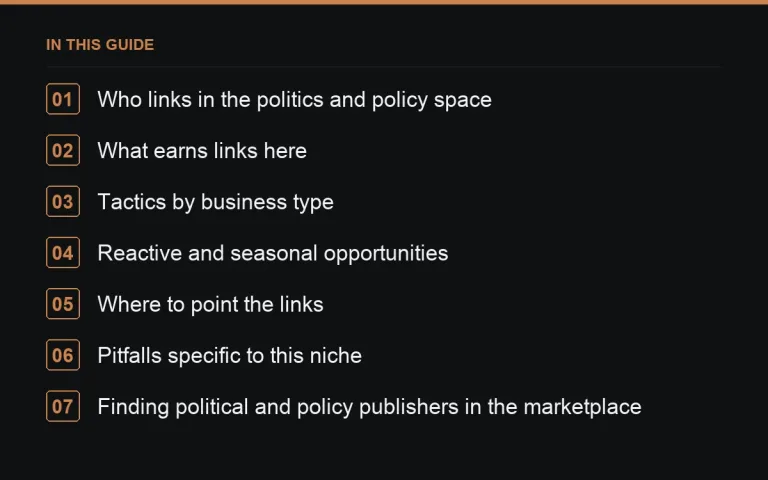
Who links in the politics and policy space
Policy research organisations and think tanks, political journalism and commentary sites, academic publications on governance and public policy, and advocacy organisations working on specific issues make up the core publisher base. Because political content is closely watched, publishers are cautious about who they cite.
What earns links here
- Original policy analysis with clearly sourced claims
- Explainers of legislative or regulatory processes that other sites reference for context
- Data journalism presented transparently, with sources cited rather than invented figures
- Expert commentary from genuinely qualified contributors, not marketing-driven “expert” content
A clearly maintained timeline of how a specific piece of legislation or policy has evolved, updated as it moves through each stage, becomes a reference that journalists return to repeatedly throughout the life of the story rather than only once.
Tactics by business type
| Organisation type | Best-fit tactic | Notes |
|---|---|---|
| Policy research organisation | https://successtoroad.com/blog/statistics-pages-for-links/ | Well-sourced data pages become a durable reference for journalists |
| Political commentary site | https://successtoroad.com/blog/expert-roundups/ | Cross-commentary between aligned or adjacent publications |
| Advocacy organisation | https://successtoroad.com/blog/link-building-for-media-publishers/ | Journalists covering a specific issue need accessible, quotable sources |
| Academic policy publication | https://successtoroad.com/blog/resource-page-link-building/ | Other researchers and educators cite well-documented policy resources |
Where a policy topic is genuinely complex, offering a background briefing call to a journalist ahead of publication, without requiring specific quotes to be used, often builds more long-term trust than only ever offering on-the-record soundbites.
Reactive and seasonal opportunities
Legislative sessions, election cycles and major policy announcements create a predictable, though intense, news cycle. Being genuinely prepared with accurate, well-sourced commentary ahead of known dates (a scheduled vote, a policy deadline) is far more effective than reacting after coverage has already run its course.
Where a topic is likely to attract commentary from multiple ideological perspectives, being explicit about your own organisation’s position and reasoning, rather than implying neutrality you don’t have, tends to be received more credibly over time than an inconsistent claim to objectivity.
Where to point the links
Send links to the specific analysis or explainer page relevant to the citing article, not a general homepage. Data and statistics pages, once established as reliable and well-maintained, tend to accumulate citations from journalists over an extended period without further outreach.
Maintaining a public record of past predictions or analysis, including instances where you were wrong, builds a level of credibility with sceptical political journalists that a purely promotional track record never achieves, since it demonstrates a genuine commitment to accuracy over being right in hindsight.
A clearly maintained list of past media appearances and publications, organised by topic, helps journalists quickly verify a spokesperson’s relevant expertise before deciding whether to include them in a story.
Pitfalls specific to this niche
Accuracy failures here are more consequential and more public than in almost any other niche; a single incorrect claim, once picked up and later corrected, can follow an organisation for years. Avoid framing content as neutral analysis when it’s genuinely advocacy, and vice versa — publishers and readers expect that distinction to be clear. Be especially cautious about disclosed funding and affiliations, since undisclosed interests in political content are treated far more seriously than in most commercial niches.
Finding political and policy publishers in the marketplace
https://successtoroad.com/niche/politics/ in the marketplace surfaces relevant commentary and policy-adjacent sites; check editorial history and traffic quality carefully, since this niche includes both serious research organisations and lower-quality opinion sites of limited value.
Handling scrutiny and bad-faith challenges
Content in this niche can attract organised, sometimes bad-faith pushback regardless of how carefully it’s sourced. Prepare for this by keeping detailed records of every source behind a published claim, so any challenge can be answered quickly and specifically rather than defensively. A calm, well-documented response to a challenge tends to preserve credibility even when the challenge itself was never made in good faith.
It’s also worth having a clear, written editorial policy on how corrections are handled and published, and pointing to it when a genuine error is identified. Publishers and readers alike judge organisations in this space partly on how they handle being wrong, not only on how often they are right.
Where you publish data or analysis that could be seen as favouring one side of a debate, proactively explaining your methodology and any limitations upfront tends to reduce the intensity of bad-faith challenges and makes it easier for cautious publishers to cite your work confidently.
Where to go next
See https://successtoroad.com/blog/eeat-and-links/ for why trust signals matter especially heavily here, and https://successtoroad.com/blog/google-penalties-and-links/ for the risks of unnatural link patterns in a niche that already receives heightened scrutiny.
Frequently asked questions
How important is source transparency in this niche?
Extremely; every factual claim should be traceable to a clear, checkable source. Publishers in this space routinely verify claims before citing them.
Can advocacy organisations still earn links from neutral outlets?
Yes, provided their content is factually accurate and clearly labelled as advocacy rather than presented as neutral analysis.
Is guest commentary a realistic tactic here?
Yes, for genuinely qualified contributors with real expertise, but expect a higher editorial bar and more fact-checking than in most other niches.
What happens if a factual error is published and later found?
It should be corrected transparently and promptly; credibility in this niche depends heavily on how errors are handled, not just on avoiding them entirely.
Put it into practice
Filter 54,483 websites by DR, traffic, niche and price, and order with escrow — you pay only after the link is live.
Browse the marketplace