Link Building for Environmental and Sustainability Brands
A guide to earning backlinks for environmental organisations, sustainability brands and climate-focused publishers.
Environmental and sustainability content sits under intense scrutiny for accuracy, given how often overstated claims in this space get publicly challenged. The publishers who matter most here reward genuine, well-sourced content and are quick to reject anything that reads as greenwashing.
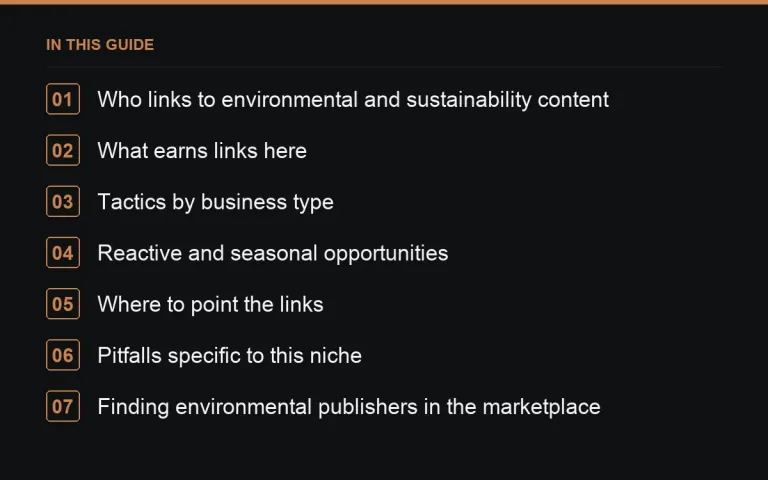
Who links to environmental and sustainability content
Environmental journalism and climate-focused media, sustainability-oriented business publications, non-profit and advocacy organisations working on environmental issues, and academic or research institutions studying environmental topics make up the core publisher base. Regional environmental news is also a meaningful source, particularly for local sustainability initiatives.
What earns links here
- Transparent, well-sourced sustainability reporting rather than vague claims
- Practical guides that help readers or businesses reduce environmental impact
- Original data presented honestly, with clear methodology and no invented figures
- Genuine partnerships with environmental organisations on shared initiatives
A clearly presented explainer of a specific environmental regulation or certification standard, kept updated as rules change, tends to be referenced repeatedly by both trade press and other organisations navigating the same compliance requirements.
Tactics by business type
| Business type | Best-fit tactic | Notes |
|---|---|---|
| Sustainability-focused brand | https://successtoroad.com/blog/statistics-pages-for-links/ | Transparent impact reporting pages are widely cited if genuinely credible |
| Environmental non-profit | https://successtoroad.com/blog/link-building-for-media-publishers/ | Climate journalists need accessible, quotable expert sources |
| Green product or service company | https://successtoroad.com/blog/resource-page-link-building/ | Genuinely useful sustainability guides referenced by lifestyle and business media |
| Environmental research organisation | https://successtoroad.com/blog/expert-roundups/ | Contribute peer-reviewed or well-documented findings to broader coverage |
Where your sustainability initiative involves a genuine trade-off or compromise, describing that honestly, rather than presenting every decision as a pure win, tends to be received more credibly by journalists who are used to more polished, less believable corporate sustainability messaging.
Reactive and seasonal opportunities
Major climate reports, environmental awareness dates, and extreme weather events all create predictable and reactive coverage windows respectively. Being prepared with accurate, well-sourced commentary ahead of known report release dates is more effective than scrambling to react once coverage is already underway.
Where third-party researchers or auditors have reviewed your practices, making that underlying report available in full, not just a summary, gives sceptical journalists the ability to verify claims themselves rather than relying solely on your own framing.
Where to point the links
Send links to specific impact reporting or guide pages relevant to the referring content, not a general homepage. Data and methodology pages, once established as credible, tend to accumulate citations over time from journalists and researchers alike.
Publishing a clear year-over-year comparison of your own environmental metrics, including years where performance declined, demonstrates a level of transparency that credible sustainability journalists specifically look for before deciding to cite an organisation’s self-reported data.
A plain-language summary accompanying any technical sustainability report helps general-interest publishers accurately represent findings that might otherwise be misreported if they only skim a dense technical document.
Pitfalls specific to this niche
Greenwashing — vague, unverifiable environmental claims — is the single biggest reputational risk in this niche and is increasingly called out publicly by journalists and readers. Never present estimated or aspirational figures as achieved results. Avoid partnering with organisations solely for a link without a genuine shared initiative; environmental publishers and non-profits are alert to transactional-feeling outreach. Be transparent about funding and affiliations, since undisclosed interests are treated seriously in this space.
Where possible, linking directly to the primary data source or study behind a sustainability claim, rather than only a summary, gives careful readers and journalists the ability to verify the claim themselves without extra correspondence.
Finding environmental publishers in the marketplace
https://successtoroad.com/niche/environment/ in the marketplace surfaces relevant sustainability and climate-focused sites; check editorial credibility and traffic quality carefully, since this niche includes both serious research-driven publications and lower-quality sites built mainly around vague sustainability content.
Documenting impact claims properly
Before publishing any environmental or sustainability claim, have a clear internal record of exactly what evidence supports it: the methodology, the scope, the date it was measured, and any limitations. This isn’t just good practice; it’s what allows you to respond credibly and quickly when a journalist or reader asks for the source, which happens more often in this niche than almost any other. A claim you can’t immediately substantiate when asked does more damage than simply not having made the claim at all.
Consider publishing a standalone methodology page alongside any impact reporting, separate from the marketing-facing summary. Journalists and researchers often look specifically for this kind of detail before deciding whether to cite a figure, and its absence is one of the more common reasons a genuinely accurate claim still fails to earn coverage.
Where third-party certification exists for your sector, pursuing and clearly displaying it gives publishers an independently verifiable credential to reference, which carries considerably more weight in outreach than a self-authored sustainability claim alone.
Where to go next
See https://successtoroad.com/blog/eeat-and-links/ for trust considerations that apply especially strongly here, and https://successtoroad.com/blog/topical-relevance/ for prioritising genuinely relevant environmental publishers.
Frequently asked questions
What's the biggest reputational risk in environmental link building?
Greenwashing: vague or unverifiable sustainability claims that get challenged publicly once scrutinised, damaging credibility well beyond the specific content in question.
Should sustainability data be self-reported or independently verified?
Independently verified is stronger where possible; if self-reported, methodology should be transparent and figures conservative rather than promotional.
Are climate report release dates a good outreach opportunity?
Yes, if you have a genuinely qualified expert able to comment on the findings quickly and accurately; being prepared ahead of the release date matters more than reacting afterward.
Do environmental non-profits accept commercial partnerships for links?
Some do, but only where there's a genuine shared initiative; purely transactional link requests are often declined by credible environmental organisations.
Put it into practice
Filter 54,483 websites by DR, traffic, niche and price, and order with escrow — you pay only after the link is live.
Browse the marketplace