Link Building for Computer Hardware and Software Brands
A guide to earning backlinks for computer hardware, peripheral and desktop software brands through tech press and reviewers.
Computers as a niche spans hardware manufacturers, peripheral makers, and desktop software companies, all competing for coverage from a tech press culture built almost entirely around independent review and benchmarking. Getting links here depends heavily on being willing to hand over genuine review access rather than just pitching press releases.
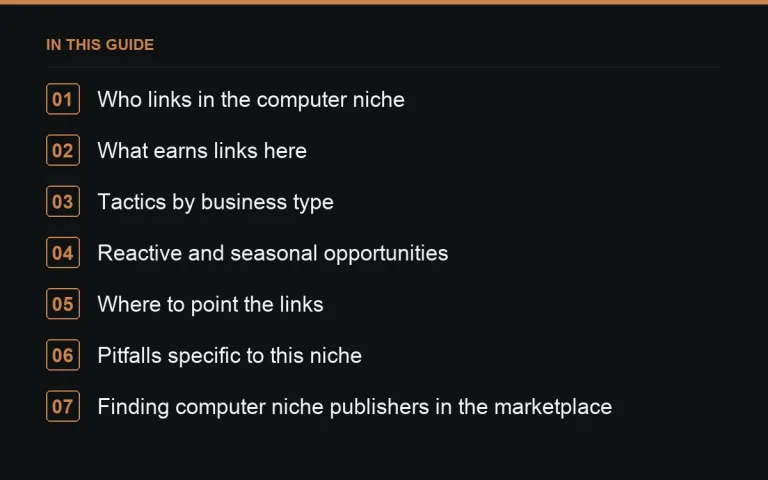
Who links in the computer niche
Tech review sites and YouTube-adjacent blogs, computing forums with an active editorial or news section, comparison and buying-guide sites, and enthusiast communities around specific hardware categories (peripherals, components, specific operating systems) make up the core publisher base.
What earns links here
- Review units and early access that let reviewers publish genuine, first-hand coverage
- Detailed spec sheets and comparison data reviewers can reference directly
- Software release notes and changelogs that trade press cites for context
- Compatibility and troubleshooting guides that forums link to when the same issue recurs
Long-running comparison and benchmark content, kept updated as new hardware releases, tends to accumulate links steadily over time from buying guides and forums that revisit the same comparison repeatedly rather than writing a new one from scratch each cycle.
Tactics by business type
| Business type | Best-fit tactic | Notes |
|---|---|---|
| Hardware manufacturer | https://successtoroad.com/blog/testimonial-link-building/ | Review-unit programmes are the standard route to tech press coverage |
| Peripheral brand | https://successtoroad.com/blog/resource-page-link-building/ | “Best of” buying guides are a durable, high-value link source |
| Desktop software company | https://successtoroad.com/blog/community-and-forum-links/ | Support and compatibility threads generate organic links when genuinely helpful |
| Computer retailer | https://successtoroad.com/blog/calculators-and-tools-for-links/ | Compatibility checkers and build calculators earn links from enthusiast sites |
Where a product spans multiple use cases — gaming, professional work, everyday use — providing reviewers with guidance on which specific use case their audience cares most about helps them write a more relevant, more useful review than a generic overview.
Reactive and seasonal opportunities
Major hardware launches, back-to-school and holiday buying-guide season, and component shortages or price shifts all create predictable coverage windows. Building relationships with reviewers before a launch (not after) is how review units turn into launch-day coverage rather than a delayed, lower-impact mention.
Where a review unit is genuinely limited in supply ahead of launch, being transparent with smaller outlets about allocation constraints, rather than leaving them uncertain, tends to preserve the relationship even when they don’t receive a unit that particular cycle.
Where to point the links
Send links from reviews to the specific product page under review, and from buying guides to category pages rather than the homepage. Support and compatibility content should link to the relevant software or driver download page, matching what the reader actually needs next.
Providing reviewers with a clear, honest list of known limitations alongside a review unit, rather than only strengths, is counterintuitive but tends to produce more balanced, more trusted coverage, and it protects the relationship when a reviewer inevitably discovers a limitation independently.
A concise, accurate one-page technical summary alongside a longer review unit briefing saves time-pressed reviewers from digging through a full specification sheet themselves, and increases the odds key details are represented accurately.
Pitfalls specific to this niche
Sending review units with strings attached (requiring positive coverage) damages relationships with credible reviewers and can lead to public callouts. Avoid over-reliance on a handful of very large tech outlets; smaller, specialised enthusiast sites often convert better and are easier to build a genuine relationship with, per https://successtoroad.com/blog/topical-relevance/. Watch for forums and comparison sites that exist mainly to host paid links disguised as “user reviews” — check engagement and moderation quality before pitching.
Finding computer niche publishers in the marketplace
https://successtoroad.com/niche/computers/ in the marketplace surfaces relevant tech and hardware sites; filter by traffic and DR to prioritise genuinely active review outlets, and use the https://successtoroad.com/compare/ tool to weigh a specialised enthusiast site against a larger general tech news outlet.
Managing a review-unit programme at scale
As a review programme grows, keep a simple tracking sheet of which reviewers received units, when, and what coverage resulted. This helps you identify your genuinely highest-value relationships over time rather than treating every reviewer as equally worth the cost of a unit. It also protects against the awkward situation of sending a second unit to a reviewer who never covered the first one, without any record of that history.
Consider a tiered approach: your most established relationships get early access ahead of public availability, while newer or smaller reviewers receive units alongside general availability. This rewards loyalty without shutting out the smaller, more specialised outlets that often provide the most engaged, purchase-ready readership relative to their size.
Where a product has a known limitation or an unresolved issue at launch, disclosing it proactively to reviewers rather than waiting for them to discover it independently tends to preserve trust and often results in more balanced, ultimately more favourable coverage once the issue is fixed in a later update.
Where to go next
See https://successtoroad.com/blog/competitor-backlink-analysis/ to identify which reviewers already cover competing hardware, and https://successtoroad.com/blog/link-building-kpis/ for tracking whether review coverage is translating into meaningful traffic and links.
Frequently asked questions
Is sending review units still an effective tactic?
Yes, it remains one of the most reliable ways to earn genuine, first-hand tech press coverage, provided there are no conditions attached to the coverage itself.
How do compatibility guides earn links passively?
Once a guide correctly documents a fix for a recurring issue, forums and support threads tend to link to it repeatedly over time without further outreach.
Should I focus on large tech outlets or niche reviewers?
Both have a place, but smaller, specialised reviewers often have more engaged, purchase-ready audiences and are easier to build an ongoing relationship with.
What's the risk of overly promotional software changelogs?
Framing every release as a major breakthrough undermines credibility with a technically literate audience that reads changelogs critically; plain, accurate descriptions perform better.
Put it into practice
Filter 54,483 websites by DR, traffic, niche and price, and order with escrow — you pay only after the link is live.
Browse the marketplace