Using Internal Links to Distribute Earned Authority
Internal linking determines how far earned authority spreads from your best-linked pages to the rest of the site.

External links earn authority for the specific page they point to, but internal linking is what decides whether that authority stays contained on one page or spreads to support the rest of the site. Many sites earn good external links and then let internal linking accidentally waste much of that value.
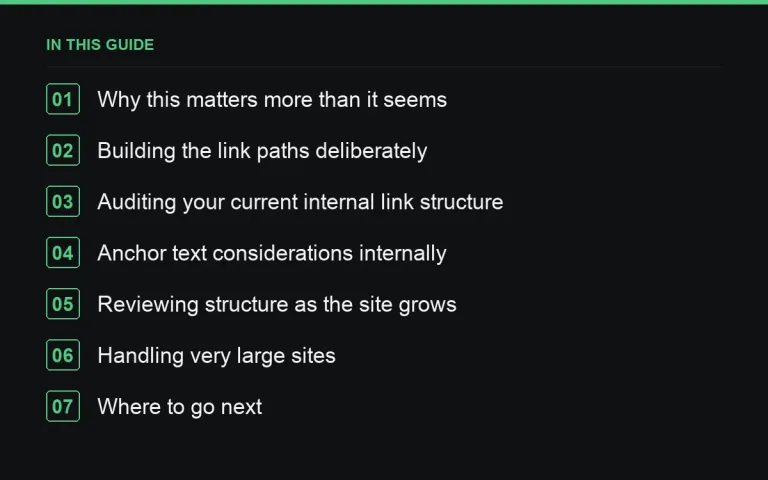
Why this matters more than it seems
A page with several strong external backlinks can act as a hub that passes some of that earned authority to other pages through internal links pointing outward from it. If that hub page has few or no internal links to your other priority pages, most of the earned value stays localised rather than lifting the pages you actually want to rank.
Identify your natural hub pages
Look at which pages already have the strongest external link profiles — these are usually pillar content, popular guides, or well-covered product categories. These pages deserve deliberate internal linking strategy, since they have the most authority to redistribute.
Building the link paths deliberately
- Link from strong hub pages to your actual priority pages, using descriptive, relevant anchor text
- Avoid burying important internal links in footers or generic navigation where they carry less contextual weight
- Keep the click depth from a hub page to a priority page as short as possible — ideally one click
- Update internal links when priority pages change, rather than leaving links pointing at superseded content
Content clusters as a structural approach
Organising related content into clusters — a comprehensive pillar page linked to and from several supporting pages on narrower subtopics — creates natural, defensible internal linking paths rather than ad hoc links added after the fact. https://successtoroad.com/blog/content-clusters-and-links/ covers building this structure from scratch if you don’t already have one.
Auditing your current internal link structure
Pull a list of your top external-link-earning pages and check how many internal links point from each one to your current priority pages. It’s common to find that a site’s most-linked page internally links mainly to old, low-priority content simply because that’s what existed when the page was written — this is a quick, high-leverage fix once identified.
A simple audit table
| Hub page | External link strength | Links to priority pages? |
|---|---|---|
| Popular guide A | Strong | No — links mostly to old posts |
| Popular guide B | Moderate | Yes — one relevant link |
Anchor text considerations internally
Internal anchor text carries less risk than external anchor text, since search engines don’t treat it as an external endorsement, but descriptive, varied anchor text still helps convey relevance more clearly than generic “click here” links. Keep it natural rather than exactly matching a target keyword every time.
How this interacts with external link building
This internal work directly increases the return on your external link building spend — if you’re about to invest budget in earning new links to a page, check first whether that page is well-positioned within your internal link structure to actually make use of them, and whether it in turn links onward to other priority pages once it has that authority.
Reviewing structure as the site grows
Internal link structure tends to decay as sites grow — new content gets added without updating older hub pages to reference it, and priority pages shift without a corresponding internal linking update. Build a periodic internal link review into https://successtoroad.com/blog/quarterly-reviews/ rather than treating the structure as a one-time setup.
Handling very large sites
On sites with thousands of pages, a full manual internal link audit isn’t practical. Focus the audit specifically on your handful of strongest external-link-earning pages and your current priority pages, rather than attempting a comprehensive site-wide review, which produces most of the value for a fraction of the effort.
Automating parts of the process
Some content management systems support automated related-content or contextual linking modules, which can help maintain reasonable internal link coverage as a site scales beyond what manual editing can sustain. These are a helpful supplement, but they shouldn’t fully replace deliberate, editorially chosen links from your strongest pages to your genuine priorities.
Training content writers on this habit
Build a simple checklist step into your content publishing process asking whether a new page links to and from relevant existing priority pages, so this doesn’t rely entirely on a periodic audit catching gaps after the fact.
A note on orphaned pages
While auditing, watch for pages with very few or no internal links pointing to them at all — these can’t benefit from any distributed authority regardless of how strong your hub pages are, and are worth fixing as a first, easy step before the more nuanced prioritisation work.
Where to go next
Earned external authority only helps the whole site if internal linking actually distributes it. Pair this with https://successtoroad.com/blog/prioritising-pages-to-build-links-to/ to make sure the pages receiving internal link equity are the ones worth prioritising, and https://successtoroad.com/marketplace/ when you’re ready to earn new external links to feed into a structure that’s already set up to distribute them well.
Frequently asked questions
Does internal linking pass the same kind of value as external backlinks?
Not identically — internal links help distribute authority and signal relevance within a site, but they don't carry the independent trust signal an external endorsement does. Both matter, for different reasons.
How many internal links should point to a priority page?
There's no fixed number; the goal is that a page is reachable within a reasonably short click path from your site's strongest, most externally-linked pages, with contextually relevant anchor text.
Should I use exact-match anchor text for internal links?
Descriptive, relevant anchor text is fine and often more natural-reading than always matching an exact keyword. Vary it rather than repeating the identical phrase across every internal link to the same page.
How often should internal link structure be reviewed?
At least as often as your priority pages list changes, commonly quarterly, since new content and shifting priorities both cause internal link structures to drift out of alignment with current goals.
Put it into practice
Filter 54,483 websites by DR, traffic, niche and price, and order with escrow — you pay only after the link is live.
Browse the marketplace