Improving Your Site’s Metrics to Earn More
Legitimate ways to grow your site's authority and traffic so you can justify higher guest post prices.

The fastest way to earn more from guest post sales isn’t better negotiation tactics; it’s genuinely improving the metrics buyers actually check. This post covers legitimate, sustainable ways to do that.
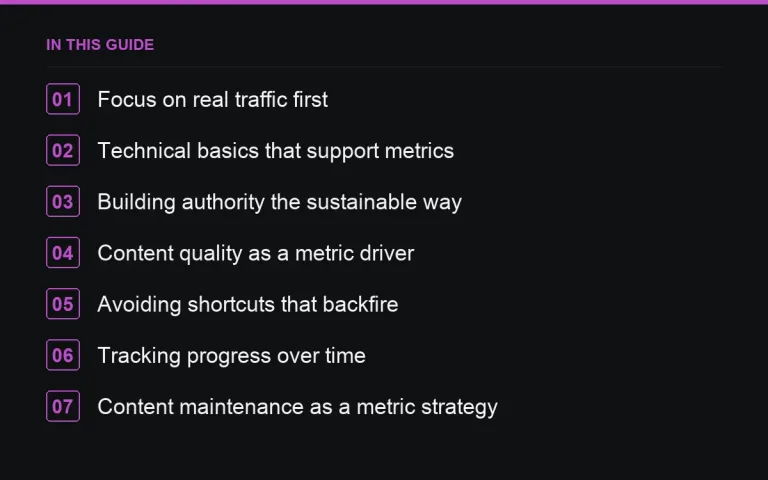
Focus on real traffic first
Publishing your own consistent, useful content is the most durable way to grow organic traffic, which in turn supports higher domain authority over time. A site that only ever hosts sponsored content rarely grows its own traffic base, which caps how much you can eventually charge; see https://successtoroad.com/blog/how-many-sponsored-posts-is-too-many/.
Technical basics that support metrics
- Fast page load times and a mobile-friendly layout.
- Clean internal linking between your own related articles.
- No broken links or orphaned pages dragging down crawl efficiency.
- A logical, consistent site structure that search engines can index easily.
Building authority the sustainable way
Publishing genuinely useful, original content that other sites want to reference naturally builds authority over time, more reliably than any shortcut. This overlaps with general SEO practice rather than anything specific to monetization; see https://successtoroad.com/blog/publisher-seo-basics/ if that phrase exists in your broader reading, or start from your own content calendar.
Content quality as a metric driver
Search engines and readers both respond to depth, accuracy, and usefulness over thin, repetitive content. Regularly updating older posts that have started to underperform is often more efficient than only publishing new material; see https://successtoroad.com/blog/content-quality-and-buyer-ratings/ for how quality connects to buyer perception too.
Avoiding shortcuts that backfire
Buying links to your own site, stuffing content with keywords, or any manipulative tactic aimed purely at inflating a metric tends to be short-lived and can actively damage your site’s standing once identified. The same editorial discipline you apply to buyers’ content should apply to your own.
Tracking progress over time
Check your key metrics periodically rather than constantly, and connect improvements to pricing decisions; see https://successtoroad.com/blog/raising-prices-as-your-metrics-grow/. Real improvement tends to be gradual, not sudden, so judge progress over months rather than days.
Content maintenance as a metric strategy
New content isn’t the only lever. Reviewing older posts that have slipped in rankings and updating them with more current, more thorough information often produces a better return than publishing something entirely new, especially for a site with a sizeable back catalogue. This also gives you more strong, relevant pages to offer for link insertions; see https://successtoroad.com/blog/pricing-link-insertions/.
How metric improvement supports your monetization overall
Stronger metrics feed directly into nearly everything else covered in this guide: a higher price you can defend, a listing that converts better, and a stronger position when negotiating with buyers; see https://successtoroad.com/blog/what-buyers-look-for-in-a-listing/.
Realistic timelines for improvement
Meaningful metric growth tends to take months, not weeks, and it compounds with consistent effort rather than a single burst of activity. Set a periodic review point, such as quarterly, to check whether your traffic and authority are trending in the right direction, and adjust your content or technical priorities based on what that review actually shows rather than on assumptions about what should be working.
Improving metrics across a portfolio
If you run more than one site, apply the same improvement discipline to each rather than only your best-performing property. A smaller site’s metrics can often be improved faster precisely because it’s starting from a lower base, and even modest gains there can unlock a meaningful price increase; see https://successtoroad.com/blog/multi-site-publishers/ for managing this across several sites at once.
Metrics as a byproduct of good practice, not the goal itself
It’s worth remembering that strong metrics are really a byproduct of running a genuinely good site: useful content, a clean technical setup, and a sensible approach to monetization. Chasing a specific number directly, without the underlying substance, rarely produces durable results, whereas focusing on the fundamentals tends to move the numbers in the right direction as a natural consequence.
Patience pays off here
Publishers who stay consistent with genuine improvement work, even when progress feels slow month to month, tend to end up in a noticeably stronger position after a year or two than those who chase quick, unsustainable shortcuts along the way.
A closing summary
Better metrics aren’t a separate project from running a good site; they’re simply what happens when a good site keeps doing the fundamentals well over time.
One more note
Track your progress in writing rather than by impression alone, since a written record makes it far easier to notice genuine improvement as it accumulates month over month, especially across a long stretch of time. It also makes it much easier to justify a price increase with genuine confidence once the moment for that actually comes around, rather than guessing at whether the timing is right.
Where to go next
As your metrics improve, revisit your listing and pricing to reflect the new reality; see https://successtoroad.com/blog/writing-a-listing-description-that-sells/ and https://successtoroad.com/blog/pricing-your-guest-posts-on-your-site/. Return to https://successtoroad.com/blog/monetize-your-website-guide/ for the full process, or benchmark against strong listings at https://successtoroad.com/top-publishers/ and https://successtoroad.com/marketplace/.
Frequently asked questions
What's the single best way to improve my site's metrics?
Publishing consistent, genuinely useful original content is the most durable driver of both traffic and authority over time.
Do technical fixes like page speed actually matter for metrics?
Yes, technical basics like load time, mobile friendliness, and clean internal linking support both search performance and overall site health.
Should I buy links to boost my own site's authority?
No. Manipulative shortcuts tend to be short-lived and can damage your site's standing once identified, undermining the same standards you apply to buyers.
How often should I check my metrics?
Periodically, such as every few months, rather than constantly. Real improvement is usually gradual and better judged over a longer stretch of time.
Put it into practice
Filter 54,483 websites by DR, traffic, niche and price, and order with escrow — you pay only after the link is live.
Browse the marketplace