Handling Guest Post Revision Requests
How to handle revision requests so they stay quick, fair, and don't blow up your turnaround time.
Revision requests are a normal part of running guest post orders, but unmanaged, they can turn a quick order into a slow, frustrating back-and-forth. A clear revision policy set up front keeps this part of the process smooth for both sides.
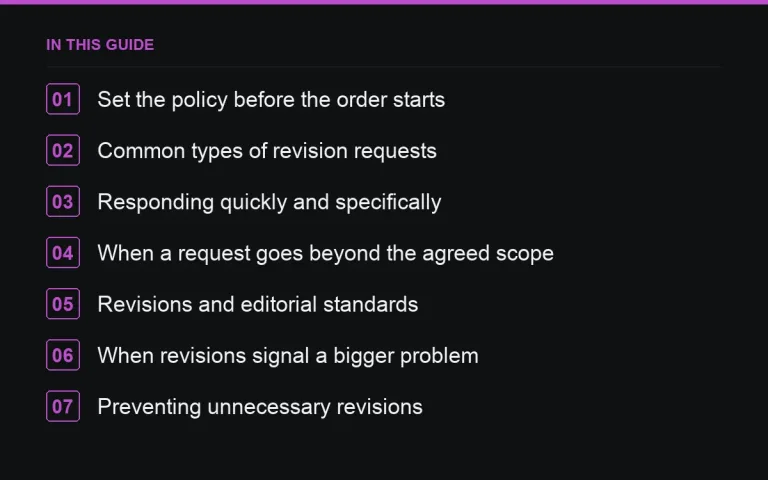
Set the policy before the order starts
State in your listing how many rounds of revision are included and what counts as a reasonable revision versus a full rewrite. This avoids disputes later about whether a request is within scope; see https://successtoroad.com/blog/writing-a-listing-description-that-sells/ for where this belongs in your listing.
Common types of revision requests
- Wording or tone adjustments to better match the buyer’s brand voice.
- Anchor text or link placement changes.
- Requests to shorten or expand specific sections.
- Factual corrections the buyer has flagged.
Responding quickly and specifically
Turn revisions around fast, since buyers are often working against their own deadlines. Ask for specific, line-level feedback if a request arrives vague, rather than guessing at what needs to change; this reduces the number of revision rounds needed overall. See https://successtoroad.com/blog/communicating-with-buyers-through-order-messages/ for how to ask clarifying questions efficiently.
When a request goes beyond the agreed scope
If a buyer asks for a full rewrite or additional links beyond what was originally agreed, it’s fair to treat that as a new request rather than a free revision. Explain the distinction clearly rather than silently absorbing extra work, which just trains buyers to expect unlimited revisions going forward.
Revisions and editorial standards
Don’t let a revision request push content outside your own editorial rules, such as adding excessive anchor text or an off-topic tangent. Hold the same standards during revisions that you applied when first accepting the brief; see https://successtoroad.com/blog/editorial-standards-that-protect-your-rankings/.
When revisions signal a bigger problem
Repeated, escalating revision requests from the same buyer sometimes point to a brief that was never clearly scoped in the first place, or occasionally to a buyer who’s simply difficult to satisfy. If it starts to feel unreasonable, see https://successtoroad.com/blog/dealing-with-disputes-fairly/ for how to handle disagreements that go beyond normal revisions.
Preventing unnecessary revisions
Many revision rounds are avoidable if the original brief was reviewed carefully before acceptance and any ambiguity was cleared up with a question rather than a guess; see https://successtoroad.com/blog/accepting-and-rejecting-briefs/. A short confirmation message summarising your understanding of the brief before you start writing or publishing can catch mismatches early, before they turn into a formal revision request.
Revisions on link insertions versus full posts
A revision on a link insertion is usually a small, fast fix, such as adjusting anchor text or moving the link to a better spot in the paragraph. A revision on a full guest post can be more involved if it touches structure or tone rather than a single detail. Treat the two differently in your internal turnaround expectations, and make sure your stated policy covers both cases; see https://successtoroad.com/blog/pricing-link-insertions/.
Keeping revision history organised
For a longer or more complex order, keep a simple version note of what changed at each round, so you don’t accidentally revert an earlier fix while addressing a new request. This is a small habit, but it prevents the frustrating situation where a buyer’s second revision request undoes progress from the first round because the changes weren’t tracked clearly.
Revisions as a quality signal, not just a cost
A publisher who handles revisions smoothly and without friction often earns more repeat business than one who resists every request, even if the underlying content quality is similar. Buyers remember how easy or difficult it was to get a piece exactly right, and that experience feeds directly into the ratings covered in https://successtoroad.com/blog/content-quality-and-buyer-ratings/.
Setting the right tone for a revision reply
Acknowledge the specific request rather than a generic “noted,” and confirm your understanding of exactly what’s changing before you make the edit. This small step avoids the frustrating scenario where you deliver a revised version that doesn’t quite match what the buyer actually meant, which just triggers another round and stretches out an order that should have been quick.
Treating revisions as part of the service, not an inconvenience
A reasonable amount of revision is simply part of what buyers are paying for when they order a guest post. Framing it that way internally, rather than as an unwelcome extra task, tends to produce a more patient, more useful response than treating every request as a burden to get through as quickly as possible.
A short closing note
A clear policy, applied consistently, is what keeps revisions from becoming a source of friction on either side of an order.
Final thought
Handled well, a revision round strengthens rather than damages the relationship with a buyer.
Where to go next
Once revisions are settled and the buyer approves the content, move to publication and payment; see https://successtoroad.com/blog/delivering-the-live-url-and-getting-paid/. Return to https://successtoroad.com/blog/monetize-your-website-guide/ for the full process, or check current order volume at https://successtoroad.com/marketplace/.
Frequently asked questions
How many revision rounds should I include?
State a specific number in your listing, commonly one or two rounds, so both sides know the scope before the order starts.
What if a buyer asks for changes beyond the original scope?
Treat it as a new request rather than a free revision, and explain the distinction clearly to the buyer.
Should revisions ever override my editorial standards?
No. Apply the same standards during revisions as you did when accepting the original brief, even under pressure from the buyer.
What if revision requests keep escalating?
That often signals a brief that wasn't clearly scoped up front. If it becomes unreasonable, treat it as a dispute rather than an endless revision cycle.
Put it into practice
Filter 54,483 websites by DR, traffic, niche and price, and order with escrow — you pay only after the link is live.
Browse the marketplace