Guest Posting on Dutch-Language Websites
The Dutch-speaking market is compact, affluent and direct. Here's how to build links there without overselling to a skeptical audience.
The Dutch-speaking market covers the Netherlands and Flanders, the Dutch-speaking region of Belgium. It’s compact compared to the major European languages, digitally advanced, and affluent, with readers who value directness and have little patience for marketing fluff — a trait worth keeping in mind for every piece of content you place there, not just the outreach emails.
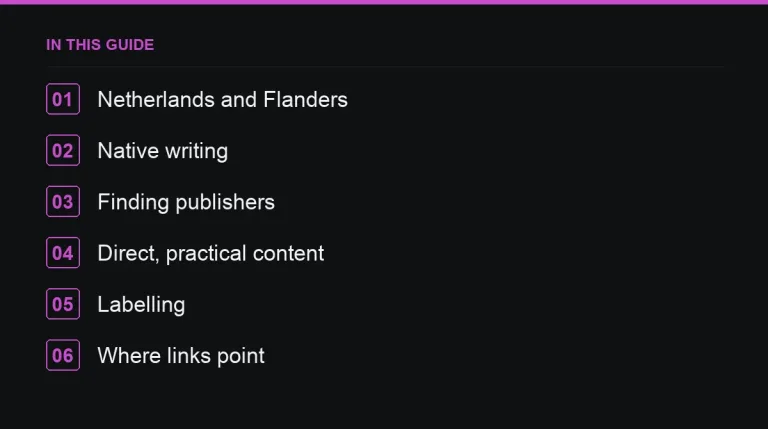
Netherlands and Flanders are related, not identical
Dutch as spoken and written in the Netherlands and Flemish Dutch differ in vocabulary, tone and some idiom, and each region has its own distinct media landscape. Choose publishers based on where your customers specifically are rather than treating “Dutch-language” as a single interchangeable pool, the same principle covered for other split markets in our French-language guest posting guide.
Native writing is non-negotiable
Dutch editors expect genuinely native, natural writing rather than content that merely uses correct grammar. Many Dutch readers also read English comfortably, which sometimes tempts advertisers into thinking English content might pass on a Dutch site — it won’t with a serious editor, and content for Dutch sites should always be written in Dutch, specifically for a Dutch readership rather than adapted from an English original.
Finding publishers in a smaller market
Browse Dutch-language sites by niche in the marketplace. Because the overall market is smaller than French, German or Spanish, there are fewer sites available per specific niche, so genuine relevance sometimes means broadening slightly to adjacent topics rather than insisting on an exact niche match, following the flexibility principle discussed in our topical relevance guide.
- Confirm whether a site’s audience is primarily Dutch or Flemish before pitching a specific angle.
- Expect a smaller total pool of sites than in larger European languages — plan outreach volume accordingly.
- Favour clear, practical article angles over anything that reads as a sales pitch.
- Check that sponsored content is labelled, as required under local advertising codes.
Direct, practical content wins
Dutch audiences generally favour clear, practical, no-nonsense content that gets to the point quickly rather than building up to a conclusion through several paragraphs of context. Guest articles that state the useful information early and support it with specifics tend to perform noticeably better with both editors and readers than pieces written in a more discursive or promotional style.
Labelling and disclosure
Advertising codes in both the Netherlands and Belgium expect sponsored content to be clearly recognisable to readers as such. Professional Dutch and Flemish publishers label sponsored posts appropriately and often apply suitable link attributes, a pattern consistent with the approach described in our link attributes guide.
| Region | Note |
|---|---|
| Netherlands | Larger publisher pool, more niche variety |
| Flanders (Belgium) | Smaller pool, distinct regional media and vocabulary |
Where links should point
Point Dutch links at properly localised Dutch-language pages (nl-NL or nl-BE as appropriate) with correct hreflang tags, following the same setup described in our international link building guide. A Flemish reader landing on a page clearly written for the Netherlands, or vice versa, is a small but noticeable mismatch that undermines trust.
What to expect from budget and volume
Because the total pool of Dutch and Flemish sites is smaller than in larger European languages, expect to pay reasonably close attention to individual relationships rather than running a high-volume, spreadsheet-driven outreach campaign. A handful of strong, recurring relationships with relevant Dutch publishers will typically outperform a scattershot approach across dozens of loosely-relevant sites, simply because there are fewer genuinely good options to spread effort across in the first place.
Budget expectations should also account for the market’s affluence: Dutch and Flemish publishers with genuinely engaged, high-value audiences are not necessarily cheap just because the country is smaller than Germany or France, and unusually low prices are as worth scrutinising here as anywhere else.
It’s also worth allowing extra lead time for scheduling, since editorial calendars at smaller Dutch and Flemish sites are often managed by one or two people rather than a dedicated commissioning team. A proposal sent with a tight deadline is more likely to be declined outright than one that gives the editor a comfortable window to fit it into an existing schedule.
Finally, don’t mistake reserved communication style for disinterest. Dutch and Flemish editors often reply briefly and to the point, without the warmer small talk common in some other markets, and a short, factual response confirming a placement should be read as agreement, not lukewarm interest. Judge the relationship by whether commitments are kept, not by how much enthusiasm the emails convey.
This directness extends to feedback as well. If a Dutch or Flemish editor asks for changes to a draft, the request is usually specific and easy to act on, without the softer framing some other markets use to cushion criticism. Treat it as useful, efficient editorial input rather than a sign the relationship is off to a poor start.
Where to go next
For other compact but valuable European markets, see our guides on Turkish-language guest posting and Italian-language guest posting. To shortlist Dutch and Flemish publishers directly, browse Dutch-language sites in the marketplace.
Frequently asked questions
Is Dutch the same in the Netherlands and Belgium?
It's the same underlying language but with real differences in vocabulary, tone and idiom, plus entirely separate media landscapes in each region. Match your writers and target publishers to whichever market your customers are actually in.
Should I publish English content on Dutch sites?
No. Write in Dutch specifically for Dutch or Flemish readers, even though many of them read English comfortably, since serious editors expect genuinely native content rather than an English piece submitted as-is.
Are there enough Dutch sites for niche link building?
Fewer per specific niche than in larger languages like German or French, so plan for a smaller total pool and consider broadening to genuinely adjacent topics when an exact niche match isn't available.
Do Dutch readers respond differently to content style?
Yes. Dutch audiences generally favour clear, direct, practical content that gets to the useful information quickly, and tend to respond poorly to anything that reads as an extended sales pitch or excessive buildup.
Is sponsored content labelling required in the Netherlands and Belgium?
Yes, under advertising codes in both countries that expect sponsored content to be clearly recognisable to readers. Reputable publishers label it appropriately, which is a sign of quality rather than a limitation.
Put it into practice
Filter 54,483 websites by DR, traffic, niche and price, and order with escrow — you pay only after the link is live.
Browse the marketplace