Guest Posting on Italian-Language Websites
Italy has strong regional media and particular expectations for editorial quality. Here's how to build Italian links that actually work.
Italy has a strong and somewhat fragmented publishing culture, spanning national outlets, regional newspapers and highly specialised niche sites that punch well above their traffic numbers within their subject area. Italian link building works best when it leans into that structure: native content, genuinely local angles, and publishers whose audience is verifiably in Italy rather than assumed from the domain.
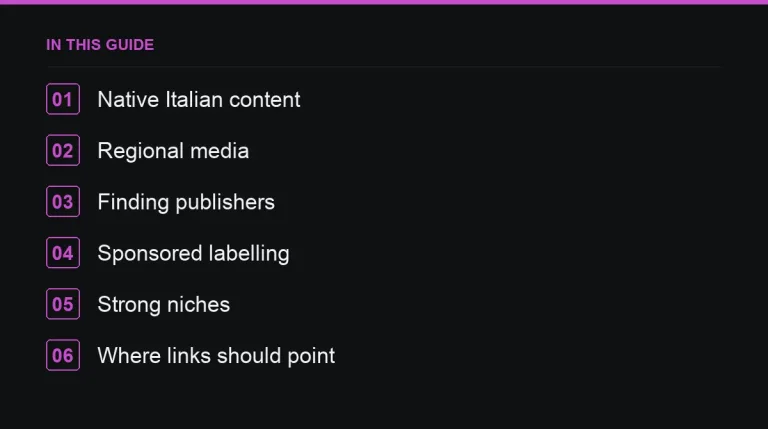
Native Italian content, written for the niche
Use native Italian writers rather than translators. Italian readers and editors notice translated phrasing quickly, and serious editors reject it outright rather than lightly editing it into shape. Tone also varies considerably by niche in Italian publishing — fashion and food content reads in a noticeably different register from finance or technology writing, so match your writer’s background to the topic, not just the language.
The strength of regional media
Italy’s regions each support strong local publications with genuinely engaged local readerships, and for businesses serving a specific region, regional news and lifestyle sites can be considerably more relevant than national outlets with broader but shallower reach. This mirrors the logic in our local SEO links guide, applied at the scale of an Italian region rather than a city.
Finding publishers with real Italian audiences
Browse Italian-language sites by niche and confirm that traffic genuinely comes from Italy, or from Italian-speaking Switzerland specifically if that’s part of your target market. Look closely at recent posts for editorial quality and consistency rather than judging from a single showcase article the publisher may have supplied for exactly this purpose.
- Check traffic-by-country data before assuming a .it domain means an Italian audience.
- Read at least five to ten recent articles, not just the one the site offers as an example.
- Confirm the niche matches closely — Italian readers expect specialist depth in strong categories.
- Look for regional relevance if your business serves a specific part of Italy.
Sponsored content labelling
Advertising self-regulation in Italy expects sponsored content to be clearly recognisable to readers as such. Reputable publishers label sponsored posts appropriately and apply suitable link attributes — see our guide on link attributes for what this typically looks like in practice and why it’s a sign of quality rather than a limitation.
Where Italian publishing is genuinely strong
Italian audiences are especially engaged around food, fashion, design, travel and motoring, categories supported by a large number of specialist publications with real, dedicated readerships. Matching your niche closely to one of these strong categories, following the principles in our topical relevance guide, tends to produce noticeably better results than a generic approach.
| Category | Publishing strength in Italy |
|---|---|
| Food and wine | Very strong, many specialist blogs and magazines |
| Fashion and design | Very strong, national and regional coverage |
| Travel | Strong, both national and regional |
| Automotive | Strong, dedicated enthusiast press |
| Technology | Moderate, smaller but active niche sites |
Working with Italian editors
Italian editors, particularly at regional and niche publications, often respond well to a personal, relationship-based approach rather than a purely transactional pitch. A short introductory exchange before proposing specific content tends to land better than an immediate, formal proposal, especially with smaller family-run publications that still make up a meaningful share of the Italian niche media landscape. Patience pays off here: response times can be slower than in larger, more commercialised markets, but the relationships that result tend to be more durable and open the door to repeat placements.
It also helps to be specific about why you approached that particular publication rather than sending an obviously generic template. Reference a recent article, explain why your proposed topic fits their existing coverage, and keep the pitch itself short. Italian editors, like most editors, are more receptive to a proposal that shows you’ve actually read their site than to one that could have been sent to a hundred other publications unchanged.
Keep expectations realistic on turnaround too. Smaller regional and specialist Italian publications are often run by one or two people alongside other work, and a submission can sit for several weeks before it’s reviewed. Following up politely once, after a reasonable interval, is normal practice; repeated follow-ups within days of the first message tend to work against you rather than for you.
None of this means Italian outreach is slow across the board — larger national outlets with dedicated commissioning editors often move faster than smaller specialist sites — but building slack into your project timeline for the specialist end of the market will save you a lot of unnecessary anxiety about placements that simply haven’t been reviewed yet.
Where links should point
Point Italian links at properly localised Italian-language pages with correct hreflang, not at your default-language pages, following the same technical approach outlined in our international link building guide. Italian users and Italian search results both respond better to content clearly built for them.
Where to go next
For similar principles applied to other European markets, see our guides on French-language guest posting and German-language guest posting. To find vetted Italian publishers, browse Italian-language sites in the marketplace, filtering by niche and confirmed traffic country.
Frequently asked questions
Are regional Italian sites worth it?
For regionally-focused businesses, often more than national sites, because the audience match is closer and the readership is genuinely engaged with local content. Don't dismiss a regional site just because its overall traffic looks smaller.
Can I publish English content on Italian sites?
Italian sites publish in Italian for Italian readers, and editors expect submissions in Italian too. Use native Italian writers rather than submitting English content or a machine translation of it.
Which niches are strong in Italy?
Food and wine, fashion, design, travel and motoring all support a large number of specialist Italian publications with genuinely engaged readerships, making them easier to place relevant guest content in than more generic categories.
How do I verify an Italian site's real audience?
Check traffic-by-country data directly rather than trusting the .it domain extension, and read several recent articles for editorial consistency rather than relying on a single showcase piece the publisher may supply for outreach purposes.
Do Italian publishers label sponsored content?
Reputable ones do, under Italian advertising self-regulation, which expects sponsored content to be clearly recognisable to readers. Treat clear labelling as a sign of a trustworthy, professional publisher rather than a drawback.
Put it into practice
Filter 54,483 websites by DR, traffic, niche and price, and order with escrow — you pay only after the link is live.
Browse the marketplace