Editorial Standards That Protect Your Rankings
How clear editorial standards keep your monetization sustainable instead of damaging your own rankings.

Selling guest posts and links is only sustainable if it doesn’t damage the site doing the selling. Editorial standards are the guardrails that keep monetization from quietly turning your site into something search engines, and your own readers, trust less over time.
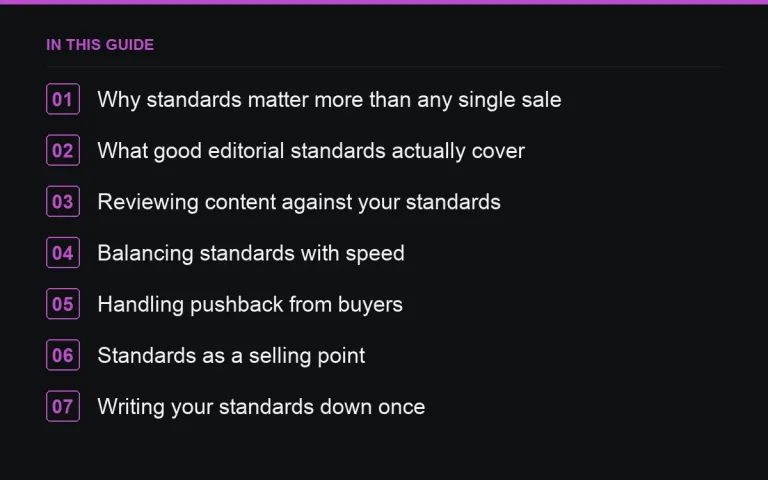
Why standards matter more than any single sale
A site that accepts anything, regardless of topic fit or quality, starts to look like a link farm rather than a publication, both to readers and eventually to search engines. One bad post is rarely fatal, but a pattern of low-quality, off-topic, keyword-stuffed content compounds into a real problem. Protecting your standards protects every future order, not just the one in front of you.
What good editorial standards actually cover
- Topic and niche fit relative to your site’s existing content.
- Minimum content quality: original writing, no thin or spun text.
- Anchor text rules, avoiding obviously manipulative exact-match anchors stacked in one place.
- A cap on the number of outbound links per post.
- Restricted categories you won’t accept regardless of price, such as certain regulated or low-trust niches.
Reviewing content against your standards
Read every submission fully before publishing, even from repeat buyers whose past work has been fine. A quick skim misses subtle issues like an unnatural anchor or an off-topic tangent that only shows up once you actually read the piece. See https://successtoroad.com/blog/accepting-and-rejecting-briefs/ for evaluating requests before they’re even written.
Balancing standards with speed
Rigorous standards don’t have to mean slow delivery. A clear, written checklist you apply consistently is faster than an ad hoc judgment call each time, and it keeps your turnaround time competitive; see https://successtoroad.com/blog/turnaround-time-and-why-fast-delivery-wins-orders/.
Handling pushback from buyers
Some buyers will push for exceptions to your anchor text or topic rules. Holding the line, politely, is usually better long-term than bending standards for one order; a buyer who respects your process is more likely to become a repeat customer anyway. See https://successtoroad.com/blog/dealing-with-disputes-fairly/ for when disagreements escalate.
Standards as a selling point
Clearly stated editorial standards, rather than scaring buyers off, actually reassure serious ones that your site is well maintained and worth the price. Reference them directly in your listing, tying back to https://successtoroad.com/blog/writing-a-listing-description-that-sells/.
Writing your standards down once
A written checklist, even a short one, is far more consistent than judging each brief from memory. Cover topic fit, anchor text limits, link count, restricted categories, and your disclosure approach in one place, and update it only deliberately rather than adjusting it informally order by order. This document also doubles as the source for your listing’s editorial section; see https://successtoroad.com/blog/writing-a-listing-description-that-sells/.
Standards and long-term site health
The real payoff of firm editorial standards shows up slowly: a site that has consistently rejected off-topic, low-quality, or manipulative briefs tends to keep its metrics healthier over the years than one that accepted everything for short-term revenue. That healthier metric base is exactly what supports the pricing decisions covered in https://successtoroad.com/blog/raising-prices-as-your-metrics-grow/ and https://successtoroad.com/blog/improving-your-sites-metrics-to-earn-more/.
Applying standards consistently across a team
If anyone else helps you review or publish sponsored content, make sure they’re working from the same written standards rather than their own judgment. Inconsistent application, where one reviewer is stricter than another, creates confusion for buyers and can lead to content slipping through that you’d have rejected yourself; this becomes especially relevant once you’re managing enough volume to need help, discussed in https://successtoroad.com/blog/growing-from-one-listing-to-a-publishing-business/.
Revisiting standards as your site evolves
A standard that made sense when your site was new and needed any traffic it could get may no longer fit once your metrics have improved and you can afford to be more selective. Periodically revisit your written checklist, particularly your restricted categories and anchor text rules, and tighten them as your site’s position in the market strengthens, in step with the pricing changes covered in https://successtoroad.com/blog/raising-prices-as-your-metrics-grow/.
Standards as a two-way filter
Clear standards don’t just filter out bad content; they also filter out buyers who were never going to be a good long-term fit for your site in the first place. A buyer who pushes hard against basic, reasonable rules on a first order is unlikely to become the kind of easy, repeat relationship described in https://successtoroad.com/blog/building-a-repeat-buyer-base/, so a firm early boundary can save you friction later.
Keeping perspective on standards
None of this needs to feel adversarial toward buyers. Most briefs, evaluated fairly, will fit within reasonable standards without much friction at all, and the rare firm no is simply the cost of protecting the site’s long-term value for everyone who orders from it.
A final summary
Good editorial standards are less a barrier to monetization and more the thing that makes monetization worth doing in the first place: they’re what keeps a site valuable enough to sell placements on for years, rather than just one busy season.
Where to go next
Editorial standards work alongside a sensible sponsored-content policy; see https://successtoroad.com/blog/the-sponsored-tag-when-to-use-it/ and https://successtoroad.com/blog/how-many-sponsored-posts-is-too-many/. Return to https://successtoroad.com/blog/monetize-your-website-guide/ for the full process, or review comparable listings at https://successtoroad.com/top-publishers/ and current demand at https://successtoroad.com/marketplace/.
Frequently asked questions
Will selling guest posts hurt my SEO?
Not inherently, but accepting low-quality, off-topic, or manipulative content at volume can. Clear editorial standards are what keep monetization and rankings compatible.
How strict should my anchor text rules be?
Strict enough to prevent stacks of exact-match commercial anchors in one article. A reasonable cap and a preference for natural anchors protects the page long-term.
Should I reject a high-paying but off-topic brief?
Generally yes. Off-topic content damages topical relevance and reader trust in ways that outlast the value of one order.
Do editorial standards slow down turnaround time?
Not if you apply a consistent, written checklist rather than deciding case by case each time.
Put it into practice
Filter 54,483 websites by DR, traffic, niche and price, and order with escrow — you pay only after the link is live.
Browse the marketplace