Link Building Strategy for Highly Competitive SERPs
In highly competitive SERPs, patience, relevance and content differentiation matter more than matching competitor link volume.

Some search results are dominated by large, well-resourced sites with years of accumulated authority, and going after these terms directly with a standard link building approach often disappoints. A different mindset, more patient and more selective, tends to work better than trying to match competitor volume outright.
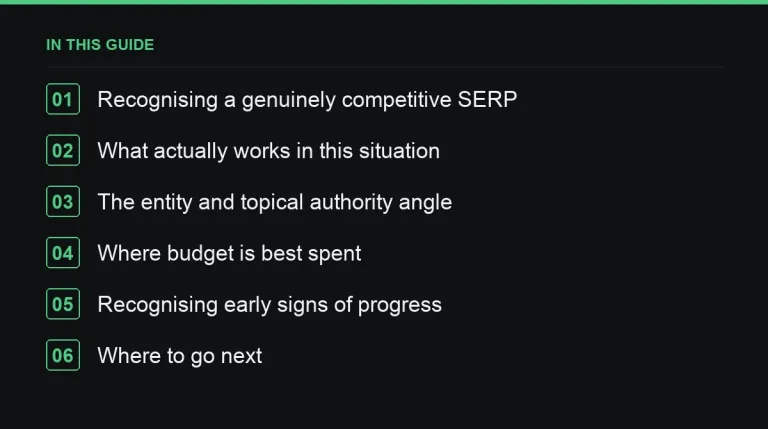
Recognising a genuinely competitive SERP
Look for signs like: most top results are from large, recognisable brands or established publications; the content on those pages is comprehensive and well-maintained; and the referring domain counts, when checked, are substantially higher than typical for your niche. https://successtoroad.com/blog/seo-competitor-research/ helps confirm this isn’t just perception.
Recalibrating what success looks like
Displacing an entrenched, well-resourced result in the near term is a genuinely difficult goal, and treating it as the only measure of success sets an unrealistic bar. A more useful goal is often steady, sustained movement toward the lower end of page one or the top of page two, which still captures meaningful traffic without requiring you to overtake the very top results immediately.
What actually works in this situation
- Finding a genuinely differentiated angle on the topic rather than competing head-on with the same content approach
- Targeting adjacent, less competitive long-tail variations that still serve the same broader business goal — see https://successtoroad.com/blog/long-tail-vs-head-terms/
- Building sustained relevance and topical authority over time rather than expecting a single campaign to close the gap
- Being selective and patient with link building rather than trying to match competitor volume quickly, which raises risk without matching quality
The entity and topical authority angle
Large competitors often win partly because search engines recognise them as authoritative across an entire topic area, not just a single page. Building out https://successtoroad.com/blog/entity-and-topical-authority-strategy/ across several related pages, rather than concentrating all effort on one page, can be a more realistic long-term path to competing in a tough SERP than isolated link building to a single URL.
A realistic timeline
| Phase | Realistic goal |
|---|---|
| Months 1-6 | Establish topical depth, begin steady link acquisition |
| Months 6-12 | Move toward the lower half of page one for the main term |
| Year two and beyond | Contest higher positions as topical authority compounds |
Where budget is best spent
In a highly competitive SERP, budget often goes further spread across supporting content and a broader topical footprint than concentrated entirely on link building to one page. Revisit https://successtoroad.com/blog/balancing-links-and-content-investment/ with this specific scenario in mind — content and topical breadth frequently matter as much as, or more than, additional links here.
Avoiding discouragement-driven decisions
Slow progress in a tough SERP can tempt a switch to riskier, faster tactics out of frustration. This is exactly the situation https://successtoroad.com/blog/risk-appetite-frameworks/ is meant to guard against — a framework set calmly in advance prevents a difficult SERP from pushing a otherwise-cautious program into higher-risk territory.
Recognising early signs of progress
In a genuinely tough SERP, meaningful signs of progress can look modest at first — a slight upward trend in position, growing relevance signals, or incremental improvements in referring domain count relative to the gap identified earlier. Recognise and track these smaller signals rather than waiting only for a dramatic jump in position to call the effort worthwhile.
When a partial win is still a win
Capturing meaningful traffic from a position just below the very top results is often a legitimate, valuable outcome in a highly competitive space, even without displacing the market leader. Measure success against a realistic benchmark for the specific SERP rather than an absolute “must be first” standard.
Benchmarking against the right comparison set
Rather than comparing your progress solely against the very top of a tough SERP, also track your position relative to other challengers in a similar position to you, which gives a more encouraging and realistic sense of relative progress.
A note on team morale
Slow, hard-won progress in a tough SERP can be discouraging for a team used to faster wins elsewhere on the site. Framing this work explicitly as a longer-term investment from the outset helps manage that expectation internally, not just with external stakeholders.
Finally, keep a long view — genuinely competitive spaces reward sites that stay consistent for years, not months, so build the plan and the stakeholder expectations around that reality from the outset.
A short written record of the realistic timeline agreed with stakeholders at the outset is worth revisiting whenever patience starts to wear thin.
None of this guarantees success against deeply entrenched competitors, but it substantially improves the odds compared with an impatient, under-resourced attempt.
Treat the whole effort as a long-term investment decision made deliberately, with stakeholders aware from the outset of what a realistic timeline actually looks like.
Where to go next
Competitive SERPs reward patience, differentiation and topical breadth over trying to simply out-volume an entrenched competitor. See https://successtoroad.com/blog/prioritising-pages-to-build-links-to/ to confirm a page in this situation is genuinely worth the sustained investment it requires, and https://successtoroad.com/marketplace/ for sourcing the quality, relevant links this longer-term approach depends on.
Frequently asked questions
Is it ever worth giving up on a highly competitive term?
Sometimes, if a realistic assessment shows the gap isn't closable within a reasonable timeframe relative to the page's value. It's a legitimate call, best made deliberately using a prioritisation framework rather than by getting discouraged.
Should I try to match competitors' link volume in a competitive SERP?
Generally not directly — matching volume quickly raises risk without necessarily matching quality. Steady, selective link acquisition alongside topical authority building tends to work better over time.
How long does it realistically take to compete in a tough SERP?
Often a year or more of sustained effort across content, topical authority and links, rather than a single campaign. Setting this expectation early avoids premature judgments that the strategy isn't working.
Does content matter more than links in these situations?
Both usually matter, but topical breadth and depth often carry more relative weight in highly competitive spaces than they would in a less contested SERP, making balanced investment worthwhile.
Put it into practice
Filter 54,483 websites by DR, traffic, niche and price, and order with escrow — you pay only after the link is live.
Browse the marketplace