Combining Digital PR, Content and Direct Placements
Blending PR, content-led links and direct placements spreads risk and covers gaps that any single channel leaves.
Sites that rely on a single link building channel — only guest posts, only digital PR, only content-led earned links — tend to be more exposed when that channel gets harder, more expensive, or less effective. A deliberate blend of approaches covers each other’s weaknesses and produces a more resilient program.
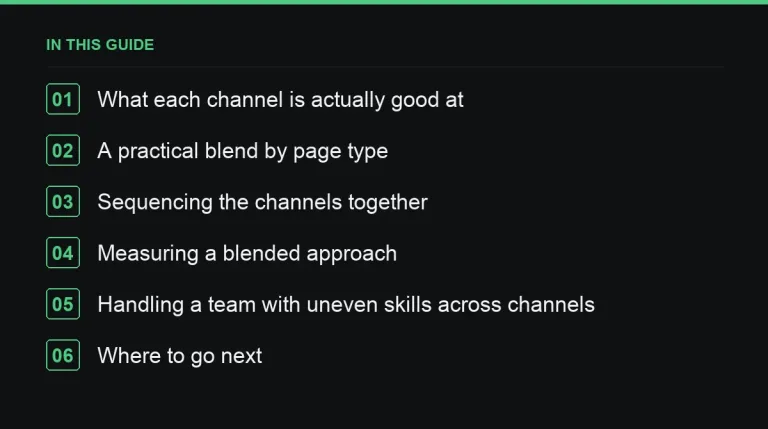
What each channel is actually good at
Digital PR campaigns are strong for reaching a broad audience quickly and building brand search alongside links, but results are less predictable and depend on genuinely newsworthy angles — see https://successtoroad.com/blog/data-driven-pr-campaigns/ and https://successtoroad.com/blog/digital-pr-campaign-ideas/. Linkable content — original research, comprehensive guides, useful tools — earns links passively over a longer period with less ongoing effort once published, covered in https://successtoroad.com/blog/content-that-earns-links/. Direct placements, including guest posts and paid insertions, offer the most control and predictability over which page gets linked and when, but require ongoing spend and effort to sustain at volume.
Why relying on just one creates fragility
A program built entirely around guest posting is exposed if publisher acceptance rates drop or costs rise. One built entirely around digital PR is exposed to slow months when no newsworthy angle presents itself. One built entirely around passive content is exposed to slow, unpredictable timelines that don’t suit pages needing links on a schedule.
A practical blend by page type
| Page type | Best-fit primary channel |
|---|---|
| High-priority commercial page with a firm timeline | Direct placements for predictability |
| Brand-building or broad-reach goal | Digital PR campaigns |
| Evergreen resource with no urgency | Linkable content, earned passively over time |
Sequencing the channels together
These channels can also reinforce each other rather than operate independently — a piece of original research built as linkable content can also become the centrepiece of a digital PR pitch, and a successful PR campaign can generate relationships worth pursuing for future direct placements. Building this sequencing deliberately gets more value from the same underlying work than treating each channel in isolation.
Allocating budget across the blend
There’s no fixed ideal split — it depends on your priority pages, timeline pressure and existing capabilities. https://successtoroad.com/blog/building-a-12-month-link-plan/ is the right place to make this allocation explicit rather than defaulting to whichever channel is easiest to execute or most familiar to your team.
Measuring a blended approach
Attribution gets somewhat harder with multiple channels running simultaneously, but it’s still worth tracking each channel’s output and rough contribution separately rather than lumping everything into one number. https://successtoroad.com/blog/measuring-link-building-roi/ and https://successtoroad.com/blog/measuring-link-impact-with-control-pages/ both apply per-channel as well as overall.
Avoiding channel bias
Teams often default to whichever channel they’re most comfortable with, regardless of fit — a content team defaults to linkable assets, a PR-experienced hire defaults to campaigns. Deliberately reviewing the blend against actual page needs, rather than team comfort, produces a better-matched strategy.
Handling a team with uneven skills across channels
Few teams have equally strong capability in digital PR, content production and direct placement outreach all at once. Where a genuine skills gap exists, it’s often more practical to outsource or hire selectively for the weakest channel rather than attempting all three in-house at an inconsistent standard, which can undermine the credibility benefits any of them are meant to provide.
Reviewing the blend annually
As team capability and budget change, revisit the ideal channel blend at least once a year rather than assuming the original allocation remains correct indefinitely — a growing content capability, for instance, might justify shifting more weight toward passive, compounding content-led link earning over time.
Setting channel-specific goals
Give each channel its own specific, realistic goal rather than one blended target for the whole program, since a single combined number makes it hard to tell which channel is actually underperforming when overall results fall short.
A note on timing across channels
Avoid launching a major push across all three channels simultaneously the first time you try this blended approach — staggering the rollout makes it easier to learn what’s working in each channel before scaling all of them at once.
Finally, review the blend’s overall performance at least annually alongside your broader strategy documentation, adjusting the mix as your team’s capability and the competitive landscape both change.
A short shared dashboard tracking each channel’s own goal, even a simple one, keeps the blended approach honest and reviewable.
None of this needs to happen all at once — building the blend gradually over a year or two is a perfectly reasonable pace for most teams.
Treat the blended approach as something that matures over time, improving as each channel’s own process gets refined through practice rather than expecting a polished mix from the very first attempt.
Where to go next
A deliberate blend of digital PR, linkable content and direct placements spreads risk and covers each channel’s individual weaknesses. See https://successtoroad.com/blog/prioritising-pages-to-build-links-to/ to decide which channel fits which page, and https://successtoroad.com/marketplace/ for the direct placement side of the blend once you’ve decided where it fits.
Frequently asked questions
Do I need to run all three channels — PR, content and placements — simultaneously?
Not necessarily all at once from day one, but relying entirely on just one long-term creates fragility. Building toward a blend over time, matched to your priority pages, is a reasonable goal.
Which channel produces the fastest results?
Direct placements typically offer the most predictable timeline since you control when and where the link appears, whereas digital PR and passive content-led links tend to be less predictable in timing.
Can one piece of work serve multiple channels?
Yes — original research or a comprehensive guide built as linkable content can also anchor a digital PR pitch, getting more value from the same underlying work rather than treating each channel separately.
How should budget be split across the three channels?
There's no universal split; it should reflect your priority pages' needs, timeline pressure and existing team capabilities, decided explicitly as part of your annual plan rather than by default.
Put it into practice
Filter 54,483 websites by DR, traffic, niche and price, and order with escrow — you pay only after the link is live.
Browse the marketplace