When to Ignore Metrics and Trust Your Judgment Instead
Metrics are a filter, not a religion — here is when following them exactly produces the wrong answer.

Every other post in this series explains how to read a metric correctly. This one is about the opposite case: situations where leaning on metrics at all leads you to the wrong decision, and where a different kind of judgment should take over.
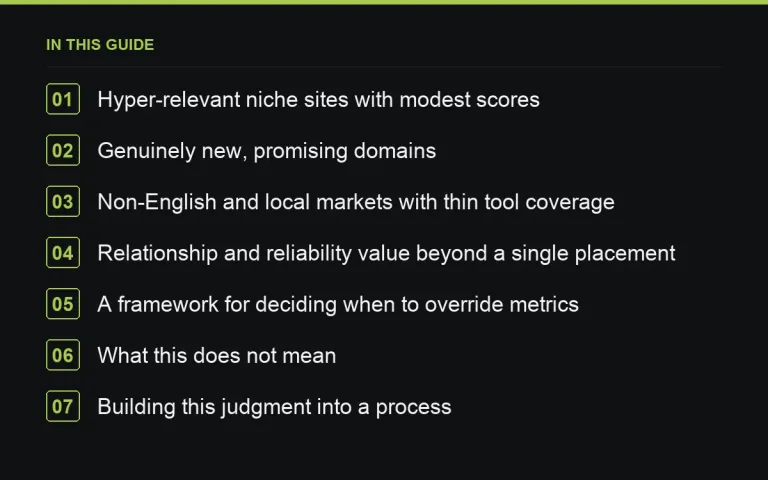
Hyper-relevant niche sites with modest scores
A small, tightly focused site serving exactly your buyer’s niche — read by the right people, even if not many of them by national standards — is often a better placement than a much higher-DR general site with no specific connection to that audience. Relevance can outweigh raw authority, particularly for a buyer whose goal is reaching a specific professional or enthusiast community rather than maximising generic link equity. See the local case of this in https://successtoroad.com/blog/metrics-for-local-sites/ and the broader relevance discussion in https://successtoroad.com/blog/traffic-by-country-for-placements/.
Genuinely new, promising domains
A brand-new site with excellent content and a credible team will show weak metrics for months, purely because DR, DA and traffic estimates are all backward-looking. Rejecting every new domain on metrics alone means missing early access to sites that may become genuinely valuable later. See https://successtoroad.com/blog/metrics-for-new-domains/ for what to check instead in these cases.
Non-English and local markets with thin tool coverage
As covered in https://successtoroad.com/blog/metrics-for-non-english-sites/, coverage gaps in major SEO tools can understate genuinely strong sites in smaller-language or local markets. A low score in these cases may reflect the tool’s limits rather than the site’s actual quality — manual judgment, informed by relative comparison within the same market, should carry more weight here.
Relationship and reliability value beyond a single placement
A publisher you have worked with repeatedly, who delivers on time, communicates clearly, and maintains consistent editorial standards, carries a kind of value that no metric captures directly. If a long-standing, reliable publisher’s metrics dip slightly, that is not automatically a reason to abandon the relationship, particularly if the underlying reasons are understood and the site otherwise remains a genuine, actively maintained publication.
A framework for deciding when to override metrics
| Situation | Reasonable override |
|---|---|
| Very niche-relevant but modest-metric site | Weight relevance and manual quality above raw authority score |
| New domain with strong content and team | Judge on content and team, not current DR/traffic |
| Local or non-English site with thin tool coverage | Compare within its own market rather than against global norms |
| Established, reliable relationship with a minor metric dip | Weigh track record alongside the current snapshot |
What this does not mean
Ignoring metrics selectively is not the same as ignoring them entirely, or as an excuse to skip due diligence on sites that genuinely look risky. The cases above are specific situations where a metric’s known limitation — being backward-looking, being coverage-dependent, or simply not measuring relevance directly — makes it the wrong sole basis for a decision, not a general licence to disregard due diligence.
Building this judgment into a process
A scoring model (https://successtoroad.com/blog/scoring-model-for-publisher-selection/) can and should include a manual-override flag for exactly these situations, rather than being purely mechanical. Documenting why an override was made, even briefly, helps keep the exception genuinely justified rather than becoming an excuse to skip vetting altogether.
Recognising the difference between an exception and a rationalisation
The line between a legitimate exception and simply talking yourself into a bad decision can be thin, particularly under time pressure or when a site’s outreach has been especially persuasive. A useful discipline is asking whether the specific override reason would still sound convincing if written down and shown to someone else on your team without any other context. If the justification only sounds reasonable in the moment, it is worth pausing rather than proceeding.
Building institutional memory around past overrides
Teams that make these override decisions repeatedly benefit from tracking outcomes over time: which overridden placements turned out well, and which ones confirmed that the metrics had actually been right to flag a concern. This turns individual judgment calls into a growing, evidence-based sense of when overriding metrics tends to pay off in your specific niche, rather than each override being a one-off leap of faith made independently of past experience.
Getting a second opinion on a borderline override
For a genuinely significant decision, particularly one involving a notable override of your normal thresholds, asking a colleague for an independent read before committing adds a useful check against individual bias. A second person evaluating the same override reasoning, without having been part of the original outreach conversation, can catch a rationalisation that felt convincing in isolation but does not hold up under a fresh, less invested perspective.
Recognising that this applies narrowly, not broadly
The situations described throughout this piece are deliberately specific: known limitations of backward-looking scores, coverage gaps in certain markets, and genuine relevance advantages that outweigh a modest metric gap. This is not a general licence to disregard metrics whenever a site’s pitch is compelling; the discipline of documenting the specific, narrow reason for any override is what keeps this approach from quietly eroding into no real standards at all.
Where to go next
For the baseline metrics this post is deliberately pushing back against over-relying on, see https://successtoroad.com/blog/seo-metrics-explained/. Find both high-metric and genuinely niche-relevant options in https://successtoroad.com/marketplace/, and read https://successtoroad.com/blog/how-to-read-a-link-profile/ before making any override decision.
Frequently asked questions
Does this mean metrics are not useful?
No, metrics remain useful as an efficient first filter across large prospect lists. This post is about the specific, narrower situations where they should not be the deciding factor on their own.
How do I justify overriding a metric threshold to a client or manager?
Document the specific reasoning — niche relevance, domain age, market coverage gaps, or established track record — rather than simply overriding without explanation, so the decision is defensible later.
Should I lower my standards generally because metrics have limits?
No, the point is applying judgment in specific known-limitation cases, not lowering overall due diligence. Continue applying full vetting to sites outside these specific situations.
Is a long relationship with a publisher a substitute for checking current metrics?
Not entirely — periodically re-check even long-standing publishers, but weigh a minor dip against the established track record rather than dropping the relationship immediately.
Can this reasoning be misused to justify a bad placement?
Yes, which is why documenting the specific justification each time matters — it keeps the exception tied to a real, identifiable reason rather than becoming a generic excuse.
Put it into practice
Filter 54,483 websites by DR, traffic, niche and price, and order with escrow — you pay only after the link is live.
Browse the marketplace