What to Do When a Publisher Removes Your Link
A removed link is annoying but common — here's how to respond and what to check before assuming bad faith.
You paid for or earned a placement, confirmed it was live, and some time later it’s gone. This happens more often than most people expect, for reasons ranging from a routine content refresh to a genuine policy change at the publisher. How you respond should depend on why it happened, not just the fact that it happened.
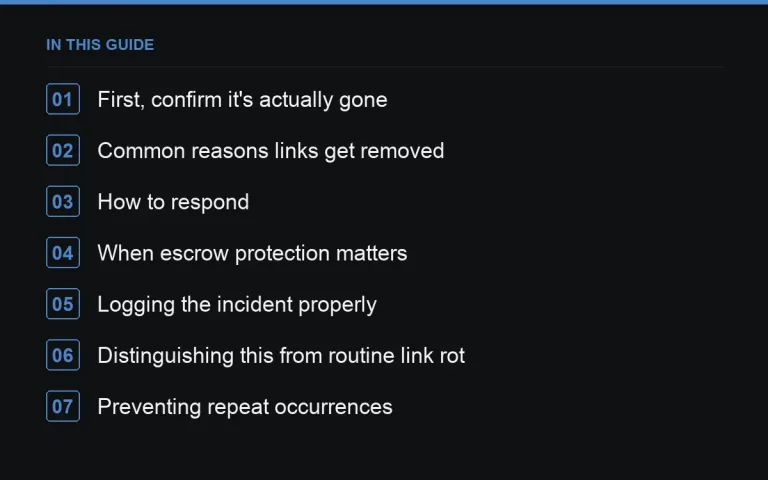
First, confirm it’s actually gone
Check the current live page directly rather than relying only on a monitoring tool’s alert, since occasional false positives happen from temporary site issues or caching. Also check whether the entire page was removed versus just your specific link being edited out of otherwise intact content.
Common reasons links get removed
| Reason | How to tell |
|---|---|
| Routine content refresh or rewrite | Page still exists, content has changed, other links may also be gone |
| Publisher policy change (e.g., no longer allowing paid links) | Often communicated via a blanket email or update; check other recent placements too |
| Manual action risk on the publisher’s side | Publisher removing many outbound paid links at once, often site-wide |
| Simple oversight or technical error | Isolated case, often resolved quickly once reported |
| Non-payment or dispute on the buyer’s side | Check if there was an unresolved billing or terms issue |
How to respond
- Reach out to the publisher directly and ask what happened before assuming the worst
- If it was accidental or a bug, request reinstatement — this is often resolved quickly
- If it’s a genuine policy change, respect it rather than pushing back aggressively; the relationship matters more than one link
- If it was a paid, escrow-protected order, use the platform’s dispute or resolution process rather than relying purely on direct outreach
When escrow protection matters
Placements bought through a marketplace with escrow, where funds are released only once the buyer approves the live URL, give you real recourse if a link disappears shortly after approval or was never actually delivered as agreed — a meaningful protection compared with informal direct outreach deals that have no such safeguard.
Logging the incident properly
Record the removal in your audit documentation regardless of the outcome — see https://successtoroad.com/blog/documenting-a-backlink-audit/ — including the reason if you were able to determine one. This protects you if the same publisher’s reliability comes up again in future placement decisions, tying back into https://successtoroad.com/blog/risk-scoring-a-placement-before-you-buy/.
Distinguishing this from routine link rot
A deliberate removal is a different category from the natural background decay covered in https://successtoroad.com/blog/link-rot-and-weekly-monitoring/ — the response differs because a deliberate removal, especially on a paid placement, may warrant a refund conversation or dispute rather than simple reclaim outreach.
Preventing repeat occurrences
If a specific publisher has a pattern of removing paid links after a period, factor that into future purchase decisions and prioritize sites with a track record of stability, per https://successtoroad.com/blog/auditing-a-publishers-guest-post-history/.
What a reasonable first message looks like
Keep the initial outreach factual and low-pressure: note that you noticed the link is no longer present, ask if there’s a specific reason, and express openness to whatever the answer is. Leading with an accusatory tone before you know what happened tends to close down a conversation that might otherwise have ended in a simple, quick fix. Save firmer language for cases where you’ve confirmed a paid placement was removed without any communication and without a refund offered.
When to simply let it go
Not every removed link is worth pursuing, particularly for low-cost or long-past placements where the time spent chasing a resolution exceeds any reasonable value of the link itself. Set a rough threshold for yourself — based on placement cost, the site’s overall quality, or how recently it happened — below which you simply note the loss and move on rather than spending disproportionate effort recovering something minor.
Learning from a pattern across multiple removals
If you’re managing many placements across many publishers, keep a simple running note of removals and their outcomes. A pattern showing removals cluster around specific publisher types or specific arrangement styles — informal direct deals versus platform-mediated orders, for instance — is useful for shaping how you source and structure future placements, not just for handling this one incident.
When it’s the right call to simply move on
Sometimes the most efficient response is to accept the loss, redirect the budget toward a fresh placement with a more reliable publisher, and not spend further time on recovery. This is a reasonable call once you’ve made a genuine attempt at resolution and it hasn’t produced a clear answer within a reasonable timeframe — persistence has diminishing returns once a publisher has gone quiet.
Turning an isolated incident into a better process
Use each removal incident as a small prompt to tighten your own process going forward — clearer written terms before a placement, more explicit confirmation of expected duration, and preference for platforms with built-in protection over informal arrangements. A single removal is an inconvenience; the same mistake repeating across many placements is a process problem worth actually fixing.
Where to go next
Sourcing placements through https://successtoroad.com/marketplace/ with weekly link monitoring and escrow protection reduces both the odds of this happening unnoticed and your exposure if it does.
Frequently asked questions
Should I assume bad faith if a link disappears?
Not initially. Many removals are routine content refreshes or technical accidents rather than deliberate bad faith. Reach out and ask before assuming the worst, since a straightforward conversation often resolves it.
What if the publisher won't reinstate a paid link?
If the placement was made through a platform with escrow or dispute resolution, use that process. For informal direct arrangements, you have less recourse, which is part of why using a protected marketplace matters for paid placements.
Is a publisher removing many links at once always a bad sign?
It can indicate the publisher is responding to their own risk concerns, such as an emerging manual action threat on their side, which is a reasonable thing for them to do even though it's inconvenient for you.
Should I keep buying from a publisher who removed my link once?
Use judgment based on the reason. An isolated technical issue that was quickly resolved is different from a pattern of removing paid links after a short period, which should factor into future purchase decisions.
Put it into practice
Filter 54,483 websites by DR, traffic, niche and price, and order with escrow — you pay only after the link is live.
Browse the marketplace