Backlink Audits for YMYL Sites
YMYL sites face closer scrutiny, which means their backlink audits should hold a higher bar than average.
“Your Money or Your Life” (YMYL) is the term used for content categories — health, finance, legal, safety — where inaccurate or low-quality information can meaningfully affect a reader’s wellbeing or finances. Search engines apply extra scrutiny to these topics generally, and that scrutiny extends to the trust signals a site’s backlink profile is expected to demonstrate.
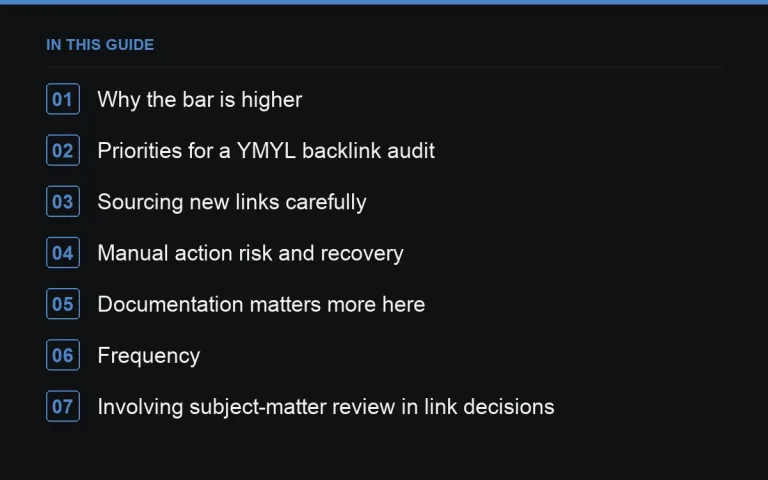
Why the bar is higher
A YMYL site’s rankings tend to depend more heavily on demonstrated expertise, authority, and trust than a typical hobby or entertainment site. Backlinks are one input into that trust picture, which means a profile heavy on low-quality, irrelevant, or spammy links is more likely to draw attention and cause visible harm on a YMYL site than on a lower-stakes one.
Priorities for a YMYL backlink audit
- Weight relevance more heavily than on other sites — links from genuinely authoritative, on-topic sources matter more here specifically
- Be stricter about https://successtoroad.com/blog/what-is-a-toxic-link-really/ — the tolerance for ambiguous or borderline links should be lower
- Check sponsored and guest content especially carefully for proper disclosure, since undisclosed paid content is a bigger trust liability in these categories — see https://successtoroad.com/blog/sponsored-posts-done-wrong/
- Run https://successtoroad.com/blog/link-network-and-pbn-detection/ checks more thoroughly, since network links are a clearer risk here than in lower-stakes niches
Sourcing new links carefully
| Prioritize | Avoid |
|---|---|
| Established, topically relevant publishers with real editorial standards | General “accepts anything” guest post mills |
| Sites with demonstrated expertise or credentials in the relevant field | Unrelated niches picked purely for cheap availability |
| Properly disclosed sponsored or expert-contributed content | Undisclosed paid placements blended as if independently written |
Manual action risk and recovery
If a YMYL site does receive a link-related manual action, the reconsideration bar tends to be applied with the same general rigor as any site, but the broader trust context means recovery of lost rankings can be slower even after the action lifts. This makes prevention, through more conservative link acquisition, more valuable than for lower-stakes categories — see https://successtoroad.com/blog/manual-actions-and-reconsideration/ for the general process either way.
Documentation matters more here
Keep a more thorough audit trail than you might for a lower-stakes site — https://successtoroad.com/blog/documenting-a-backlink-audit/ becomes especially valuable if you ever need to demonstrate diligence, whether to a search engine reviewer, a client, or an internal compliance function common in regulated YMYL industries like finance.
Frequency
Given the higher stakes, err toward the more frequent end of the ranges discussed in https://successtoroad.com/blog/how-often-to-audit-backlinks/ — quarterly full audits with monthly lighter checks is a reasonable baseline for most YMYL sites rather than the lighter schedule appropriate for a low-stakes hobby blog.
Involving subject-matter review in link decisions
For genuinely regulated categories like finance or medical information, it can be worth involving someone with actual subject-matter or compliance knowledge in reviewing prospective link sources, not just an SEO-focused evaluation. A site might look fine by traffic and relevance metrics alone but carry claims or associations that create a different kind of risk entirely, one that a purely SEO-focused audit wouldn’t catch.
Balancing caution with actually building links
Being more conservative doesn’t mean avoiding link building altogether — a YMYL site still needs a healthy, growing backlink profile to compete, and excessive caution that results in no new link acquisition at all just cedes ground to less careful competitors. The goal is a higher bar for each individual placement, not fewer placements overall; spend the extra scrutiny on quality rather than using it as a reason to slow down entirely.
Watching for regulatory and compliance overlap
In heavily regulated YMYL categories like finance, some link and content practices that would be a purely SEO consideration elsewhere can also intersect with actual regulatory or advertising compliance obligations. If your organization has a compliance function, it’s worth a brief conversation about whether link-building or sponsored content practices need sign-off beyond the SEO team’s usual review.
Evaluating author and contributor credibility
For YMYL content specifically, check not just the linking site’s overall quality but also whether guest or contributed content is attributed to someone with credible relevant background, since this is part of the broader trust picture these categories are held to. A well-written piece from an anonymous or clearly unqualified byline carries less weight in these categories than the same piece attributed to someone with genuine, verifiable relevant expertise.
A conservative closing principle
When genuinely unsure whether a placement meets the higher bar these categories deserve, default to caution rather than convenience. The cost of skipping a mediocre opportunity is negligible; the cost of a genuinely poor placement compounding trust concerns on a YMYL site is not, and that asymmetry should guide close calls.
Bringing new team members up to speed
If someone new joins a team responsible for a YMYL site’s link building, spend real time walking them through why the bar here is higher before they start pitching or approving placements on their own. A newcomer applying general-purpose link-building instincts without this context is one of the more common ways a previously careful site’s standards quietly slip.
Where to go next
When sourcing new placements, filter specifically by relevant niches such as https://successtoroad.com/niche/health/ or https://successtoroad.com/niche/finance/ on https://successtoroad.com/marketplace/ and prioritize sites with clear editorial standards over sheer volume or price.
Frequently asked questions
What counts as a YMYL site specifically?
Common categories include health and medical information, financial and investment advice, legal information, and anything touching safety or major life decisions. The classification is about topic impact on readers' wellbeing or finances, not site size or traffic.
Are the ranking factors different for YMYL sites?
The same general principles apply, but demonstrated expertise, authority, and trust tend to carry more weight given the higher stakes of inaccurate information in these categories, which extends to how backlink quality is likely weighed.
Should I avoid all guest posting for a YMYL site?
No, but be more selective about publisher quality and topical relevance than you might be for a lower-stakes site, and ensure any expert-contributed or sponsored content is properly disclosed.
Does a YMYL site need more frequent audits?
Generally yes, given the higher stakes of any link-related issue going unnoticed. A quarterly full audit with lighter monthly checks is a reasonable baseline rather than the more relaxed schedule suitable for lower-stakes sites.
Put it into practice
Filter 54,483 websites by DR, traffic, niche and price, and order with escrow — you pay only after the link is live.
Browse the marketplace