A Ten-Minute Checklist to Vet a Site Before You Buy a Placement
The compressed version of every check on this site, in the order that catches the most problems fastest.
Full due diligence on a prospective publisher can take much longer than most buyers have time for on every single decision. This checklist compresses the essential checks into roughly ten minutes, ordered to catch the most common problems first.
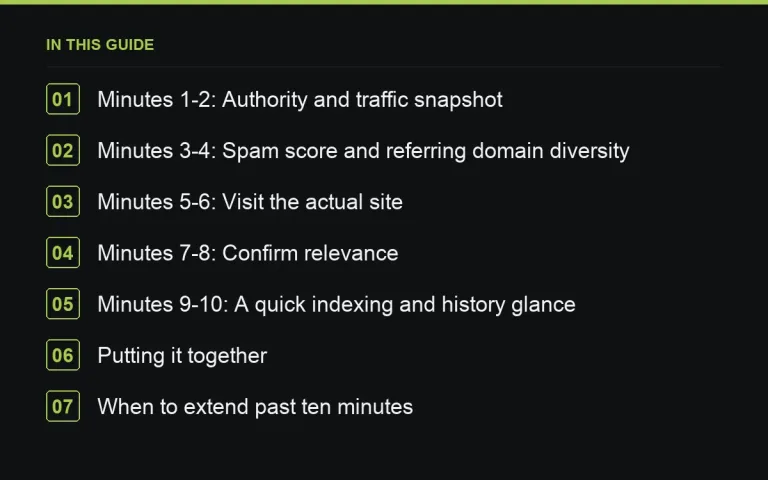
Minutes 1-2: Authority and traffic snapshot
Pull DR or DA, referring domains, and the traffic estimate. You are looking for a rough sanity check: does this site show reasonable authority backed by a plausible traffic number, or does one number look wildly out of step with the others. See https://successtoroad.com/blog/domain-rating-explained/ and https://successtoroad.com/blog/organic-traffic-estimates-why-tools-disagree/ for context on reading these correctly.
Minutes 3-4: Spam score and referring domain diversity
Check spam score and the ratio of total backlinks to unique referring domains. A concentrated profile or elevated spam score at this stage is a prompt to look closer at the actual link profile before going further, not necessarily an automatic rejection — see https://successtoroad.com/blog/spam-score-explained/ and https://successtoroad.com/blog/referring-domains-vs-backlinks-explained/.
Minutes 5-6: Visit the actual site
- Check the date and frequency of recent posts — is this an active publication? (https://successtoroad.com/blog/content-freshness-as-a-signal/)
- Skim two or three recent articles for genuine editorial quality, not thin filler content.
- Note the outbound link pattern on those pages — a handful of relevant links is healthy, a crowded page of unrelated links is not (https://successtoroad.com/blog/outbound-link-ratio/).
Minutes 7-8: Confirm relevance
Check niche fit against your buyer’s industry, and country or language relevance if that matters for this specific campaign (https://successtoroad.com/blog/traffic-by-country-for-placements/). A strong site that is simply the wrong audience is still the wrong choice.
Minutes 9-10: A quick indexing and history glance
Do a fast site-search to confirm the domain is genuinely indexed and active in search results (https://successtoroad.com/blog/indexing-checks/). If anything from the earlier steps raised a flag — a metrics jump, an unfamiliar niche mismatch, a suspiciously strong score for a very new-looking site — spend the remaining time on a quick history check instead (https://successtoroad.com/blog/site-age-and-history-checks/).
Putting it together
| Time | Check |
|---|---|
| 0-2 min | Authority and traffic snapshot |
| 3-4 min | Spam score and referring domain diversity |
| 5-6 min | Manual look at the actual site and recent content |
| 7-8 min | Niche, country and language relevance |
| 9-10 min | Indexing check, or a deeper look if something flagged earlier |
When to extend past ten minutes
For a higher-value or ongoing publisher relationship, it is worth extending this into the fuller process covered in https://successtoroad.com/blog/how-to-read-a-link-profile/ and building the results into a proper https://successtoroad.com/blog/scoring-model-for-publisher-selection/ rather than relying on a quick pass alone. Reserve the ten-minute version for lower-stakes, higher-volume decisions where speed matters more than exhaustive certainty.
Making this repeatable across a team
Writing this checklist down as a literal shared document, rather than keeping it as tacit knowledge in one person’s head, keeps buying decisions consistent across a team and across time, especially as new people take on vetting responsibilities.
Adapting the checklist to your own priorities
This sequence is a sensible default, but it is worth adjusting the order and emphasis based on what matters most for your specific type of campaign. A buyer running a purely local campaign might move relevance and country checks earlier, since a site failing that filter makes every other check moot regardless of how strong its other numbers look. A buyer more concerned with link safety than reach might spend relatively more of the ten minutes on the spam score and profile diversity step instead.
Keeping a simple record as you go
Even a fast ten-minute check benefits from a brief written record, such as a single line per prospect noting the outcome and any flags raised. This takes only a few extra seconds per site but saves considerable time later if you revisit the same prospect for a future campaign, and it gives you a rough audit trail if a placement later underperforms and you want to understand why it was approved in the first place.
Practising the checklist until it becomes second nature
Like the fuller link-profile walkthrough, this compressed checklist gets noticeably faster with repetition. Running through it deliberately on a handful of sites you already know well, comparing your quick read against what you already understand about them, is a useful way to calibrate your judgment before relying on the ten-minute version for genuinely unfamiliar prospects.
Knowing when ten minutes genuinely is not enough
For any prospect where the ten-minute pass surfaces a genuine ambiguity, whether in the metrics, the content, or the relevance fit, it is better to extend the review than to force a decision within the original time budget simply for the sake of speed. The checklist is designed to handle routine, lower-stakes decisions efficiently, not to replace deeper judgment when a prospect genuinely warrants it.
Where to go next
For full definitions of every metric referenced in this checklist, see https://successtoroad.com/blog/seo-metrics-explained/. Apply it directly to prospects in https://successtoroad.com/marketplace/, or speed up the first pass across a whole list with https://successtoroad.com/blog/bulk-domain-check-for-prospect-lists/.
Frequently asked questions
Is a ten-minute check enough for a high-value placement?
For lower-stakes or high-volume decisions, yes. For a significant spend or an ongoing relationship, extend into the fuller review process covered in {{post:how-to-read-a-link-profile}}.
What should I do if something flags during the quick check?
Stop and spend the remaining time investigating that specific flag rather than rushing through the rest of the checklist, since an unresolved red flag matters more than completing every step.
Can this checklist be run by someone without SEO experience?
With the linked explanations for each metric, a reasonably careful non-specialist can follow this checklist, though judgment calls on borderline cases benefit from more experience.
Should the order of these checks ever change?
The order here front-loads the fastest, most revealing checks first, but you can reorder based on what matters most for your specific campaign, such as checking relevance before authority for a highly location-specific buyer.
How do I apply this to a long list of prospects efficiently?
Run an automated bulk check first to narrow the list, then apply this ten-minute manual checklist only to the survivors — see {{post:bulk-domain-check-for-prospect-lists}}.
Put it into practice
Filter 54,483 websites by DR, traffic, niche and price, and order with escrow — you pay only after the link is live.
Browse the marketplace