Trust Flow and Citation Flow: Majestic’s Two-Number System Explained
Why Majestic uses two numbers instead of one, and how to read them together.
Most authority metrics condense a backlink profile into a single number. Majestic, deliberately, uses two: Citation Flow and Trust Flow. Read separately they are only half the story; read together they reveal something neither DA nor DR shows on its own.
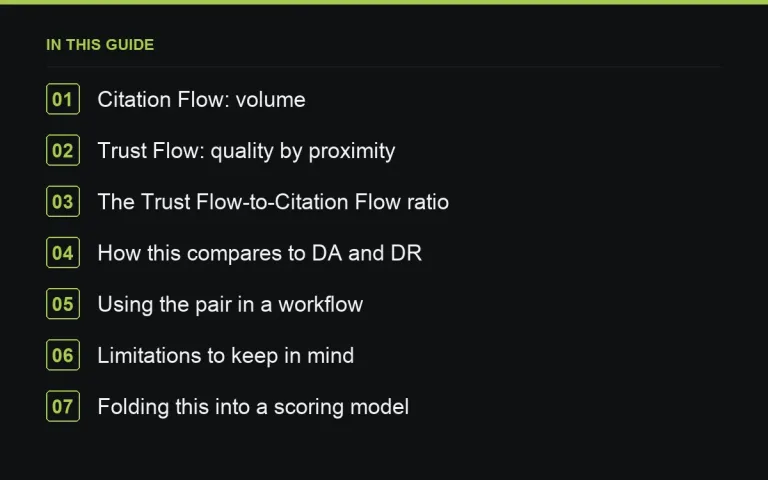
Citation Flow: volume
Citation Flow predicts a URL’s influence based purely on the quantity of links pointing at it, weighted by the Citation Flow of the linking pages themselves. It answers “how much link volume is behind this,” without judging whether those links come from reputable sources.
Trust Flow: quality by proximity
Trust Flow starts from a seed set of manually reviewed, trustworthy sites and measures how many hops of separation a given site is from that seed set through the link graph. The closer a domain is to trusted sources, the higher its Trust Flow. It is a proxy for trustworthiness rather than raw size.
Why the pair matters more than either alone
- High Citation Flow with low Trust Flow often signals a site built up mostly through link farms, spam directories, or low-value volume.
- Low Citation Flow with reasonable Trust Flow can describe a small, careful, editorially strict site — fewer links, but from good neighbourhoods.
- High scores on both suggest a site with genuine reach and a clean neighbourhood, generally the safest kind of placement.
The Trust Flow-to-Citation Flow ratio
A commonly used shorthand is dividing Trust Flow by Citation Flow. A ratio close to or above 1 suggests a comparatively clean profile; a ratio well below 0.5 is a flag worth investigating further, though it is not proof of a problem on its own — some legitimate large sites simply accumulate volume faster than trust signals can propagate. Treat the ratio as a prompt to look closer, not a verdict, and pair it with an actual look at the link profile — see https://successtoroad.com/blog/how-to-read-a-link-profile/.
How this compares to DA and DR
Domain Rating (https://successtoroad.com/blog/domain-rating-explained/) and Domain Authority (https://successtoroad.com/blog/domain-authority-explained/) each collapse volume and trust into one figure using their own formula. Majestic’s decision to keep them separate is useful specifically because it lets you spot the volume-without-trust pattern that a single blended score can hide. If you only have time to check one extra metric beyond DR or DA, Trust Flow is often the most informative addition.
Using the pair in a workflow
| Pattern | Likely meaning | Action |
|---|---|---|
| CF and TF both high | Established, broadly trusted site | Good candidate, verify relevance |
| CF high, TF low | Bulk or low-quality link volume | Investigate profile, consider passing |
| CF low, TF reasonable | Small but clean site | Good for niche relevance, modest reach |
| Both low | New or minor site | Check https://successtoroad.com/blog/metrics-for-new-domains/ before dismissing |
Limitations to keep in mind
Majestic’s index is built from its own crawler, which does not cover the web identically to Ahrefs’ or Moz’s crawlers, so Trust Flow and Citation Flow can diverge from DR and DA for reasons that have nothing to do with quality — simply different coverage. Neither score accounts for traffic; a site can have strong Trust Flow and almost no visitors, which is why pairing it with an audience metric such as https://successtoroad.com/blog/organic-traffic-estimates-why-tools-disagree/ still matters.
Folding this into a scoring model
If you are vetting prospects at any scale, it helps to formalise this rather than eyeballing every profile. https://successtoroad.com/blog/scoring-model-for-publisher-selection/ walks through weighting Trust Flow, Citation Flow, traffic and spam score into one comparable figure, and https://successtoroad.com/blog/bulk-domain-check-for-prospect-lists/ covers pulling these numbers for a whole list at once instead of one site at a time.
Applying the pair to guest post evaluation
When you are specifically evaluating a guest-posting opportunity rather than a general link partnership, Trust Flow and Citation Flow are worth checking at both the domain and, where available, the page level. A domain with solid Trust Flow overall can still host individual pages that sit in a weaker part of the site’s link graph, particularly older or rarely updated sections. If the publisher can tell you which page or section your post will appear in, checking that specific area’s standing, not just the domain average, gives a more accurate read of what you are actually buying.
A note on Majestic’s fresh versus historic index
Majestic offers both a “fresh” index, reflecting more recent crawl data, and a “historic” index built from a longer accumulation of link data. Scores can differ meaningfully between the two, and relying on only one without checking the other can give a skewed sense of a site’s current standing. A site whose historic Trust Flow looks strong but whose fresh index has dropped sharply may be losing active link equity even though its long-term reputation still looks solid on paper.
Where to go next
For how Trust Flow and Citation Flow sit next to every other metric covered on this site, read https://successtoroad.com/blog/seo-metrics-explained/. To check these scores on live prospects, search https://successtoroad.com/marketplace/, or compare candidates directly with https://successtoroad.com/blog/comparing-two-sites-with-compare-tool/.
Frequently asked questions
What is a good Trust Flow score?
There is no universal threshold; it depends on niche and site size. Compare Trust Flow against Citation Flow for the same site and against other sites in the same category rather than against an arbitrary number.
Why does one site show high Citation Flow but low Trust Flow?
This usually happens when a large volume of links comes from sites that are themselves distant from Majestic's trusted seed set, often low-quality directories or link networks. See {{post:metric-inflation-and-how-to-spot-it}}.
Is Trust Flow the same as Domain Rating or Domain Authority?
No. All three estimate link-based authority but use different indexes and formulas. See {{post:domain-rating-explained}} and {{post:domain-authority-explained}} for how those two differ from Majestic's approach.
Can a brand-new site have decent Trust Flow?
It is uncommon early on, since Trust Flow depends on being linked from trusted sites, which takes time to accumulate. See {{post:metrics-for-new-domains}} for what to check on new sites instead.
Should I reject a site with a low Trust Flow-to-Citation Flow ratio?
Not automatically. Use it as a prompt to inspect the actual link profile rather than an automatic disqualifier — some legitimate sites still show an imperfect ratio.
Put it into practice
Filter 54,483 websites by DR, traffic, niche and price, and order with escrow — you pay only after the link is live.
Browse the marketplace