Sponsored Posts Done Wrong: What an Audit Catches
The most common sponsored post problems are avoidable, and an audit is where they usually surface first.
Sponsored posts are a completely legitimate part of a link-building and content strategy, but a specific set of recurring mistakes turns them from a normal marketing activity into an audit red flag. Most of these mistakes are avoidable with a bit of care before the post goes live, not after.
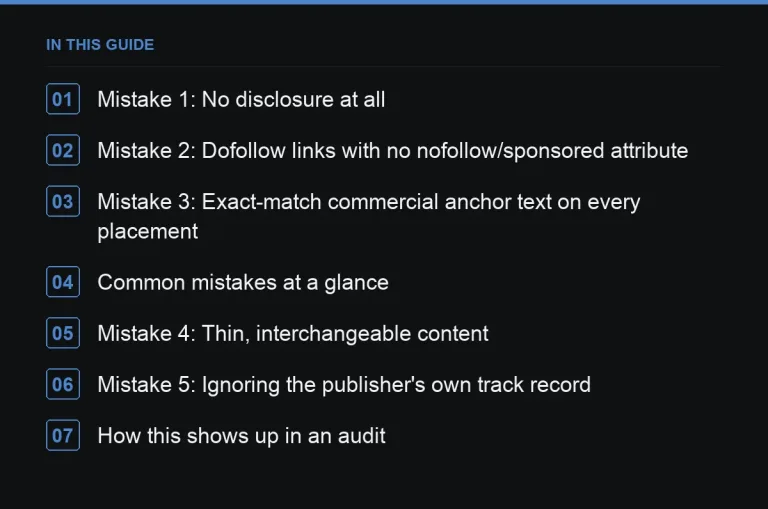
Mistake 1: No disclosure at all
Sponsored content that reads as if it were independently written, with no indication it was paid for, is the most common and most consequential mistake. Beyond the guideline risk, it also erodes trust with readers if it’s ever noticed. Proper disclosure — a label, a byline note, or a clear statement — should be non-negotiable regardless of which side of the transaction you’re on.
Mistake 2: Dofollow links with no nofollow/sponsored attribute
Paid links are expected to carry a rel=”sponsored” or at minimum nofollow attribute. A pattern of dofollow links across many sponsored placements is one of the clearer signals search engines look for when identifying paid link schemes, and it’s an easy thing to check during any https://successtoroad.com/blog/backlink-audit-guide/ pass.
Mistake 3: Exact-match commercial anchor text on every placement
Requesting the same commercial keyword phrase as anchor text on every sponsored post creates the kind of concentrated pattern covered in https://successtoroad.com/blog/auditing-anchor-distribution/. Vary anchor text across placements and favor branded or natural phrasing over exact-match keywords.
Common mistakes at a glance
| Mistake | Fix |
|---|---|
| No sponsorship disclosure | Add a clear label or note on every sponsored piece |
| Dofollow links on paid content | Use nofollow or sponsored attributes consistently |
| Repeated exact-match anchors | Vary anchor text, favor branded and natural phrases |
| Thin, templated content across many sites | Write genuinely useful, site-specific content each time |
| Buying volume from low-quality sites for cheap links | Prioritize relevance and real traffic over sheer quantity |
Mistake 4: Thin, interchangeable content
Sponsored posts that read like they could be dropped onto any site with a find-and-replace of the brand name are a quality signal, not just a risk signal — they don’t perform well for the linking site’s readers either, which shortens how long a publisher is willing to keep them live.
Mistake 5: Ignoring the publisher’s own track record
Placing sponsored content on a site without checking its history invites exactly the kind of surprises covered in https://successtoroad.com/blog/auditing-a-publishers-guest-post-history/ — a site that’s already known for accepting low-quality sponsored content at volume isn’t going to treat your placement any more carefully.
How this shows up in an audit
When reviewing your own site’s outbound or inbound sponsored links during a routine audit, flag any without proper attribution, note repeated anchor patterns, and check whether older sponsored placements are still live and unchanged. This is a normal part of https://successtoroad.com/blog/backlink-audit-guide/, not a separate process.
Doing it right going forward
None of this requires giving up sponsored content as a strategy — it requires disclosure, correct link attributes, varied natural anchor text, genuinely useful content, and picking publishers with a solid track record.
A quick pre-publication checklist
Before a sponsored post goes live on either side of the transaction, confirm four things: the disclosure is present and clearly worded, the link carries the correct rel attribute, the anchor text is natural rather than repeated exact-match, and the content itself would be genuinely useful to that specific site’s actual readers. Checking this before publication is far less effort than discovering a problem during a later audit and having to go back and request changes after the fact.
Why buyers should care about this as much as publishers
It’s tempting to think disclosure and link attribution are the publisher’s problem to manage, but a buyer who repeatedly requests dofollow links with no attribute and exact-match anchors is actively creating the risky pattern, regardless of whether the publisher goes along with it. Responsibility here sits on both sides of the transaction, and a buyer with a track record of doing this across many placements is building exactly the kind of profile an audit would flag.
Training a broader team on these basics
If more than one person at your organization arranges sponsored placements — marketing, PR, individual product teams — make sure they all understand these basics rather than relying on one SEO specialist to catch every mistake after the fact. A quick shared checklist covering disclosure, link attributes, and anchor text variation prevents most of these mistakes at the source rather than needing to be found and fixed during a later audit.
What to do about mistakes already live from before this checklist existed
If an audit turns up a backlog of older sponsored posts made before your team adopted these standards, don’t try to fix everything at once. Prioritize by scale of exposure — start with placements on the highest-traffic sites, or those using the most concentrated anchor text — and work through the rest gradually rather than treating it as an emergency that needs resolving in a single sitting.
Where to go next
Placements sourced through https://successtoroad.com/marketplace/ come with transparent metrics and order history, making it easier to vet a publisher’s standards before committing a sponsored post budget.
Frequently asked questions
Do all sponsored links need to be nofollow?
They should carry a nofollow or sponsored attribute per current guidelines, which tells search engines the link is paid. This doesn't reduce the marketing or referral-traffic value of the placement, only the direct ranking credit passed.
Is disclosure really necessary if the content is genuinely good?
Yes, content quality doesn't substitute for disclosure. Sponsored content should be labeled as such regardless of how well it's written, both for guideline compliance and reader trust.
How do I check if my past sponsored posts used proper link attributes?
Crawl your outbound sponsored placements and check the link's rel attribute directly, or ask the publisher to confirm — a routine part of an audit rather than something to assume is correct.
Can bad sponsored post practices trigger a manual action?
At scale and combined with other manipulative signals, yes. An isolated sponsored post without proper attribution is less likely to trigger anything on its own, but the pattern across many placements is what draws attention.
Put it into practice
Filter 54,483 websites by DR, traffic, niche and price, and order with escrow — you pay only after the link is live.
Browse the marketplace