Site Age and History Checks: Confirming What a Domain Actually Is
A domain's current metrics can hide a very different past life worth knowing about before you buy a placement.

A domain’s current metrics tell you about its present link and content profile, but not its history. Checking a domain’s actual age and what it used to be reveals things that DR, DA, and traffic estimates alone will not: whether a strong authority score was earned by the current site or inherited from a completely different past use.
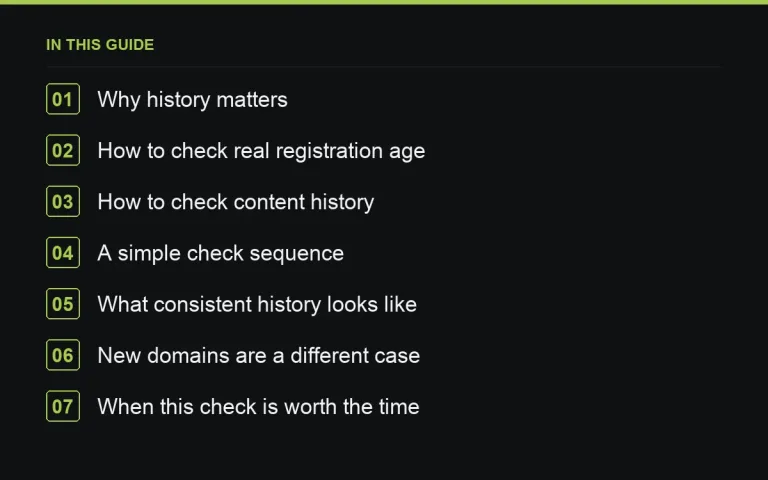
Why history matters
Domains get bought, sold, expire, and get re-registered constantly. A domain that once hosted a genuine, well-linked publication can later be picked up by a new owner and repurposed entirely — sometimes for a legitimate new business, sometimes specifically to exploit the residual authority for link selling. Both scenarios can produce similar-looking current metrics, but they represent very different risk levels for a buyer.
How to check real registration age
A domain registration lookup shows when a domain was first registered, though this is not the same as when the current content or ownership began — a domain can be decades old while its present use only started recently after a change of hands. Cross-reference registration age against how long the current type of content has actually been published.
How to check content history
Web archive tools that store snapshots of pages over time let you see what a domain looked like in the past — its design, its topic, and its apparent purpose. A domain currently presenting as a niche blog that archive snapshots show was, a year or two ago, an entirely unrelated site or a parked domain, is a domain that has recently changed hands and purpose. This is one of the most reliable ways to catch the redirect and repurposing tactics covered in https://successtoroad.com/blog/metric-inflation-and-how-to-spot-it/.
A simple check sequence
| Step | What it reveals |
|---|---|
| Registration date lookup | How long the domain itself has existed |
| Archive snapshot review across several past years | Whether the topic and purpose have stayed consistent |
| Compare snapshot content to current content | Whether metrics were earned by the current site or inherited |
What consistent history looks like
A domain that has published in roughly the same niche, under roughly the same identity, for a meaningful stretch of time is generally a safer bet than one with a choppy, inconsistent history. This does not mean every pivot is suspicious — sites do legitimately rebrand or narrow their focus — but a pivot combined with a recent metrics jump deserves the closer inspection covered in https://successtoroad.com/blog/how-to-read-a-link-profile/.
New domains are a different case
A genuinely new domain, registered recently with no prior history at all, is not a red flag in the same way a repurposed domain is — it is simply young. See https://successtoroad.com/blog/metrics-for-new-domains/ for evaluating those on their own terms rather than judging them by the same history checks meant to catch inherited-authority tricks.
When this check is worth the time
Running a full history check on every prospect is unnecessary overhead for smaller, lower-stakes placements. Reserve it for higher-value decisions, sites whose metrics look surprisingly strong for their apparent size or niche, or any prospect that otherwise raises questions during your normal vetting pass, described more generally in https://successtoroad.com/blog/vet-a-site-in-ten-minutes/.
Ownership changes without a topic change
Not every ownership change is accompanied by an obvious shift in topic or design, which makes some repurposed domains harder to spot than others. A domain that changed hands but kept publishing in a similar general subject area can still carry an inherited authority advantage that the new owner did not actually earn through their own content or outreach. Checking author names, editorial voice, and publishing consistency across the transition period, where archive snapshots allow it, can reveal a change in operation even when the surface topic looks unchanged.
Using history checks to build long-term confidence
Beyond catching outright manipulation, a consistent, traceable history also builds a different kind of confidence: a domain that has operated under the same identity, in the same niche, for several years demonstrates a level of staying power that a metrics snapshot alone cannot show. For buyers considering an ongoing publisher relationship rather than a single one-off placement, this longer view of stability is often just as valuable as any individual current metric.
When history checks are not worth the time
For very small, low-cost placements where the financial exposure is minimal, spending significant time on a full history check may not be worthwhile relative to the size of the decision. Reserve this deeper diligence for placements where the cost, or the intended length of the relationship, justifies the extra time, and rely on faster proxy checks for smaller, lower-stakes decisions instead.
What a clean history check ultimately buys you
The end goal of a history check is not suspicion for its own sake, but confidence: confirming that the metrics you are relying on for a decision were genuinely earned by the site and operation you are actually paying to work with, rather than inherited from an unrelated past use of the same domain name. That confidence is worth the modest extra time for any placement where the decision genuinely matters.
Where to go next
For the full context of metric vetting this fits into, see https://successtoroad.com/blog/seo-metrics-explained/ and https://successtoroad.com/blog/scoring-model-for-publisher-selection/. Find publishers with a track record of consistent content directly in https://successtoroad.com/marketplace/.
Frequently asked questions
Does a domain's registration date tell me when its current content started?
Not necessarily. A domain can be registered for many years but only host its current content and ownership for a much shorter recent period after changing hands.
How do I check what a domain looked like in the past?
Web archive tools that store historical page snapshots let you view a domain's earlier design and content, which is usually enough to spot a significant change in topic or purpose.
Is it always bad if a site changed its focus over time?
Not always. Legitimate rebrands and narrowing of focus happen. It becomes a concern mainly when a purpose change coincides with a suspicious jump in authority metrics.
Should I run a history check on every prospect?
No, it is most useful for higher-value decisions or sites whose metrics look unusually strong relative to their apparent size, rather than as a routine step for every small placement.
How does this relate to spam score?
Spam score can sometimes flag manipulated domains automatically, but it does not always catch a well-executed repurposing, which is why a manual history check remains a useful independent step.
Put it into practice
Filter 54,483 websites by DR, traffic, niche and price, and order with escrow — you pay only after the link is live.
Browse the marketplace