Scholarship Link Building: Why It’s Riskier Than It Looks
A scholarship page is a legitimate way to give back, but treating it as a pure link scheme invites problems.
Scholarship link building involves creating a scholarship page, offering a modest award to students, and reaching out to university financial aid or scholarship-listing pages asking them to link to it. It became popular years ago because .edu links were seen as inherently valuable, and it still gets recommended in some guides. It deserves more caution than it usually gets, particularly for a local business trying to build a defensible, long-term link profile.
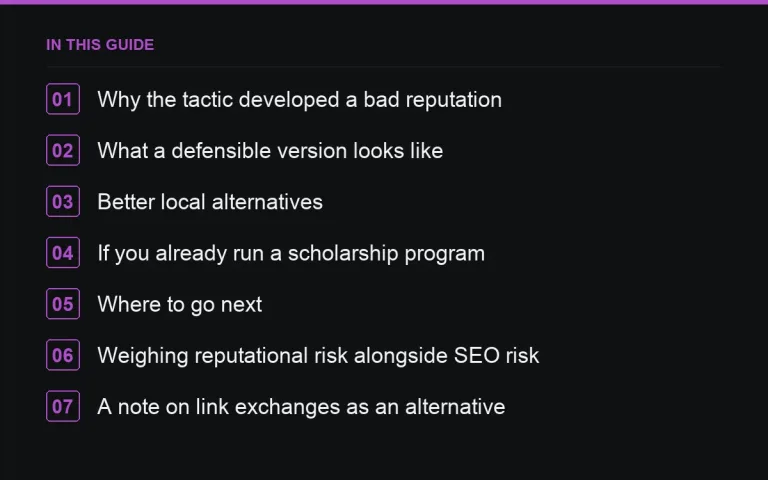
Why the tactic developed a bad reputation
When large numbers of businesses ran nearly identical scholarship pages purely to request links, universities and search engines both caught on. Many university financial aid offices now explicitly decline unsolicited scholarship link requests, and search engines have become better at recognising this pattern as a manufactured link scheme rather than a genuine educational contribution.
Signs a scholarship program will be seen as link-scheme-shaped
- The scholarship page’s only purpose is to request a link, with no real promotion to actual students.
- The outreach email leads with the link request rather than genuinely informing students about the opportunity.
- The award amount is minimal and the program has no plan to run beyond a single year.
- There is no verification process or genuine selection criteria.
What a defensible version looks like
If a scholarship genuinely fits your business — a local trade school partnership, a scholarship tied to your specific industry, or a program run in partnership with a local chamber (see https://successtoroad.com/blog/chamber-of-commerce-links/) — treat link requests as a secondary outcome, not the goal. Promote it directly to students and counsellors through channels that reach real applicants, and be prepared to run it for more than one cycle.
Better local alternatives
For most small businesses, the same budget produces more reliable and lower-risk results through sponsorships (see https://successtoroad.com/blog/sponsorship-link-building/), local event hosting (see https://successtoroad.com/blog/hosting-events-for-links/), or a straightforward donation to an existing local cause without attaching a link request condition at all. These build genuine community standing, and any resulting link becomes a side effect rather than the entire point.
If you already run a scholarship program
If your business already has a real, ongoing scholarship program for reasons unrelated to link building, there is nothing wrong with mentioning it to relevant local press (see https://successtoroad.com/blog/local-news-press-links/) or listing it where appropriate. The risk is specifically in manufacturing a program purely to extract links, not in having a genuine one.
Where to go next
If you’re deciding how to allocate a limited local link building budget, weigh scholarship programs against the more reliably effective tactics in https://successtoroad.com/blog/budget-for-local-link-building/ before committing time to this specific approach.
Weighing reputational risk alongside SEO risk
Beyond the search engine guideline concerns, a scholarship program that is obviously designed purely to harvest links can also create reputational risk if it becomes visible to your own customers or local press — being seen as running a marketing gimmick dressed up as charity is a worse outcome than simply not pursuing the tactic at all. If a scholarship idea doesn’t survive the test of “would we still do this if it produced zero links,” that’s a reasonable sign to reconsider it.
If, after weighing these risks, you decide a genuine program makes sense for your business, budget for it the way you would any other community investment (see https://successtoroad.com/blog/budget-for-local-link-building/) rather than as a discounted line item justified purely by expected link value, and consider https://successtoroad.com/marketplace/ for building additional local coverage through less risky channels in parallel.
A note on link exchanges as an alternative
Some businesses consider a straightforward link exchange with .edu sites unrelated to a scholarship, such as offering genuinely useful resources to a specific academic department. This carries similar risks if done purely for link value rather than genuine usefulness, so apply the same honesty test used for scholarships: would this be worth doing if no link resulted at all.
An honest cost-benefit comparison
Compare the total realistic cost of a scholarship program (award amount, administration time, promotion) against what the same budget could achieve through a straightforward sponsorship or a set of marketplace placements on https://successtoroad.com/marketplace/. In most cases, the alternative produces a more predictable and less risky return for a comparable investment.
Considering a partnership instead of a standalone programme
Rather than creating an entirely new scholarship from scratch, contributing to an already well-established local scholarship fund run by a school or community foundation avoids most of the reputational and search-engine-guideline risk, while still supporting a genuine local cause your business can reasonably mention.
Consulting a marketing or legal advisor first
Given the reputational and guideline risks discussed above, it’s worth a brief conversation with a marketing advisor familiar with current search engine guidelines before launching a scholarship program specifically for link-building purposes, rather than relying solely on older, outdated advice still circulating online.
Where to go next
This post is one piece of a broader local link building approach. For the full framework, see https://successtoroad.com/blog/local-link-building-guide/.
Frequently asked questions
Are scholarship links banned by search engines?
Not explicitly, but link schemes built purely to manufacture links, including many templated scholarship campaigns, run against search engine guidelines on unnatural links and can be discounted or penalised.
Do universities still link to business-run scholarships?
Some do, especially for genuinely established programs, but many financial aid offices now have policies against listing unsolicited business scholarship pages specifically because of past abuse.
Is there a safer way to combine scholarships with local SEO?
Run a real program for real reasons, promote it to actual students first, and treat any link as incidental rather than designing the whole program around link acquisition.
What should I do instead if I want an .edu-adjacent link?
Consider genuine partnerships with local schools or trade programs, guest speaking, or sponsoring a specific school event, which tend to be viewed more favourably than a templated scholarship outreach campaign.
Put it into practice
Filter 54,483 websites by DR, traffic, niche and price, and order with escrow — you pay only after the link is live.
Browse the marketplace