How to Run a Local Link Audit
Fixing existing local link and citation problems is often more impactful than chasing new links.
Before investing further in local link building, it’s worth stepping back and auditing what you already have. A local link audit surfaces citation inconsistencies, missing opportunities you’re already positioned to capture, and gaps relative to competitors, often revealing that fixing existing problems produces faster results than any new outreach campaign.
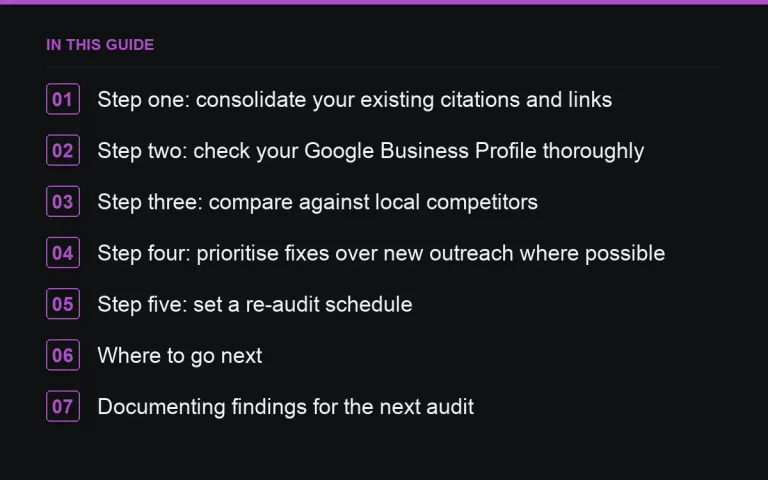
Step one: consolidate your existing citations and links
Gather every known citation and link you currently have — directories, associations, press mentions, supplier pages — and check for consistency in your business name, address, and phone number across all of them. See https://successtoroad.com/blog/citations-vs-links/ for why this consistency matters and what commonly goes wrong.
Step two: check your Google Business Profile thoroughly
Confirm your profile is complete, uses the correct category, and links to the most relevant page for your business structure. See https://successtoroad.com/blog/google-business-profile-links/ for a fuller checklist of what to review here specifically.
A basic audit checklist
- Are your name, address, and phone number identical across all major citations?
- Does your Google Business Profile link to the most relevant page, not just a generic homepage?
- Are you a member of the relevant chamber of commerce or industry association for your area (see https://successtoroad.com/blog/chamber-of-commerce-links/)?
- Do your existing suppliers and partners already link to you, or is this an untapped opportunity (see https://successtoroad.com/blog/supplier-partner-links/)?
- Are your local landing pages substantive and locally specific, or thin and templated (see https://successtoroad.com/blog/local-landing-pages-links/)?
Step three: compare against local competitors
Look at a handful of competitors ranking well in your target local searches and check which associations, directories, and media outlets link to them that you don’t yet have a relationship with. This often surfaces realistic, specific opportunities rather than a generic list of tactics to try.
Step four: prioritise fixes over new outreach where possible
Citation inconsistencies and missed supplier or partner opportunities are usually cheaper and faster to fix than earning brand-new links from scratch. Clear these first, then move remaining budget and time toward new outreach — guest posts, press pitches, sponsorships — with a cleaner foundation already in place.
Step five: set a re-audit schedule
A single audit is a snapshot, not a permanent fix. Addresses change, association memberships lapse, and new competitors enter a market. Revisiting this process every six to twelve months, alongside the ongoing measurement covered in https://successtoroad.com/blog/measuring-local-link-impact/, keeps your local link profile from quietly decaying between active campaigns.
Where to go next
Once your audit is complete, use https://successtoroad.com/blog/budget-for-local-link-building/ to plan how to allocate resources between fixing identified gaps and pursuing new tactics, and consider https://successtoroad.com/marketplace/ for filling any coverage gaps the audit reveals.
Documenting findings for the next audit
Keep a simple written record of each audit’s findings and the actions taken afterward. This makes the next audit faster, since you’re checking whether previous fixes held rather than starting the entire review from scratch, and it gives you a rough sense of progress over time even before formal metrics fully reflect it.
Sharing audit results with stakeholders
If you work with an outside marketing partner or agency, share your audit findings directly rather than assuming they’ve independently reviewed the same details. A shared understanding of what’s already working and what’s missing keeps everyone aligned on where the next round of effort should go.
Using the audit to plan the next quarter
Translate audit findings into a short list of concrete next steps with rough timelines, rather than leaving them as a general list of observations. This turns the audit from a diagnostic exercise into an actual plan that guides the next few months of work.
Assigning clear ownership for follow-through
An audit is only useful if someone is clearly responsible for acting on its findings. Assign specific fixes to specific people with a rough deadline, rather than leaving a list of good intentions that nobody is accountable for completing.
Keeping the audit proportional to business size
A single-location small business doesn’t need the same depth of audit process as a fifty-location chain. Scale the thoroughness of your audit to match your actual complexity, so the process stays sustainable enough to repeat regularly rather than becoming a dreaded, oversized task that keeps getting postponed.
A lighter, faster audit repeated consistently every few months tends to catch problems earlier than an exhaustive one attempted rarely, since small issues are easier to fix before they compound.
This lighter cadence also makes it easier to involve other staff in the process regularly, since a quick, familiar check is a much smaller ask of someone’s time than an occasional, intimidating deep review.
This lighter, more frequent rhythm tends to be far more sustainable in practice than an ambitious annual audit that keeps getting pushed back.
Consistency here matters more than depth, since a shallow but regular check catches drift long before it becomes a serious problem.
Where to go next
This post is one piece of a broader local link building approach. For the full framework, see https://successtoroad.com/blog/local-link-building-guide/.
Frequently asked questions
How often should I run a local link audit?
Every six to twelve months is reasonable for most small businesses, or sooner if you notice an unexplained ranking drop or you're expanding into a new location.
What's the most common problem a local link audit finds?
Inconsistent citation data — mismatched addresses, old phone numbers, or duplicate listings — is one of the most frequent and most fixable issues an audit surfaces.
Should I audit competitors as part of my own process?
Yes, a brief competitor comparison often surfaces specific, realistic link opportunities (associations, directories, media relationships) you might not have considered otherwise.
Is a link audit worth doing before starting any new outreach?
Generally yes, since fixing existing problems is usually cheaper and faster than new outreach, and gives new links a cleaner foundation to build on.
Put it into practice
Filter 54,483 websites by DR, traffic, niche and price, and order with escrow — you pay only after the link is live.
Browse the marketplace