PBN vs Real Sites: Why the Risk Calculation Has Changed
PBNs offer cheap, fast control over links, but the detection risk and lack of real audience make them a poor bet for most sites.
A private blog network, or PBN, is a group of websites set up and controlled by one operator specifically to host links pointing to a client’s or the operator’s own money site. They differ from real, independently-run publisher sites in one fundamental way: their purpose is to pass links, not to serve an audience. That single difference explains almost everything about why the risk profile is so different.
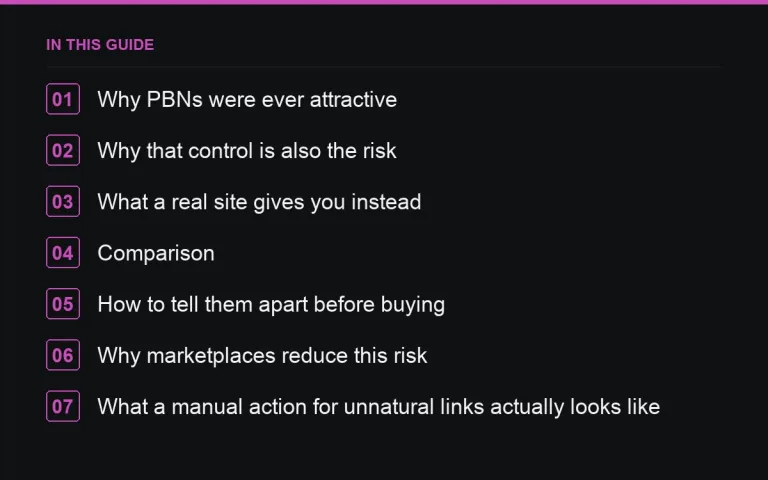
Why PBNs were ever attractive
Full control is the appeal. The operator decides the anchor text, the placement, the surrounding content and the timing, with no negotiation, no editorial pushback, and often a lower per-link cost than legitimate placements since there is no real content production or audience-building overhead behind the sites.
Why that control is also the risk
Search engines have invested heavily in detecting the patterns PBNs create: clusters of thinly-updated sites with unusually similar hosting footprints, templates, or ownership signals, all linking into a narrow set of destinations with link-heavy, low-value content. When a network is identified, the penalty typically hits every site that received links from it, not just the network itself, which means one operator’s mistake can wipe out link equity you paid for entirely.
What a real site gives you instead
A genuine, independently-run publisher has readers, a reputation, and ongoing content that exists for its own sake regardless of whether it ever sells a link. A link from a real site is judged on its own editorial merit by both search engines and human readers, and it is not exposed to a single operator’s other, unrelated sites being caught in a network-wide penalty.
Comparison
| Factor | PBN | Real site |
|---|---|---|
| Control over placement | Full | Negotiated with the publisher |
| Detection risk | High, and network-wide | Low |
| Real audience | Usually minimal or none | Genuine readers |
| Long-term durability | Fragile | Durable if the site stays active |
How to tell them apart before buying
- Check whether the site publishes content unrelated to link-selling, at a consistent pace, over a long history.
- Look for real engagement signals: comments, social shares, genuine internal linking between articles.
- Be wary of networks of sites that share hosting patterns, templates or ownership details.
- Favour marketplaces that vet publishers for real traffic rather than just accepting any listed domain.
Why marketplaces reduce this risk
A marketplace with a genuine quality gate, filtering for real traffic and authority before a site is even listed, removes most of the PBN risk from your buying process, since sites built purely to sell links rarely pass that bar. https://successtoroad.com/marketplace/ applies this kind of filter so you are choosing among sites with an actual audience, not anonymous link farms.
What a manual action for unnatural links actually looks like
If a PBN or similar scheme is ever caught and associated with your site, the consequence is often a manual action rather than a purely automated ranking drop. https://successtoroad.com/blog/what-is-unnatural-links-manual-action/ explains what that process involves and how disruptive it can be to recover from, which is worth reading before deciding any short-term gain from a risky tactic is worth the exposure.
Disavowing links you did not knowingly build
If an audit turns up links that look like they came from a network you never intentionally engaged with, perhaps from a previous agency or an old campaign, you have options short of doing nothing. https://successtoroad.com/blog/what-is-a-toxic-backlink/ and the disavow process it describes give you a path to formally disassociate from links that pose a genuine risk to your profile.
What to do if you inherit a risky profile
If you take over a site with an unclear link history, perhaps from a previous employee or agency, treat a backlink audit as a priority rather than an optional nice-to-have. Identify anything resembling a PBN pattern early, since the cost of ignoring it only grows the longer those links remain part of your profile.
If you are ever uncertain whether a specific placement resembles a PBN, err on the side of caution and skip it rather than rationalising a borderline case because the price or metrics look attractive. The potential downside of a network-wide penalty far outweighs the modest savings a risky placement might offer over a legitimate, real-site alternative.
Talking a client or colleague out of a risky shortcut
If someone on your team or a client suggests a suspiciously cheap, fast link source that resembles a PBN, walk through the network-wide penalty risk explicitly rather than just saying no. Concrete examples of what a manual action recovery process involves tend to be more persuasive than a general warning, since the abstract risk becomes tangible once the actual consequences are spelled out.
Once a colleague or client sees a concrete example of what a recovery process actually involves, the appeal of a cheap, risky shortcut usually fades quickly on its own.
Where to go next
For the related question of domain history and revival patterns, read https://successtoroad.com/blog/new-domain-vs-aged-domain/, and for a broader look at risk across methods, see https://successtoroad.com/blog/link-building-options-compared/.
Frequently asked questions
Are PBNs illegal?
No, they are not illegal, but they violate most search engines' guidelines against manipulative link schemes, and being caught can result in penalties that affect every site the network linked to.
How do search engines detect PBNs?
Common signals include shared hosting infrastructure, similar site templates, thin or repetitive content, and link patterns concentrated toward a narrow set of destinations rather than diverse, organic linking.
Is a cheap link always a sign of a PBN?
Not necessarily, some real sites price placements affordably because they are newer or in a lower-competition niche. Low price alone is not proof, but combined with thin content and no real traffic, it is a warning sign.
What should I do if I suspect I have links from a PBN?
Audit your backlink profile, identify suspicious clusters, and consider disavowing links from sites showing clear PBN characteristics, especially if you did not knowingly purchase them yourself.
Put it into practice
Filter 54,483 websites by DR, traffic, niche and price, and order with escrow — you pay only after the link is live.
Browse the marketplace