Exact-Match vs Branded Anchors: Getting Anchor Text Ratios Right
Exact-match anchors target rankings directly but carry more risk overused; branded anchors are safer and should be the majority.
Anchor text is the clickable, visible text of a link, and the words you choose have historically had a strong influence on what a linked page ranks for. That influence is also exactly why over-optimising it is one of the most detectable patterns in an unnatural link profile. Understanding the difference between exact-match and branded anchors, and how to balance them, is basic hygiene for any link building program.
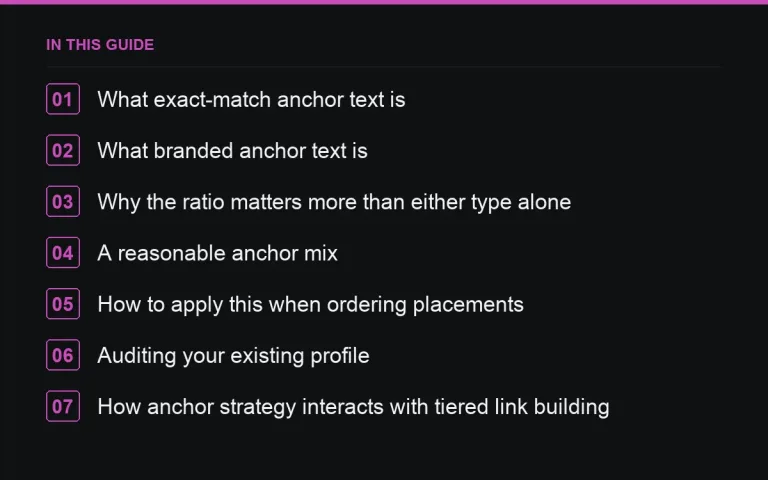
What exact-match anchor text is
An exact-match anchor uses the precise keyword phrase you want to rank for as the clickable text, for example linking the words “best running shoes” directly to a page targeting that exact query. It is the most direct way to signal topical relevance to a search engine, but it is also the least natural way people actually link to things in genuine, organic writing.
What branded anchor text is
A branded anchor uses your company or product name as the clickable text, or a close variant of it, regardless of the specific keyword the destination page targets. This is how most organic, genuinely earned links are phrased in practice, since writers naturally refer to a business by its name rather than by a search query phrase.
Why the ratio matters more than either type alone
A link profile dominated by exact-match anchors, especially if repeated identically across many different referring domains, is a strong and well-known signal of manipulated link building, since it does not match how people actually write about brands and sources in organic content. A profile weighted heavily toward branded, natural-language and generic anchors, with only an occasional, varied exact-match phrase, looks far closer to how real link accumulation happens.
A reasonable anchor mix
| Anchor type | Typical role | Suggested share |
|---|---|---|
| Branded | Company or product name | Largest share |
| Natural-language / generic | “this guide,” “learn more,” “their website” | Substantial share |
| Partial-match | Keyword phrase variant, not exact | Moderate share |
| Exact-match | Precise target keyword | Smallest share, used sparingly |
How to apply this when ordering placements
When briefing a guest post or insertion through https://successtoroad.com/marketplace/, vary your anchor request across orders rather than requesting the same exact-match phrase every time. Mix in branded mentions, natural phrases, and occasional partial-match variants so the aggregate profile looks like it was built by many different, independent writers rather than one operator repeating a template.
Auditing your existing profile
If you have not reviewed your anchor text distribution recently, pull your backlink profile and categorise the anchors into the buckets above. A profile skewed heavily toward exact-match, especially concentrated on a small number of keyword phrases, is worth correcting going forward, even if you cannot change links that are already live.
How anchor strategy interacts with tiered link building
Some more advanced programs layer additional links pointing at the pages that already host your primary placements, a practice known as tiered link building. https://successtoroad.com/blog/what-is-tiered-link-building/ explains how this works and why anchor diversity matters even more at that second layer, since compounding an already risky anchor pattern across tiers multiplies the exposure.
What the glossary says about anchor text formally
If you want the precise, formal definition search engines and the industry use, https://successtoroad.com/blog/what-is-anchor-text/ is a good quick reference to bookmark alongside this comparison.
Reviewing anchor mix as part of a routine audit
Add anchor text distribution to whatever routine link audit you already run, rather than treating it as a separate, occasional exercise. Catching a drift toward over-optimised anchors early, while you can still adjust the next few orders, is far easier than trying to correct a profile after dozens of exact-match links have already gone live.
If you work with multiple writers or freelancers across your placements, share your anchor text guidelines with all of them explicitly, since an otherwise well-managed profile can still drift toward over-optimisation if different contributors are each choosing anchor phrasing independently without a shared standard to follow.
What to do about anchors already in the wild
For links you cannot change after the fact, focus your energy on ensuring future placements correct the balance rather than trying to retroactively fix every existing link, which is rarely practical. A profile that was once skewed but has been actively diversified for the past year looks meaningfully different, and more trustworthy, than one that never adjusted at all.
A profile that shows a clear, sustained shift toward better balance over time reads very differently to anyone reviewing it than one that never changed direction at all.
Share this progress, even informally, with anyone else on your team ordering placements, so the improvement is a shared, sustained effort rather than something only one person is tracking.
This is one of the simplest, lowest-cost habits in this entire series to maintain, and it consistently pays off far more than the small amount of attention it requires.
Where to go next
Read https://successtoroad.com/blog/homepage-link-vs-deep-link/ for how anchor strategy interacts with link target choices, and https://successtoroad.com/blog/author-bio-link-vs-in-content/ for how placement location affects anchor flexibility.
Frequently asked questions
What percentage of my anchors should be exact-match?
There is no fixed universal number, but exact-match should be a small minority of your overall anchor profile, with branded and natural-language anchors making up the majority.
Is using my brand name as an anchor bad for rankings?
No, branded anchors are the most natural and common anchor type in genuinely organic link profiles, and they carry no penalty risk on their own.
Can I change anchor text after a link is already live?
Sometimes, if the publisher allows edits, but it is far easier to specify a varied, natural anchor at the time of ordering than to request changes to already-published content later.
How do I check my current anchor text distribution?
Export your backlink profile from a link tracking tool and categorise each anchor into branded, natural-language, partial-match and exact-match buckets to see your current ratio before planning new placements.
Put it into practice
Filter 54,483 websites by DR, traffic, niche and price, and order with escrow — you pay only after the link is live.
Browse the marketplace