Paid vs Earned Links: Building a Balanced Backlink Profile
Paid links give you control and predictable volume; earned links build the credibility a profile needs to look genuinely organic.
Paid links are placements you secure through direct payment, typically guest posts, insertions or sponsored mentions bought through a marketplace or negotiated directly with a publisher. Earned links are secured without payment, through content or outreach compelling enough that a publisher links to you purely because it serves their readers. Most serious link building programs use both, and understanding the trade-off helps you allocate budget sensibly.
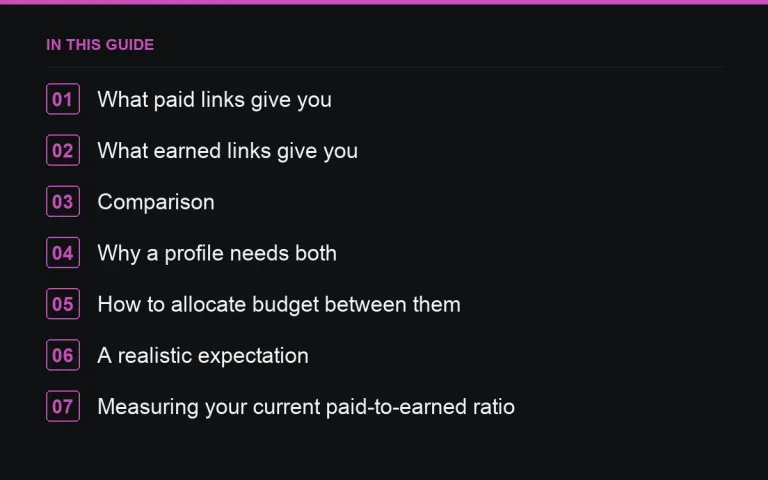
What paid links give you
Predictability is the main advantage. You know roughly what a link will cost, roughly how long it will take, and you can plan a monthly or quarterly budget around it. You also retain more control over anchor text, target URL and timing than you typically get with earned coverage, where the publisher decides all of that.
What earned links give you
Earned links, especially from well-known publications, tend to carry more weight both for search engines and for human readers, because they represent a genuine, independent endorsement rather than a transaction. They are also, by definition, free of direct payment, though they cost real time and effort in content development and pitching. The unpredictability is the trade-off: you cannot reliably schedule when or whether a pitch will land.
Comparison
| Factor | Paid links | Earned links |
|---|---|---|
| Predictability | High | Low |
| Control over placement | High | Low |
| Perceived credibility | Good, if disclosed properly | Very high |
| Cost structure | Direct, per link | Indirect, time and content investment |
Why a profile needs both
A profile made up only of paid links can look transactional if every link uses similar anchor patterns and similar publisher types. A profile made up only of earned links is rare and hard to sustain at any volume for most businesses, since earned coverage depends on genuinely newsworthy stories, which do not appear every month. Blending both gives you a steady baseline from paid placements and periodic authority boosts from earned coverage when a real story lands.
How to allocate budget between them
- Use paid placements from https://successtoroad.com/marketplace/ to maintain a consistent monthly link velocity.
- Reserve a portion of time and budget for digital PR research and pitching aimed at earned coverage.
- Track which category each link falls into so you can review the balance quarterly.
- Do not force disclosure ambiguity — always tag paid links appropriately regardless of how the mix looks.
A realistic expectation
Earned links will always be a smaller share of total link volume for most businesses outside of major consumer brands or genuinely newsworthy industries. That is fine. The goal is not a 50/50 split, it is enough earned coverage to keep the overall profile looking organically diverse, layered on top of a reliable paid foundation.
Measuring your current paid-to-earned ratio
Most teams have never actually counted how their existing link profile splits between paid and earned coverage, which makes it hard to know whether more balance is actually needed. https://successtoroad.com/blog/link-building-kpis/ suggests tracking this alongside other basic health metrics on a quarterly cadence, so the paid-versus-earned decision is grounded in your actual profile rather than intuition.
Where earned links tend to come from in practice
Earned coverage rarely appears from nowhere; it usually follows a specific piece of content or a specific pitch. https://successtoroad.com/blog/what-is-seo-outreach/ covers the mechanics of outreach that underlies most earned link acquisition, which is worth understanding even if most of your day-to-day budget goes toward paid placements.
Reviewing the mix on a fixed schedule
Set a recurring quarterly reminder to review your paid-to-earned ratio and overall link velocity together, rather than only thinking about it when a ranking drops unexpectedly. Regular review catches drift in either direction before it becomes a larger problem to unwind.
It is worth revisiting your paid-to-earned ratio whenever your business itself changes meaningfully, such as launching a genuinely newsworthy product or entering a new market, since these moments often create earned coverage opportunities that would not have existed the previous quarter. Staying alert to these openings keeps the earned side of your profile from stagnating.
Setting expectations with clients or leadership
If you report results to a client or to leadership, set expectations early that earned links will be a smaller, less predictable share of total volume than paid ones, so a quiet month for earned coverage does not read as a program failure. Framing this correctly from the start avoids an awkward conversation later when the natural unevenness of earned coverage becomes visible in your reporting.
Setting this expectation once, clearly, tends to prevent repeated awkward conversations about why a given month’s earned link count looks thin compared to the steady paid total.
Reviewing this ratio alongside your overall link velocity, rather than as a separate exercise, gives a fuller picture of whether your program is both diverse and appropriately paced for your site’s size and history.
Where to go next
Read https://successtoroad.com/blog/digital-pr-vs-guest-posting/ for how to actually pursue earned coverage, and https://successtoroad.com/blog/sponsored-vs-editorial-links/ for the disclosure mechanics that keep paid links compliant.
Frequently asked questions
Is it better to focus entirely on earned links?
For most businesses, no. Earned links alone rarely provide enough consistent volume, and a profile with zero paid or sponsored links is uncommon even for well-known brands with active PR teams.
Do paid links count as spam?
Not if properly disclosed with the correct rel attribute and placed on genuinely relevant, real-traffic sites. Disguising paid links as organic endorsements is the actual violation, not the payment itself.
How much should I budget for earned link efforts?
It depends on your industry's newsworthiness and your team's PR capacity. Treat it as a supplementary investment rather than your core link building budget unless your business genuinely generates frequent, newsworthy stories.
Can a paid placement lead to earned links later?
Yes, a well-placed guest post can raise your visibility to editors and readers who later cite or link to you independently, effectively converting a one-time paid effort into ongoing earned attention.
Put it into practice
Filter 54,483 websites by DR, traffic, niche and price, and order with escrow — you pay only after the link is live.
Browse the marketplace