Outbound Link Ratio: What Too Many (or Too Few) Outgoing Links Signal
How many links a page sends out already tells you something about how it will treat yours.
Outbound link ratio — how many external links a page or site sends out, especially relative to its own content volume — is a quieter signal than DR or traffic, but it says a lot about editorial discipline and about how much any single link on that page is actually worth.
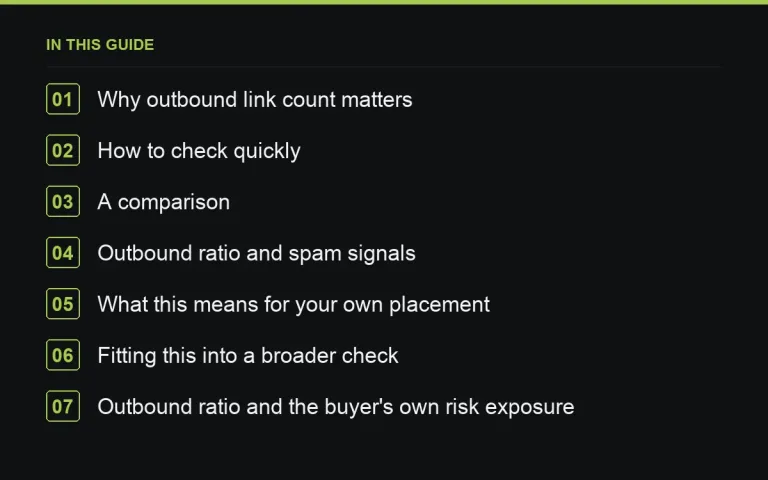
Why outbound link count matters
Link equity a page can pass is finite in practice — a page linking out to two other sites concentrates more relative weight on each of those links than a page linking out to forty. A guest post or link insertion placed on a page already crowded with unrelated outbound links, sponsored mentions, or affiliate links is diluted among all of them, regardless of how strong the hosting domain’s overall DR looks.
Patterns worth checking
- A single page with an unusually large number of outbound links, especially to unrelated commercial sites, often indicates the page exists mainly to sell placements rather than serve readers.
- A site-wide pattern of every article carrying several paid-looking outbound links suggests an editorial operation heavily built around monetising outbound links, which affects both quality perception and potential platform risk.
- A page with a reasonable handful of genuinely relevant outbound links, consistent with normal editorial referencing, is the healthiest pattern and the one your own link will benefit most from sitting alongside.
How to check quickly
When reviewing a candidate page for a link insertion, or a publisher’s recent guest posts generally, count the outbound links on a sample of pages. If most pages carry only a small number of external links used in clearly editorial ways — supporting a claim, citing a source — that’s a good sign. If pages regularly carry many more links than that, especially clustered near the bottom or in an obviously inserted style, treat it as a caution.
A comparison
| Pattern | Read |
|---|---|
| Few outbound links, clearly editorial context | Healthy — your link carries more relative weight |
| Many outbound links, mixed relevance | Diluted value — investigate before committing |
| Outbound links dominated by unrelated commercial sites | Possible link-selling-first operation — check spam score too |
Outbound ratio and spam signals
An unusually high outbound link ratio, particularly to unrelated commercial niches, is one of the features that spam score models weigh — see https://successtoroad.com/blog/spam-score-explained/ — but a manual glance at actual pages, described in https://successtoroad.com/blog/how-to-read-a-link-profile/, catches subtler cases that an automated score can miss, particularly on sites that keep the count just under whatever threshold a model flags.
What this means for your own placement
Before agreeing to a placement, it is reasonable to ask a publisher how many other outbound or sponsored links typically appear on a page similar to the one hosting yours. A publisher with a clear, restrained policy on this is generally more trustworthy than one that treats every page as an open link marketplace.
Fitting this into a broader check
Outbound link ratio is one line item in a fuller manual vetting pass rather than a metric you would look up in a dashboard on its own. Include it in the checklist covered in https://successtoroad.com/blog/vet-a-site-in-ten-minutes/, and weigh it alongside content freshness (https://successtoroad.com/blog/content-freshness-as-a-signal/) and engagement signals (https://successtoroad.com/blog/engagement-signals-without-analytics/) when judging overall editorial quality.
Outbound ratio and the buyer’s own risk exposure
An overloaded page is not just diluted for your link’s SEO value, it can also carry a reputational and risk dimension. A page that sits alongside many low-quality, unrelated outbound links can itself become more likely to be flagged by spam-detection systems over time, regardless of how your own link was earned. Placing content on pages with a clean, restrained outbound link pattern reduces your exposure to whatever happens to the page’s other links later, which you have no control over once your placement is live.
Distinguishing paid and editorial outbound links
Not all outbound links on a page are equal in how they should be read. A page that cites two or three sources in the course of making an argument is behaving normally. A page that appends a cluster of unrelated links at the end, with no clear editorial connection to the article’s actual content, is a different and more concerning pattern, even if the total outbound count looks similar on the surface. Reading the context each link sits in, not just counting them, gives the more accurate picture.
How outbound ratio interacts with page length
A longer, more comprehensive article naturally supports a somewhat higher number of outbound citations than a short post, simply because it covers more ground and references more sources along the way. When judging whether an outbound link count looks excessive, weigh it against the length and depth of the content itself rather than applying a single fixed number regardless of how substantial the underlying article actually is.
Where to go next
For the complete metrics landscape this quality check complements, see https://successtoroad.com/blog/seo-metrics-explained/. Browse publishers with visible editorial standards in https://successtoroad.com/marketplace/, or compare a shortlist directly with https://successtoroad.com/blog/comparing-two-sites-with-compare-tool/.
Frequently asked questions
What counts as too many outbound links on one page?
There is no fixed universal number, but a page with dramatically more external links than is typical for genuine editorial content, especially clustered and unrelated to the topic, is worth a closer look.
Does outbound link ratio affect my own link's SEO value?
It can, since link equity a page passes is effectively shared across all its outbound links, so a page crowded with many other links dilutes the relative weight your specific link receives.
Is a site with zero outbound links automatically better?
Not necessarily — some genuinely relevant outbound linking is normal, healthy editorial practice. Extremely low outbound linking on every page can simply reflect a different editorial style rather than higher quality.
How do I check outbound link ratio without a specialised tool?
Manually reviewing a handful of a publisher's recent pages and counting external links gives a reasonable sense, especially combined with judging whether those links look editorially relevant.
Can I ask a publisher about their outbound link policy before ordering?
Yes, this is a reasonable question to ask directly, and a clear, restrained answer is generally a positive sign about the publisher's overall editorial standards.
Put it into practice
Filter 54,483 websites by DR, traffic, niche and price, and order with escrow — you pay only after the link is live.
Browse the marketplace