Nordic Markets: A Link Building Overview
An overview of the Nordic region for link building, covering what these markets share and where they genuinely differ.
Sweden, Norway, Denmark and Finland get grouped together constantly, and there’s good reason for it: high internet usage, strong editorial standards, a shared cultural comfort with understated, evidence-based writing, and generally higher placement pricing than most of Europe. But each has its own language (Finland’s especially, being unrelated to the Scandinavian languages) and its own publisher landscape, so “Nordic” is a planning frame, not a single market to buy into.
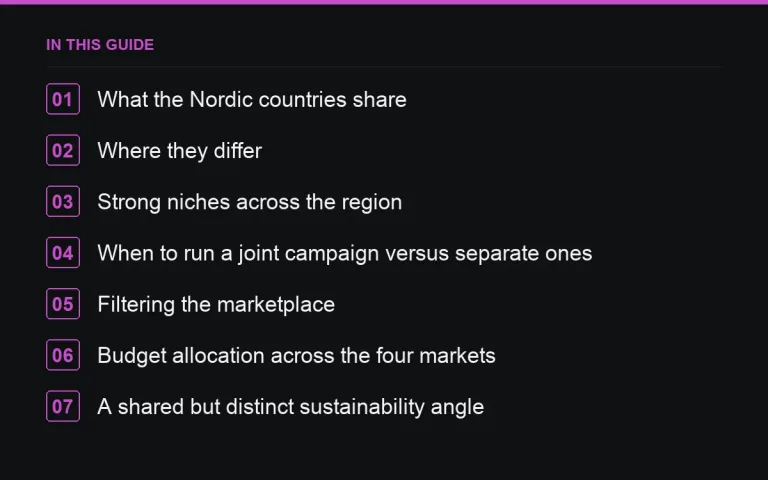
What the Nordic countries share
All four markets favour calm, well-referenced content over aggressive sales writing, expect clear disclosure of sponsored content as both cultural norm and often legal requirement, and generally have smaller total publisher pools than bigger European markets, reflecting smaller populations. Sustainability and environmental content performs consistently well across all four, reflecting genuine, sustained reader interest rather than a passing trend.
Where they differ
Swedish, Norwegian and Danish are closely related languages, and a reasonably competent speaker of one can often follow the others in writing, though native-quality content still needs to be produced separately for each — they are not interchangeable for guest posting purposes despite the similarity. Finnish is a completely different language family and needs to be treated as its own dedicated language track with no shortcuts from the other three. Iceland, sometimes included in “Nordic,” is small enough that a dedicated Icelandic campaign is only worth it for very specific projects; most brands skip it or handle it through occasional English-language placements.
Strong niches across the region
- Sustainability, environment and green business.
- Technology, fintech and startup culture, particularly strong in Sweden and Finland.
- Design and architecture.
- Outdoor lifestyle and travel.
When to run a joint campaign versus separate ones
A joint Nordic strategy makes sense for planning budget and timelines, and for sourcing content around shared themes like sustainability that translate well across the region. It doesn’t make sense for the actual writing — each language needs its own native content, and pitches should reference each country specifically rather than a generic “Nordic” framing that editors will recognise as impersonal.
Filtering the marketplace
Use https://successtoroad.com/language/swedish/, https://successtoroad.com/language/norwegian/ and the marketplace’s language options for Danish and Finnish as separate filters rather than one combined search, and layer in https://successtoroad.com/niche/environment/ given how strong that category performs region-wide. The https://successtoroad.com/compare/ tool is useful for weighing pricing across all four markets on one view, since costs vary more than the shared cultural traits might suggest.
Budget allocation across the four markets
Sweden’s larger population generally justifies the largest share of a combined Nordic budget, with Norway and Denmark receiving comparable mid-sized allocations and Finland treated as its own dedicated line item given the language difference rather than an afterthought.
A shared but distinct sustainability angle
While sustainability performs well across all four markets, the specific framing differs — Norway’s content often ties to energy and maritime industries, Sweden’s to design and manufacturing, and Finland’s to forestry and technology, so even a shared theme benefits from country-specific angling rather than one generic sustainability piece translated four times.
Tracking performance by country rather than region
Even when running a combined Nordic campaign, track results separately by country from the outset. Combining Swedish, Norwegian, Danish and Finnish performance into one blended number makes it hard to tell which specific market is actually driving results, and can mask a genuinely underperforming country behind stronger results elsewhere in the region.
This separation also makes it easier to justify Finland’s distinct budget line to stakeholders who might otherwise assume “Nordic” performance applies uniformly across all four countries.
A note on long-term investment
Given the smaller total publisher pools across all four Nordic countries, building durable relationships with a core set of trusted publishers in each market tends to pay off more over time than constantly sourcing new outlets for every campaign cycle.
Working with cross-border Nordic business media
Given how closely integrated these four economies are, a layer of cross-border Nordic business and trade media exists covering the region as a whole rather than any single country. This can be a useful complement to country-specific placements for B2B content that genuinely applies across the wider Nordic business community.
Working with Denmark specifically within the region
Denmark, while closely related to Sweden and Norway linguistically, has its own distinct design, technology and sustainability-focused media landscape worth evaluating on its own terms rather than assuming it mirrors its neighbours in publisher structure or pricing. Copenhagen in particular has an active design and lifestyle blogging scene distinct from the more industrial focus seen in parts of Norway.
As with the wider region, judging each Nordic country on its own terms — rather than assuming uniform performance across all four simply because they share cultural and economic similarities — leads to smarter budget decisions over time.
Where to go next
Read our dedicated guides to https://successtoroad.com/blog/guest-posting-swedish-sites/ and https://successtoroad.com/blog/guest-posting-norwegian-sites/ for placement-level detail in those two markets. Our https://successtoroad.com/blog/international-link-building/ guide covers planning a region like this within a global campaign, and https://successtoroad.com/blog/multilingual-site-link-strategy/ and https://successtoroad.com/blog/cultural-norms-publisher-negotiations/ both help with the language and tone decisions discussed above.
Frequently asked questions
Can I use the same content across Sweden, Norway and Denmark?
The languages are closely related, but native-quality content still needs to be produced separately for each market. They're not interchangeable for guest posting despite the linguistic similarity.
Is Finnish similar enough to the Scandinavian languages to shortcut?
No. Finnish belongs to a completely different language family and needs to be treated as its own dedicated language track.
Is Iceland worth including in a Nordic campaign?
Usually only for specific projects, given its very small population and publisher pool. Most brands skip a dedicated Icelandic campaign or handle it occasionally through English-language placements.
What topics perform consistently well across the whole region?
Sustainability and environmental content sees strong, sustained engagement across Sweden, Norway, Denmark and Finland alike, more so than in most other parts of Europe.
Put it into practice
Filter 54,483 websites by DR, traffic, niche and price, and order with escrow — you pay only after the link is live.
Browse the marketplace